Digital Tower System Architecture for Uncontrolled Airports
Remote towers can bring affordable air traffic control to thousands of small airports.
Most airports in a given country operate without a control tower, and the system that governs traffic at those fields runs on an honor code. Pilots announce their position and intentions on a shared radio frequency for the airport, listen for other aircraft doing the same, and sort out sequencing among themselves. No one is issuing clearances. No one is separating traffic. The pilot in the pattern serves as both the operator and the safety net, an arrangement built into the airspace by design rather than a lapse that better compliance would fix.
The honor system has a gap written into its own rulebook: using the CTAF is not a legal requirement for aircraft flying to or from an airport without an operating tower. A pilot can fly the entire pattern in silence and remain within the rules. Ultralights, gliders, and certain experimental aircraft often carry no radio at all, so they can occupy the same airspace as everyone else and never announce a position. That traffic is invisible to anyone relying on CTAF chatter to build a mental picture of what's nearby, no matter how disciplined the rest of the pilots in the pattern happen to be.
The NTSB has found that failure to see and avoid other aircraft is the most probable cause of mid-air collisions. That finding describes what happens when human eyes are the only sensor in the system and no coordinating authority exists to back them up. Visual scanning from a cockpit has known limits: a windscreen frame, a wing that blocks a sector of sky, an aircraft on a collision course that produces no apparent relative motion until it's too close to matter. None of that is a failure of any individual pilot's attentiveness. It's what happens when an airspace depends entirely on unaided human vision and voluntary radio calls to keep aircraft apart, with no backstop if either one doesn't happen.
The limits of a traditional manned tower at scale
The obvious fix, building a staffed tower at every uncontrolled field, runs into money and people long before it runs into airspace design. Small airports lean on federal and state grants far more heavily than large commercial hubs do when it comes to financing capital projects, and a staffed tower is a large, permanent capital and operating commitment, not a one-time purchase. Construction, equipment, and a facility built to house round-the-clock staff sit on top of the recurring cost of paying controllers for decades. For airports that already strain to fund runway repaving and lighting upgrades, that math rarely works out.
Even where the money could be found, the people aren't there to staff the booth. The air traffic control workforce is already under pressure at towers that exist today, and that shortage leaves no bench of spare controllers to post at new facilities. The contractor tower program, which extends staffed coverage to smaller fields that qualify, is itself capacity-constrained and reaches only a slice of the airports that could use some form of coordinating authority. The uncontrolled tier makes up most of U.S. airports, and it sits below where that program's reach stops. Scaling the traditional tower model to reach it isn't a matter of political will. It runs into a hard ceiling of dollars and trained people that construction budgets alone can't lift.
What a digital tower system is, the component stack
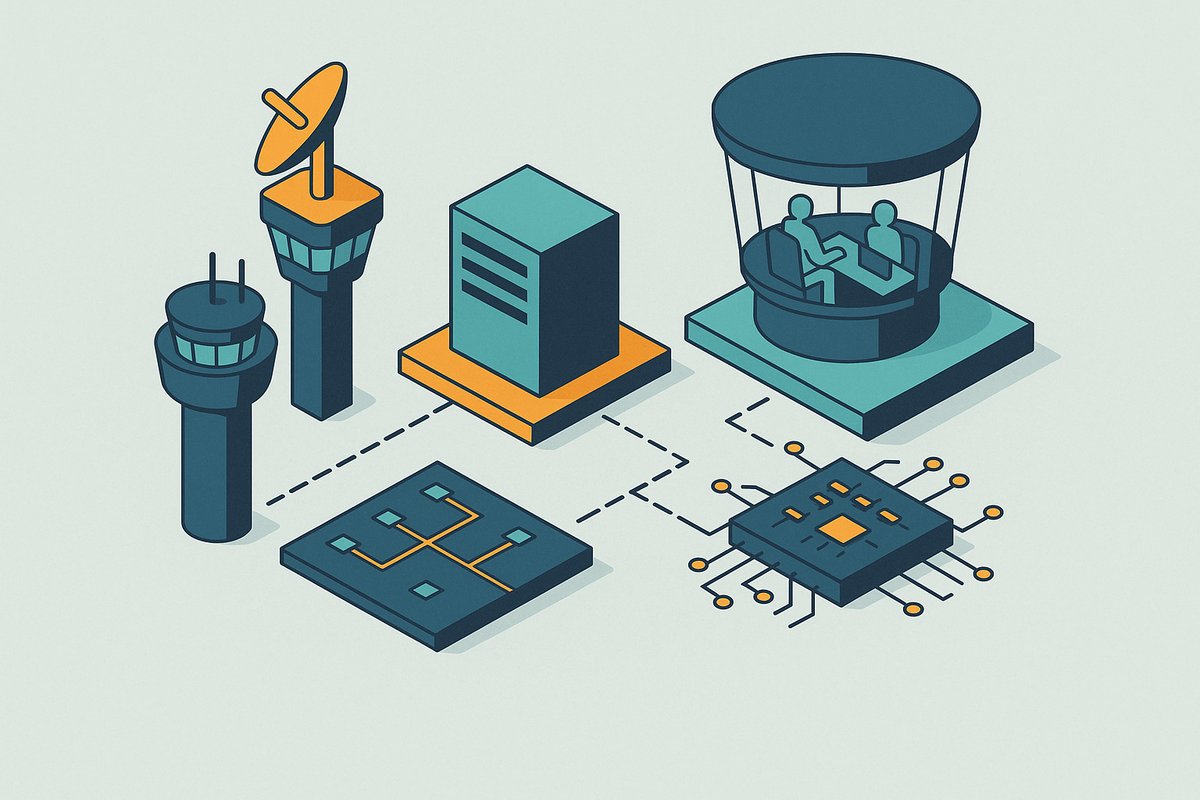
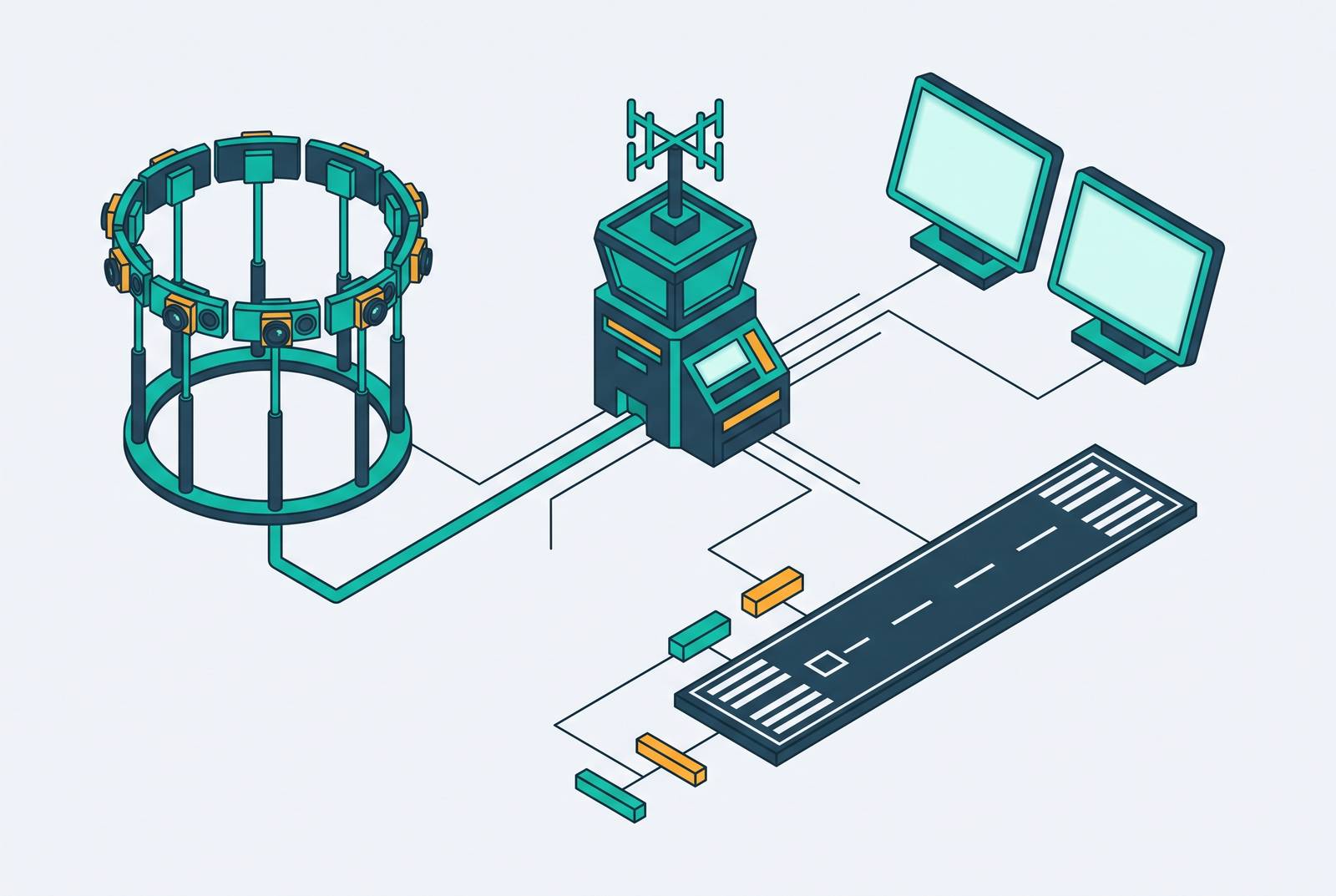
A digital tower is a stack of four layers standing in for one controller's eyes, each built to answer a specific limitation of the uncontrolled environment, working together to produce a single operational picture a controller can act on from a remote position.
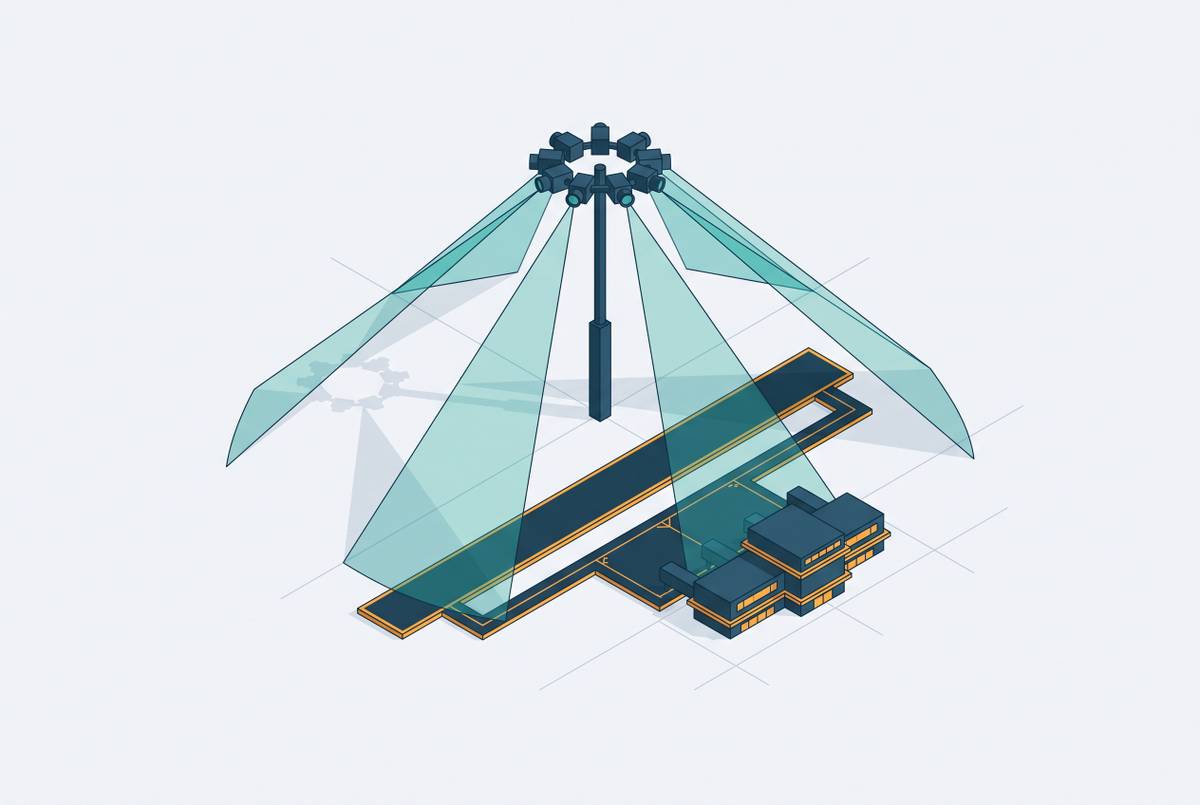
The visual capture layer starts with dozens of high-definition cameras mounted around the airfield, each one aimed at an arrival path, a departure path, or a ramp area, stitched together into a panoramic view of the field on a bank of digital screens. Pan-tilt-zoom functions let a controller push in on any part of the airport surface or the approach environment for a closer look, the way a controller in a physical cab might lift binoculars, except the resolution and reach go further. Infrared imaging pushes usable coverage into darkness and low visibility, conditions where a human observer sitting in a glass cab would be at the limit of what eyes alone can do. A camera can sit wherever the sight line is best rather than wherever a tower happens to have been built decades earlier, so you can engineer placement around terrain and vegetation to eliminate blind spots a physical tower's location would otherwise create.
The identification layer takes what the cameras see and attaches meaning to it. Each aircraft within range can be tagged with its tail number directly on the controller's display, the way a radar label tags a target on a scope. That's identity information a human observer with binoculars has no reliable way to produce, since tail numbers painted on a distant airframe are rarely legible at the ranges and angles that matter.
Two-way radio links the remote controller position and aircraft flying the pattern. At a towered airport, this layer replaces one radio channel with another. At an uncontrolled airport, it adds a kind of structured, authoritative controller-to-pilot communication that never existed there before, turning a frequency full of self-announcements into one with someone listening and directing.
The data processing and integration layer is where all of that comes together. Camera feeds, tagging information, and whatever other sensor data the system carries get combined into one coherent operational picture at the controller's station, rather than arriving as separate, disconnected feeds the controller has to reconcile in real time.
The controller interface layer is the position itself: the screens, the audio setup, the control inputs a controller uses to manage the airfield. It's designed to reproduce the situational awareness a controller would have standing in a physical cab, and in specific ways to exceed it, through the zoom, the infrared reach, and the tagging that a pair of eyes in a glass room never had access to.
The Remote Tower Center model and its path to affordable service
None of that stack pays for itself if it's built once per airport the way a traditional tower is. The economics only work under the Remote Tower Center model, where a single controller position manages traffic at multiple airports at once, and the hardware architecture was built to support that from the start.
Under the RTC model, the fixed cost of cameras, processing, and the controller interface gets spread across every airport served from that one location, rather than each field absorbing the full cost of its own dedicated facility and its own staff. Because the cameras are carrying much of the observational burden that a human in a cab would otherwise provide alone, the ratio of controllers to airports can run more favorably than in conventional staffing, with one controller position covering fields that would each need a dedicated human presence under the old model.
Avinor's rollout in Norway lays out the reasoning: cut capital expenditure by skipping new tower construction, cut operating costs by running multiple operations where a single controller position manages traffic at as many as three airports, and ease the recruitment burden that comes with staffing separate towers at separate locations. That three-part case, lower construction cost, lower operating cost, less recruitment strain, maps onto exactly the constraints small U.S. airports face today.
Grant money for digital tower assessment and deployment already exists in the U.S. The bottleneck is the pace at which the FAA can certify these systems, which makes the RTC cost model a strong argument for airport operators who already have access to funding channels and are waiting on the regulatory side to catch up.
The safety and operational tradeoffs that come with multi-airport remote control
The RTC model's economics depend on Multi-Mode Operation, one controller managing more than one airport's traffic at the same time, and that dependency carries a safety consideration the field has documented rather than brushed past: call-sign confusion.
When a single controller position handles several aerodromes inside the same MMO configuration, similar-sounding call signs across those airports can get crossed, especially if radio conditions degrade. A controller juggling two or three airports' worth of traffic has less margin to catch an ambiguous call sign than a controller focused on a single field, and the risk compounds exactly where the model is most valuable, in the simultaneous multi-airport operation that makes the economics work.
That tension runs through the model's own justification. A working paper from an international air traffic controllers' association cited an economic analysis that found remote tower centers need to serve more than one airport, ideally at the same time, if they are to produce real cost savings. The economics require MMO. The safety community has not yet validated MMO at the scale the economics call for, and that gap between what makes the model affordable and what the field has proven safe sits at the center of the RTC approach.
None of that argues for abandoning the architecture. It argues for designing the identification, audio, and interface layers specifically around reducing confusion: distinct visual labeling for each airport on the controller's display, audio separation between frequencies, and call-sign protocols built for multi-airport operation rather than borrowed from single-airport practice. David Harris, director of Johnston Regional Airport, put the practical comparison in plain terms: from an effectiveness standpoint, the expectation is that the system will be much more effective than a human being in a tower with a set of binoculars. That's a judgment about what the sensor stack delivers against the baseline it's actually replacing, not against some hypothetical ideal tower staffed around the clock at every small field in the country.
What the Leesburg experience revealed about the approval process
Whether the technology works is no longer the open question. At Leesburg Executive Airport (KJYO), a Remote Tower system ran error-free for years under an experimental program that never got full certification. An operational record like that, years of error-free performance, would support a finding of maturity in any conventional technology review. What remains open is whether the FAA's certification framework can process a system type it wasn't built to evaluate.
The agency's response to that record was to require the vendor to remove the entire remote tower system from Leesburg and install it at the FAA Technical Center in Atlantic City for testing, with no clear account of how standing the system up at an unrelated site would help certify the system that was already running successfully where it stood. The FAA has said digital tower approval belongs under the contract tower program, and it points to potential safety impacts, including hazardous or misleading information reaching controllers. That posture reads as an agency reaching for the nearest existing regulatory category and asking a new kind of system to fit inside it, whether or not the fit is right.
Congress has already weighed in on the pace of that process. Lawmakers required the FAA to expand its remote and digital tower approval process beyond Atlantic City to at least three airport locations, so the legislative branch has signaled where it wants this to go, even though the regulatory machinery has been slow to follow. That mandate sits alongside the FAA's own modernization plan, which calls for replacing decades-old analog infrastructure with fiber, wireless, and IP-based digital systems across the national airspace system. An agency committed on paper to a digital future for its own infrastructure, while treating a working digital tower system as a novelty that needs to prove itself all over again at a different site, is holding two positions that don't sit comfortably together.
What the architecture enables beyond basic traffic separation
Once the sensor, communication, and data layers are sitting at a small airport, that same infrastructure does more than separate traffic in the pattern. It opens up uses that multiply the value of a single installation well past its original purpose.
Drone integration is one of the clearest. Small airports today have almost no awareness or communication layer for drone activity in their airspace beyond the same CTAF self-announcement that already struggles to cover manned traffic. An airport that can see, identify, and talk to everything flying through its airspace is a far more credible integration point for drone operations than one relying on pilots announcing themselves on a shared frequency and hoping everyone's listening.
The same stack can also extend coverage in time, not just in capability. A digital position that handles traffic at an uncontrolled field during the day can be pointed at a nearby Class D tower after hours, so it covers the period when that tower closes, typically overnight, without adding any new physical infrastructure at the towered airport itself.
If a primary tower goes down, Remote Tower Centers can serve as backup coverage, so they add a layer of redundancy the current system doesn't have anywhere else. And because the RTC model lets controllers work across multiple airports from one central location, it opens scheduling and coverage options that fixed, single-airport staffing can't match, which matters directly against a controller shortage that spans the whole national airspace system, not just the uncontrolled tier.
All of that points toward the same place the FAA's own modernization language already points: a national airspace system built on fiber, wireless, and digital infrastructure rather than decades-old analog equipment. Digital towers at small airports are the way that modernization actually reaches the majority of U.S. airports that the current system, staffed towers and all, has never covered.
The component choices that matter most for airports that have never had a tower
Every layer in this stack was described above as solving a particular limitation, and at an uncontrolled airport, each of those layers is solving it from zero. There's no existing cab to upgrade, no existing staffing model to digitize, and no existing controller-to-pilot channel to improve on. The infrared camera that extends coverage into nighttime conditions is producing the first night coverage that airport has ever had, not a marginal safety improvement over a human in a booth.
The identification and tagging layer carries more weight here than anywhere else in the system. A controller at a Class D tower already has transponder data flowing in through ground infrastructure that's been in place for years. At an uncontrolled field, the tagging layer is often the first time any ground-based system has ever linked an aircraft's identity to its position in that airfield's airspace. The communication layer follows the same pattern: structured controller-to-pilot radio fills a silence rather than replacing an older system that used to do the job. The first time a pilot approaching a historically uncontrolled field hears an actual controller's voice on frequency marks a change in kind.
You shouldn't ask whether a digital tower matches a fully staffed, traditionally built control tower feature for feature. The relevant comparison is whether it beats the honor system currently running at the large majority of U.S. airports that have no coordinating authority. Leesburg's record and the certification fight that followed it show this path isn't frictionless, and the call-sign work ahead on multi-mode operation shows the field still has engineering to finish. For the airports that have never had a tower, staffed or otherwise, the component stack described here gives a clear answer to the one question that actually matters for them.