Camera Array Design for Small Airport Coverage
Camera coverage at small airports must eliminate blind spots where aircraft could collide unseen.
Small airports run on trust. At a non-towered field, no one in a cab is watching who's rolling onto the runway or turning base to final. Pilots separate themselves by radio call and by looking out the windscreen, and the entire safety picture depends on everyone doing that correctly, every time, with no backstop watching from above.
Situational awareness at small airports versus controlled fields
Self-separation sounds orderly in a training manual. In practice, it means a pilot announcing "midfield downwind" is trusting that every other aircraft in the pattern is listening on the right frequency, transmitting on it, and interpreting the call the same way. Nothing enforces that trust. No one corrects it when it fails.
The geometry of the traffic pattern is where that failure concentrates. Standard patterns assume aircraft enter on a 45-degree leg to downwind, fly a rectangular circuit, and depart straight out or on the crosswind published for that runway. A pilot who departs crosswind instead of straight out, for a legitimate reason like noise abatement or terrain, cuts directly across the path of aircraft entering the pattern the standard way. Neither pilot is wrong. The conflict is built into the mismatch between two reasonable procedures executed in the same airspace with no one coordinating them.
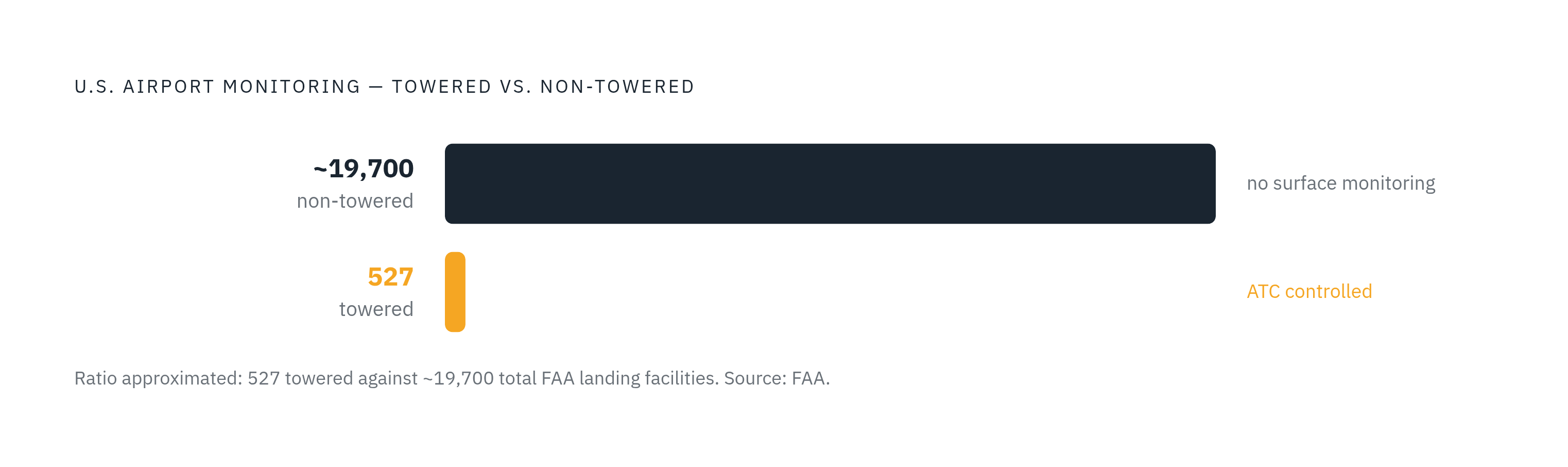
That mismatch, scaled across the national airspace system, makes the exposure clear. The United States has approximately 527 towered airports against tens of thousands of non-towered landing facilities, and the overwhelming majority of airfields operate with no one monitoring the surface or the pattern. That means the overwhelming share of takeoffs and landings in the country happen at fields where nobody on the ground is tracking the surface, the pattern, or the final approach course.
The FAA's own NAS Safety Review didn't describe this as a theoretical exposure. It concluded that staffing and infrastructure challenges are eroding the margin of safety to a level the agency itself calls unsustainable. It's getting worse.
What a conventional tower cab gives a controller
A controller working a traditional tower cab sees the whole field at once. The vantage point delivers a continuous, unobstructed 360-degree view across the runways, taxiways, aprons, and the surrounding airspace, letting one person track several aircraft simultaneously, notice a fuel truck crossing where it shouldn't, and watch a squall line building on the horizon before it reaches the pattern.
Sound matters just as much as sight. A controller hears an engine run up before a pilot announces departure, or catches the pitch change that signals a go-around before the radio call comes in. That auditory layer runs alongside the visual one, and together they form a single, continuous cross-check: what the radio says gets measured constantly against what the controller can see and hear happening on the field.
Without the tower, every piece of that cross-check disappears at once. Nobody is confirming that the aircraft calling "clear of the runway" actually is. Nobody notices the wildlife walking onto the threshold or the non-standard departure that isn't going to get announced until it's already underway.
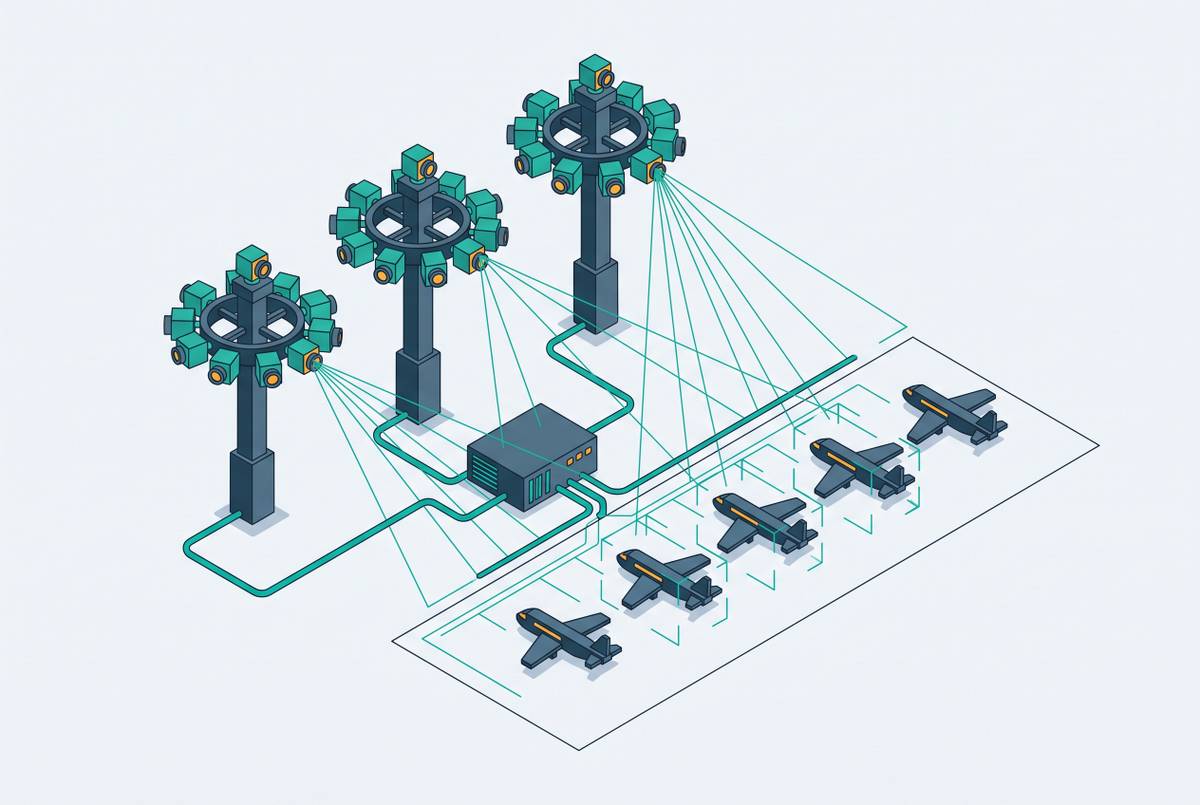
Remote tower systems exist to rebuild that exact perceptual package rather than something looser or approximate. Optical sensors recreate the 360-degree sightline, infrared and thermal cameras extend it through night and weather a human eye can't penetrate, smart overlays add aircraft position and runway data onto the display, and live airport audio restores the soundscape a controller would otherwise lose entirely. Every one of those components maps to something a physical tower cab provides for free, by virtue of a person sitting in a glass room above the field.
Staffing and cost structure make traditional towers the wrong solution for small airports
The obvious fix, build more towers and staff them, runs straight into a workforce problem that has no quick resolution. The FAA closed fiscal year 2025 with roughly six percent fewer controllers than it had a decade earlier, even as total flight volume climbed over the same stretch. That's not a temporary dip waiting on a hiring cycle to correct itself.
FAA Administrator Bryan Bedford told lawmakers at a December hearing: "We'll never catch up." The system, in his description, is structured to run short-staffed indefinitely, not simply lagging behind a target it will eventually meet.
The agency's 2026-2028 Workforce Plan sets out an ambitious hiring push, with higher academy starting pay and a shorter path from application to certification. Critics examining that plan point out that even the most aggressive version of it, sustained for the full five years, doesn't close the deficit. Staffing constraints of that scale rule out a one-tower-per-airport model for the tens of thousands of fields that don't have one now. There simply aren't enough certified controllers coming through the pipeline to staff them conventionally, regardless of how much a given airport might benefit from having one.
That constraint is what makes a multi-airport control model, one controller certified across several small fields and managing them one at a time, the only arithmetic that closes. It doesn't require solving the national staffing shortage. It requires making each controller's attention cover more ground, which is a design problem, not a hiring problem.
The core engineering problem: covering a small airport's geometry with overlapping fields of view
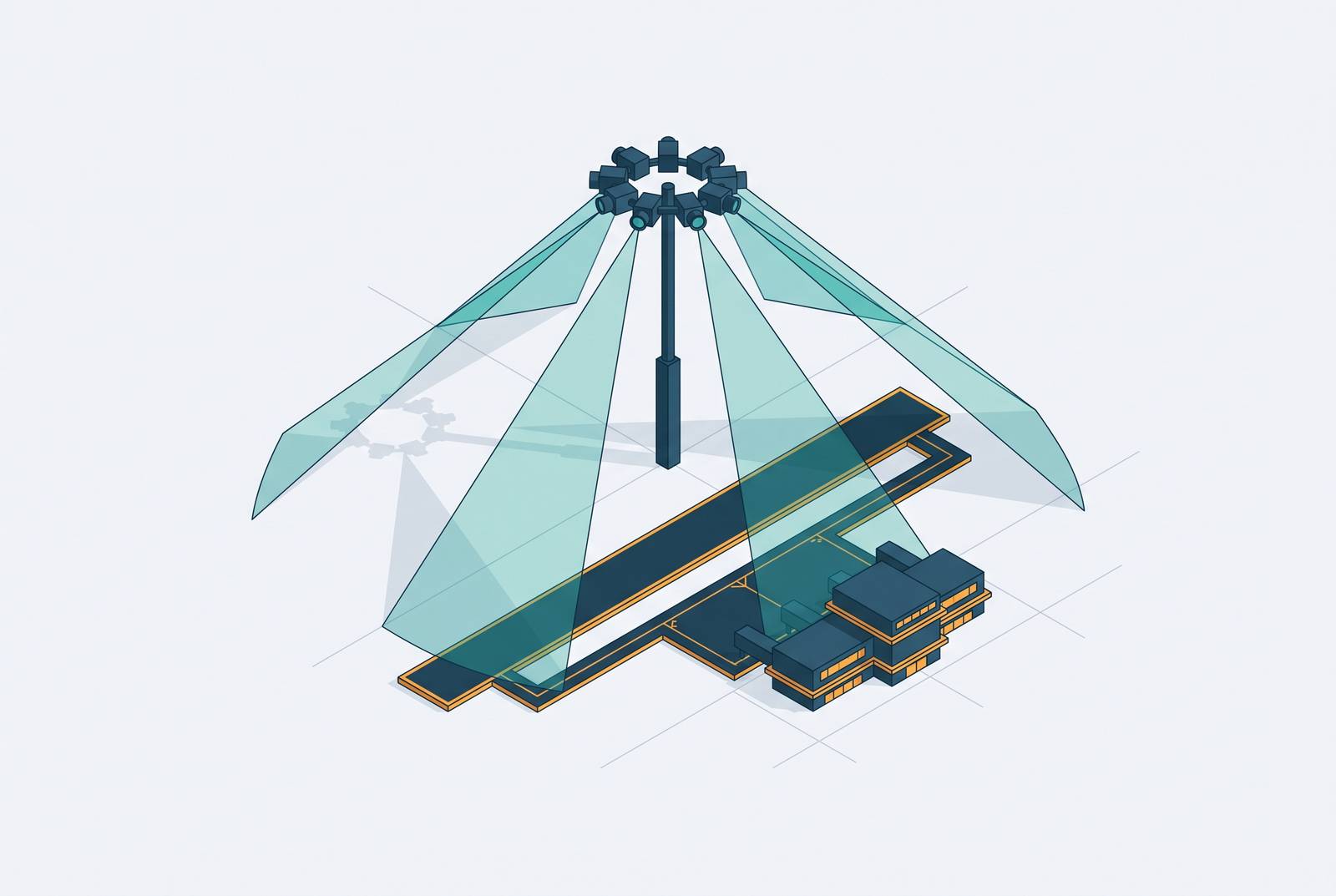
Once a camera array replaces a human eye in a cab, coverage requires more than pointing one wide lens at the field and hoping it catches everything. Every zone that matters, runways, taxiways, aprons, the approach corridors, the points where aircraft enter the pattern, has to fall inside the field of view of at least one camera, and the transitions between those zones need to overlap so nothing slips through in the gap between two frames.
Placement follows the airport's actual shape. Runway orientation determines where cameras need to sit to avoid staring straight into a rising or setting sun. Hangars and other structures throw shadows and physical occlusion that a designer has to route around. The typical altitude and radius of the traffic pattern tells the designer where an aircraft will be, and how far off the ground, at each point in its circuit, which in turn tells the designer where the camera has to be able to see.
Overlap at those transition points isn't padding for its own sake. It functions the way peripheral vision functions for a human controller: an aircraft rolling from runway onto taxiway, or crossing from final approach over the threshold, has to stay visible to the system the entire time it moves, with no instant where it exists in a blind seam between two camera fields.
Small airports change the shape of this problem. Shorter runways and simpler taxiway layouts cut down on the sheer number of zones that need coverage. But trees, terrain, and buildings often sit closer to the movement area at a small field than they would at a major commercial one, and at low camera angles those obstructions create occlusion problems that a larger, more open airport would rarely encounter.
Sensor selection maps to specific coverage conditions
Daylight optical cameras handle the baseline condition: clear skies, good light. High resolution here matters because a controller relying on the feed needs to read tail numbers, judge ground vehicle position, and assess surface condition with the same confidence a human eye would have looking out a tower window.
Infrared and thermal sensors pick up where optical cameras stop being useful, at night, in fog, in haze, in heavy rain, or when a low sun angle washes out a standard lens entirely. Thermal imaging works by reading heat rather than reflected light, so it can pick out a running engine or a vehicle idling on the ramp under conditions where an optical camera would show nothing but a gray wall. That capability lines up directly with where risk actually concentrates at non-towered fields: night operations and marginal weather are exactly when no human observer is present and self-separation is hardest to execute safely.
Smart overlays add a further layer on top of the raw camera feed, laying aircraft position, runway data, and weather information directly onto the display so a controller isn't mentally cross-referencing a radar blip against a visual smudge on a screen. The overlay does that correlation automatically, freeing the controller's attention for judgment calls rather than data assembly.
Combining optical, infrared and thermal sensors with smart overlays produces a system that holds the same quality of observation in fog and darkness that it holds in a clear noon sky, a feat no person can match alone in a tower cab. A human controller's eyes get worse at night. A well-designed camera array doesn't.
Design decisions in the field: the Norway and Leesburg cases
Norway's Avinor program is the largest working proof that this approach scales. Norway's Avinor program, beginning with the NINOX initiative in 2015, has become the world's largest implementation of digital remote towers; as of April 2025, a number of airports across Norway are managed from a single Remote Tower Centre in Bodø, with additional airports scheduled to go live within two to three years. The Norway case demonstrates that a camera-array-based system can sustain operational coverage across a diverse network of small airports from a centralized point, including airports in demanding weather environments where optical-only systems would fail.
Leesburg Executive Airport in Virginia ran a remote tower program from 2015 until 2023, a run of eight years that has since ended. Airport director Scott Coffman reported that traffic grew by more than a quarter over that period, and the airport added a second flight school, a second FBO, and a U.S. Customs office during the same stretch. Leesburg's program is no longer active, but the growth it oversaw stands as the clearest U.S. proof that the model can support real operational expansion at a general-use field.
Johnston Regional Airport in Smithfield, North Carolina, is the current forward case, actively positioning itself as of 2025 to be an early adopter of the FAA's next-generation digital ATC concept. The reasoning behind that push is straightforward: camera systems carry much of the observational burden that would otherwise require a controller physically present, and a single remote center built around that principle could, in theory, cover a large number of airports rather than one.
The FAA certification gap that determines what U.S. airports can deploy now
None of this can move to full operational deployment in the U.S. until the FAA finishes work Congress already told it to do. The FAA Reauthorization Act of 2024 directed the agency to build a defined system design and operational approval process and to publish a testing and deployment timeline for remote and digital towers. As of the most recent reporting, the FAA has not published a System Design Approval for any project under that mandate.
Testing is underway even without that approval. As of May 2025, the FAA had a system in trials at Atlantic City International in New Jersey, developed for that purpose, though the agency has not certified it for use anywhere in the National Airspace System. Testing without certification means the engineering work is real and the operational deployment is not, at least not yet.
The certification gap has a direct engineering consequence: airport operators and system designers cannot finalize a deployment architecture for a certified U.S. installation, so camera array design work at U.S. small airports currently serves planning and demonstration purposes rather than operational approval.
Pressure to close that gap is building through the Digital Tower Technology Coalition, formed specifically to push the FAA toward action: seeking federal funding and approval, defining standards and best practices, studying how a single center might manage multiple airports, and developing better visual detection tools. The DTTC is a member of the Modern Skies Coalition, created in 2025 to support U.S. ATC modernization efforts, including Secretary Duffy's plan and congressional legislation. Advocates within that coalition are pushing for a slice of a recently approved, multi-billion-dollar modernization allocation to go specifically toward digital tower deployment, which is the funding mechanism most likely to force the certification question to a resolution.
The case for ADS-B as an alternative to camera arrays
The strongest case against investing in camera arrays comes from ADS-B In, which already puts nearby traffic on a pilot's cockpit display with no ground infrastructure required at all. Congressional advocates for expanding ADS-B In make a fair point: it works the same way whether the airport below has a tower, a digital tower, or nothing.
The collision data doesn't make non-towered airports look like the obviously more dangerous option, either. An NTSB database analysis covering 2016 to 2026 identified 27 confirmed midair collisions where the airport type could be positively determined: 14 happened at towered airports, 13 at non-towered ones. Raw counts that close together are the empirical foundation for the argument that non-towered fields aren't dramatically more dangerous on a per-facility basis.
That comparison has a hole in it, though. Towered airports handle far more traffic, more complex mixed operations, and a wider range of aircraft types than non-towered fields typically do, and counting collisions per facility rather than per operation buries the actual risk difference per flight. A fair per-movement comparison would very likely show something different from the raw facility count, even though the brief here doesn't supply that figure directly.
Camera arrays also handle a category of risk ADS-B was never built to touch. A ground vehicle crossing a runway, a deer wandering onto the threshold at dusk, an aircraft with a transponder that failed before departure, all of these require someone or something watching visually, since a transponder return can't report what a broken avionics bay or a wandering animal is doing. ADS-B and camera arrays work as complementary layers in the same safety architecture, and a well-designed digital tower folds ADS-B data directly into its smart overlay as one more input alongside the camera feed.
eVTOL and advanced air mobility demand for camera infrastructure
Advanced air mobility operators building eVTOL aircraft already plan to lean on remote and digital tower technology for vertiport infrastructure. Camera arrays going into small airports today aren't a one-off investment aimed only at today's fixed-wing traffic.
Every choice made now, where cameras sit, which sensors cover which conditions, how overlap logic handles the transition zones, carries forward into whether a given airport is ready for that next wave of traffic or has to be redesigned for it later.
Engineering lessons for airport operators and planners
Coverage design has to start from the airport's actual geometry. Runway orientation, nearby obstructions, and pattern altitude all shape where cameras need to go, and skipping that analysis in favor of a standard layout risks leaving exactly the kind of blind seam the overlap requirement exists to eliminate.
Sensor selection has to match the conditions the airport actually sees. A field that runs a meaningful share of its operations after dark or in coastal fog needs the infrared and thermal layer built in from the start, not added later as a patch. Waiting for the FAA's certification process to fully mature before doing any of this planning work costs time operators don't get back. Norway's network and Leesburg's eight-year run both show that the underlying engineering holds up in real conditions. The certification gap is a deployment bottleneck.
Sources
- Analysis of U.S. Airport Characteristics and Their Impact on Safety (2023-2024) | Zenodo
- Coalition Pushes for Remote and Digital Air Traffic Control Towers
- Digital Towers: A new standard for air traffic management - KONGSBERG - an international technology group
- REVOLUTIONISING AIR TRAFFIC MANAGEMENT: THE RISE OF DIGITAL TOWERS ADVERTORIAL