Remote Tower ArchitectureLong read
Digital Tower Platform Selection Criteria for Drone Integration at Untowered Airports
A buyer's guide to vetting digital towers for drone-ready airports.
· 15 min read
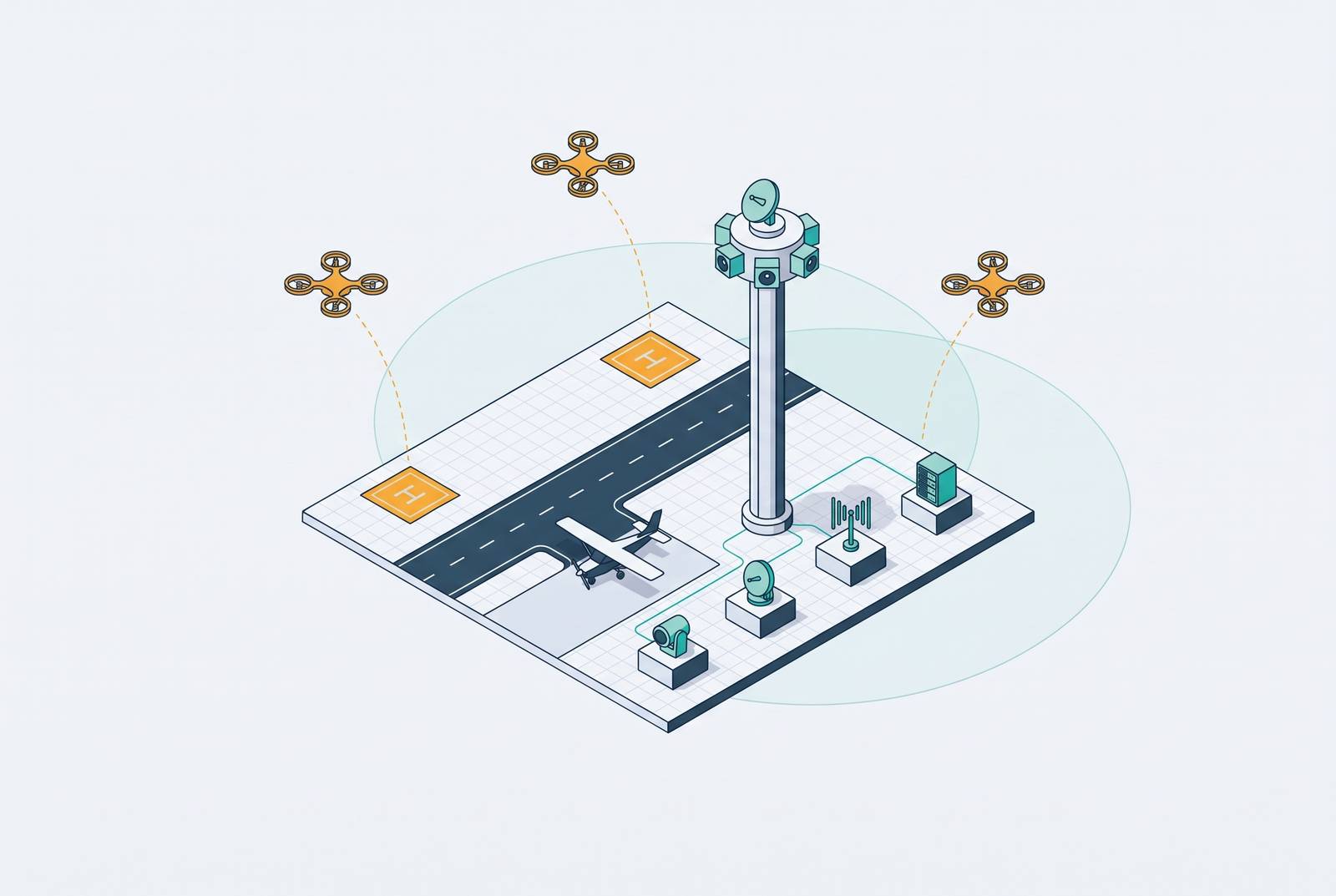
Why untowered airports are the default operating environment for commercial drone expansion
- Role: Opens the argument by establishing the structural collision between where drones are going next and where ATC coverage is absent — making the platform-selection question urgent rather than theoretical.
- Untowered airports are not an edge case in the NAS; they vastly outnumber towered fields, and the airspace above and around them is precisely where BVLOS commercial drone operations are expanding.
- The FAA's BVLOS proposed rule, published August 2025, targets low-altitude operations at the kinds of fields that have no controller to coordinate them
- The FAA's stated trajectory — shifting the NAS toward electronic situational awareness as its baseline — makes airports without any digital infrastructure structurally misaligned with the direction of drone policy
- UTM as designed is a federated, automated network: it assumes ground-truth situational awareness exists at the airport level; at an untowered field, that assumption fails entirely
- Note: Keep this section focused on the structural gap, not on drone safety statistics yet — the safety case comes next. Open on the operational reality that drone operators, delivery companies, and infrastructure inspectors are already treating untowered airports as their preferred launch and recovery points.
What actually happens when drones and manned traffic share uncontrolled airspace
- Role: Makes the safety stakes concrete using documented incidents, transitioning from the structural gap to its real-world consequences — building the case that the status quo is not a neutral baseline.
- The combination of no controller authority, voluntary CTAF participation, and drone operators who do not participate in CTAF at all creates a compounding deconfliction failure at untowered airports.
- Manned aircraft's ADS-B traffic systems do not detect most drones, because small UAS are prohibited from transmitting ADS-B Out under 14 CFR §107.53; visual detection of small UAS gives pilots almost no reaction time — the see-and-avoid framework that untowered airports depend on does not extend to drones
- CTAF participation is not required even for manned aircraft at non-towered fields; drone operators add a second layer of actors who are entirely outside that voluntary coordination loop
- The Eastern Iowa Airport incident, June 3, 2026: commercial pilots reported an unauthorized drone in their landing path; investigators identified two drone pilots working for separate contractors at a nearby QTS data center construction site — legitimate, authorized commercial activity that still produced unacceptable risk because no coordinating authority existed
- The JetBlue reported drone encounter approaching JFK runway (June 29, 2026) and the United Airlines near-miss at Newark (June 26, 2026) demonstrate that even well-resourced towered airports struggle with drone deconfliction — the problem is categorically more acute where no controller exists
- 2025 drone incidents show a shift from opportunistic to patterned, deliberate operations — the threat profile at airports is not static; it is maturing
- D-Fend Solutions' 2025 counter-UAS analysis documents the transition from isolated misuse to purposeful, repeatable operations with apparent knowledge of detection limitations
- Note: Do not dwell on the major-hub incidents as the primary argument — use them briefly to show the problem is system-wide, then pivot hard to why untowered airports are the most exposed. Avoid commercial airline framing as the main frame of reference.
How a digital tower changes the deconfliction equation for drone operations
- Role: Introduces the solution category — explaining what a digital tower actually does operationally that a CTAF-only environment cannot, so readers understand what they are evaluating before the criteria framework begins.
- A digital tower does not merely replicate a traditional tower at lower cost — its sensor architecture and integration capability make it structurally better suited to drone coordination than any physical tower built before UAS existed.
- Digital towers use pan-tilt-zoom cameras with visual and infrared sensors: precisely the instruments needed to detect and classify small UAS that are invisible to conventional radar and to the naked eye at operational distances
- Rotate Pilot's digital tower explainer notes that controllers can zoom in, switch to infrared in low visibility, and overlay traffic data directly on the visual display — capabilities a physical tower window cannot match
- Integrating UTM systems and drone detection systems directly into the digital environment of a remote tower makes it much easier for a controller to manage drone traffic than in a conventional tower — the integration point is native, not retrofitted
- The FAA's nomenclature shift from "Remote Tower" to "Digital Tower" removes the implication of off-airport siting, enabling deployment flexibility — on-site or off-site — that matches the varied physical footprints of small airports
- Controllers at a digital tower center can be certified to handle multiple airports, which directly addresses the controller-shortage reality documented across the NAS in 2026; for untowered airports that could not staff a dedicated controller, this pooled-resource model is the enabling condition
- Digital towers are eligible under the Airport Improvement Program (AIP) statute since the FAA Reauthorization Act of 2018; a September 2026 FAA guidance letter (PGL 26-06) currently limits AIP eligibility to airport sponsors that participate in, or are candidates for, the FAA Contract Tower Program — a funding pathway operators must understand before committing to a platform
- Note: Keep this section explanatory and factual, not promotional. The goal is to equip the reader to evaluate platforms intelligently — frame capabilities as evaluation criteria in embryo, not as a sales case. Do not assert that any specific vendor's product is best.
Why drone integration makes this a different procurement decision than standard ATC modernization
- Role: Pivots from what digital towers can do to what operators must specifically ask when drone integration — not just general ATC service — is the requirement, establishing the framework that the following sections will populate.
- When drone integration is the operational goal, procurement criteria that are optional in a conventional ATC upgrade become non-negotiable, and some criteria that are standard in traditional tower evaluation become secondary.
- A standard ATC procurement optimizes for controller visibility, communications reliability, and sequencing of known manned traffic — all necessary but insufficient when the airspace will include BVLOS operators, UTM data feeds, and counter-UAS sensor inputs
- Drone integration requires the platform to act as a data hub, not just a visual and communications relay: it must ingest, fuse, and display data from sources (UTM service providers, remote ID receivers, drone detection sensors) that did not exist when most tower procurement frameworks were written
- The federated UTM model the FAA is building assumes that airports generate and share situational awareness data; a platform that cannot publish to or consume from UTM data services is not a drone-integration platform regardless of its ATC capability
- Operators at untowered airports often have no existing ATC staff, no tower infrastructure, and no experience writing ATC procurement specifications — the criteria framework this article provides is oriented to that starting point, not to an operator upgrading from an existing staffed tower
- Note: This section is transitional and conceptual — keep it tight. Its job is to frame why the next sections cover the criteria they cover, not to exhaustively survey the procurement landscape. Open on the gap between generic ATC specs and drone-integration requirements; close on the reader's need for a structured evaluation lens.
Sensor architecture and UAS detection capability as the first filter
- Role: Begins the criteria framework with the most technically distinctive requirement — the sensor layer — establishing that this is where drone-integration platforms diverge most sharply from conventional digital tower offerings.
- The sensor suite a platform ships with — or can natively integrate — determines whether a controller can actually see, classify, and act on drone traffic, and it is the criterion most likely to reveal gaps between a vendor's ATC competence and its UAS-environment readiness.
- Minimum viable sensor set for drone-integration environments: high-resolution pan-tilt-zoom cameras with infrared capability, wide-area surveillance coverage of the traffic pattern and approach corridors, and low-altitude detection optimized for objects smaller and slower than manned aircraft
- Infrared matters specifically because many drone incidents occur at dawn, dusk, or in haze conditions where visual-spectrum cameras lose small UAS against complex backgrounds — the same conditions that degrade pilot see-and-avoid
- Operators should ask whether the platform's sensor data is processed on-site, in the cloud, or both, and what the failover behavior is if the data link degrades — latency in drone detection is a safety-critical parameter, not a performance preference
- Remote ID receiver integration: as Remote ID becomes the regulatory baseline for drone operations, the platform should be able to ingest Remote ID broadcasts and associate them with the visual sensor track — without this, the controller sees a drone but cannot connect it to an operator, a flight plan, or a UTM authorization
- Counter-UAS sensor integration: the platform's architecture should define clearly whether it can accept feeds from third-party RF detection, acoustic detection, or radar systems, and how those feeds appear on the controller's display — a platform that treats counter-UAS as out of scope is not ready for environments where rogue drone activity is a documented, recurring operational reality
- D-Fend Solutions' June 2026 incident briefing confirms that correctional facilities experiencing repeated drone-enabled smuggling need forensic data, flight paths, likely takeoff points, and pilot locations — not just detection alerts
- Note: Stay at the evaluation-criteria level — what to ask and why it matters. Do not enter the counter-UAS vendor space or recommend specific detection hardware. Avoid naming any companies on the never-mention list.
UTM integration depth and data interoperability with the FAA's federated architecture
- Role: Moves from the sensor layer to the data layer — the platform's ability to connect to the broader UTM ecosystem the FAA is building — arguing that a platform that cannot participate in that ecosystem will be operationally isolated as drone policy matures.
- A digital tower platform's UTM integration depth is the criterion that determines whether it functions as a node in the NAS's emerging drone traffic network or as an isolated local system that controllers must manually bridge to UTM realities.
- The FAA's UTM model is federated: automated data service providers supply situational awareness that operators use to self-deconflict; the tower is not the center of that system, but it must be able to consume the outputs and contribute ground-truth observational data back into it
- Key integration questions: Can the platform receive and display active UTM flight authorizations in the controller's operational picture? Can it push observed drone tracks to UTM service providers? Does it support standard data exchange protocols that UTM service providers already use, or does integration require custom engineering?
- BVLOS operations — the commercial use case driving most of the economic case for drone integration at small airports — require coordination between the drone operator, the UTM service provider, and any ATC authority present; a platform that handles only the ATC side without a defined interface to the UTM side forces that coordination onto voice radio, which defeats the purpose
- The FAA's Airspace Modernization Office, established on January 1, 2026 as required by the FAA Reauthorization Act of 2024, which also sunset the NextGen office and distributed its functions across multiple FAA offices, is responsible for continuous NAS modernization toward an information-centric architecture; platforms that use proprietary data formats or closed integration models are betting against that trajectory
- Operators should request from vendors a current list of UTM service providers the platform has tested against, and the protocol versions supported — not a roadmap commitment, but a demonstrated integration record
- Note: This is a technical section but the audience includes airport operators who are not engineers — frame the evaluation questions in operational terms (what the controller sees, what the drone operator experiences) rather than pure data architecture. Keep acronyms defined on first use.
Scalability from advisory services to full ATC authority as drone traffic grows
- Role: Introduces the time dimension — the platform must serve the airport not just at initial deployment but as drone density, BVLOS authorization, and regulatory requirements evolve — arguing that a platform's upgrade path is itself a selection criterion.
- An untowered airport deploying a digital tower for drone integration today will face materially different operational demands within a few years, and a platform that cannot scale its service level without full replacement creates a locked-in liability rather than a durable infrastructure investment.
- Initial deployment at a currently untowered airport may be advisory only — providing situational awareness and traffic information without formal ATC authority; as drone density increases and BVLOS operations normalize, the regulatory and operational pressure to provide separation services will grow
- Controller certification portability: if the platform supports multi-airport operations, does it support the controller certification workflows that allow a single controller to be qualified at multiple fields — the workforce-efficiency model that makes small-airport ATC financially viable?
- Platform vendors should be able to demonstrate a clear path from traffic monitoring to traffic advisories to separation authority, including what software, sensor, or regulatory steps each transition requires — a platform that treats these as separate product lines requiring separate procurement is not architected for the upgrade path
- The BNATCS program (FAA contract awarded to Peraton, December 5, 2025) aims to replace radar, telecommunications networks, automation tools, and aging control-center infrastructure across the NAS by end of 2028; platforms that are not designed to interface with next-generation NAS automation will face integration costs at exactly the moment drone traffic demands are highest
- Note: Avoid speculating about regulatory timelines beyond what the sources establish. Frame the scalability argument around documented operational precedent and the FAA's stated policy direction, not predictions about rulemaking outcomes.
Redundancy, cybersecurity, and the failure modes that matter most in a drone-dense environment
- Role: Addresses the reliability and security dimensions that become more consequential — not less — when a digital tower is coordinating drone traffic in addition to manned aircraft, completing the technical criteria framework before moving to cost and funding.
- Because a digital tower in a drone-integration role is a networked data hub connected to UTM systems, Remote ID feeds, and potentially counter-UAS sensors, its attack surface and its failure consequences are larger than those of a platform used only for conventional ATC — and the evaluation criteria must reflect that.
- Redundancy requirements specific to drone integration: the platform must maintain operational continuity not just when cameras fail (the standard remote tower failure mode) but when UTM data feeds degrade, Remote ID reception is jammed or spoofed, or a data link to the operations center is interrupted — each of these is a realistic threat in a drone-active environment
- The 2025 drone incident record shows that rogue operators increasingly demonstrate awareness of detection and response limitations; a platform whose drone-detection capability depends on a single sensor type or a single data path is exploitable
- D-Fend Solutions' analysis of 2025 incidents documents deliberate patterning and apparent understanding of detection limitations as defining characteristics of the threat environment
- Cybersecurity evaluation criteria: the platform's software supply chain, update and patch cadence, network segmentation between ATC functions and external data feeds, and the vendor's incident response commitments — particularly relevant given the company positioning that critical U.S. ATC infrastructure is best built and maintained domestically
- Degraded-mode procedures: the platform should define, document, and train controllers on exactly what services remain available when each major component fails — the analog of instrument approach minimums, applied to digital infrastructure; operators should ask for these procedures in writing during evaluation, not after contract award
- Power and communications resilience at the airport site: small and GA airports typically lack the generator capacity and redundant fiber or cellular infrastructure that major airports carry; the platform's site requirements must be evaluated against what the airport can realistically provide or fund
- Note: This section deals with technical depth that could easily become too long — keep each point at the evaluation-question level. The writer should not attempt to specify cybersecurity architectures; the goal is to give airport operators the questions to ask vendors, framed as non-negotiable evaluation criteria, not optional features.
Cost structure, AIP funding eligibility, and the financial realities of platform selection at small airports
- Role: Grounds the technical criteria in the economic constraints that actually govern decisions at small airports — arguing that a platform's cost architecture and its alignment with available federal funding pathways are evaluation criteria as important as its sensor suite.
- The financial case for a digital tower at an untowered airport is only viable if the platform's cost structure is matched to what AIP and other available funding channels can support — a technically superior platform that is not fundable is not a realistic option.
- Compared to building a traditional ATCT, a digital tower costs roughly half as much to construct; a multi-airport operations center further reduces per-facility operational costs — the economic model that makes small-airport deployment possible depends on these structural savings being preserved in the vendor's pricing, not eroded by proprietary sensor lock-in or integration fees
- AIP eligibility, confirmed since the FAA Reauthorization Act of 2018, is currently limited by the September 2026 FAA guidance letter (PGL 26-06) to airport sponsors in the FAA Contract Tower Program — operators not already in that program must evaluate whether their path to AIP funding runs through program participation, and how that affects timeline
- Post-FY2026, the IIJA supplemental funding cliff means the federal capital available to non-hub airports reverts to baseline AIP entitlements and discretionary grants; operators evaluating platforms in late 2026 are making decisions in a tighter funding environment than existed two years prior
- Total cost of ownership must include: site infrastructure upgrades (power, communications, physical mounting), sensor licensing and maintenance, software subscription or update costs, controller training and certification, and the cost of UTM integration maintenance as protocols evolve — vendors who quote installation cost only are presenting an incomplete picture
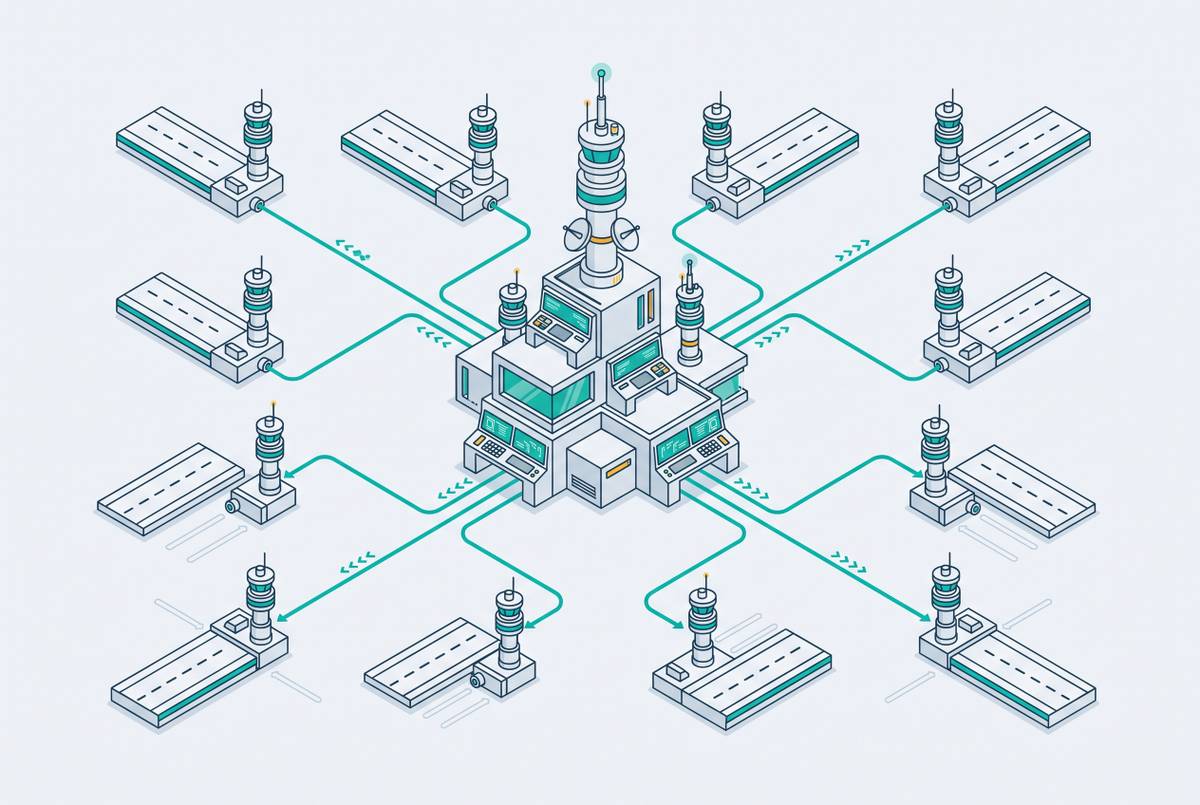
- The multi-airport operations center model is the lever that makes per-airport operational cost manageable; operators should evaluate whether a platform vendor supports shared-center deployments and what the contractual and operational model for shared staffing looks like
- Note: Do not cite specific dollar figures from the sources for construction or operational costs — the rules prohibit statistics. Characterize the magnitude accurately in words. Frame this section as evaluation criteria, not a budget tutorial; the airport operator reading this has a finance team — they need to know what cost categories to demand from vendors, not a cost estimate.
How to structure the vendor evaluation process given these criteria
- Airport operators evaluating digital tower platforms for drone integration should sequence their evaluation to expose the criteria where vendor claims most often outrun operational reality — sensor and UTM integration capability, scalability architecture, and total cost of ownership — before committing to any procurement path.
- Recommended evaluation sequence:
- First, confirm AIP funding eligibility and whether the airport's Contract Tower Program status affects available channels — this determines the financial envelope before any vendor conversation begins
- Second, evaluate sensor architecture against the drone-detection requirements specific to the airport's planned operations — BVLOS, delivery, infrastructure inspection — not generic ATC use cases
- Third, require demonstrated UTM integration evidence — not a roadmap — with the specific protocols and service providers relevant to the operators the airport expects to serve
- Fourth, test redundancy and degraded-mode procedures against the airport's actual power, communications, and staffing baseline — not against an assumed infrastructure that may not exist
- Fifth, build total cost of ownership across a multi-year horizon that accounts for the IIJA funding cliff, potential software and sensor upgrade cycles, and controller certification costs
- Request site visits to operational deployments — not demonstrations — where the platform is already managing a traffic mix that includes drone operations or UTM integration; the Norway Avinor model and the early U.S. deployments provide reference sites where controller experience with the platform under real conditions can be assessed
- The broader policy context reinforces urgency: the FAA's 2026 Drone Normalization Strategy signals a goal to shift from a NAS that accommodates the least equipped users to one built on electronic situational awareness, though it does not specifically single out airports as non-aligned entities; operators who delay platform evaluation are not holding a neutral position — they are falling further behind the regulatory and operational baseline the NAS is moving toward
Sources
Filed underRemote Tower Architecture
More in Remote Tower Architecture
Scalable Multi-Airport Remote Tower Hub Design
Priya Subramaniam

Controller Workstation Hardware in Remote Tower Deployments
Deshawn Kimura
Automation Layers Replacing Procedural Self-Announce at Non-Towered Airports Under Rising Drone Pressure
Priya Subramaniam