Technology ReviewLong read
Cost Comparison of Digital Tower Versus Traditional Manned Tower Construction
Digital towers cost about half as much to build and far less to run.
· 9 min read
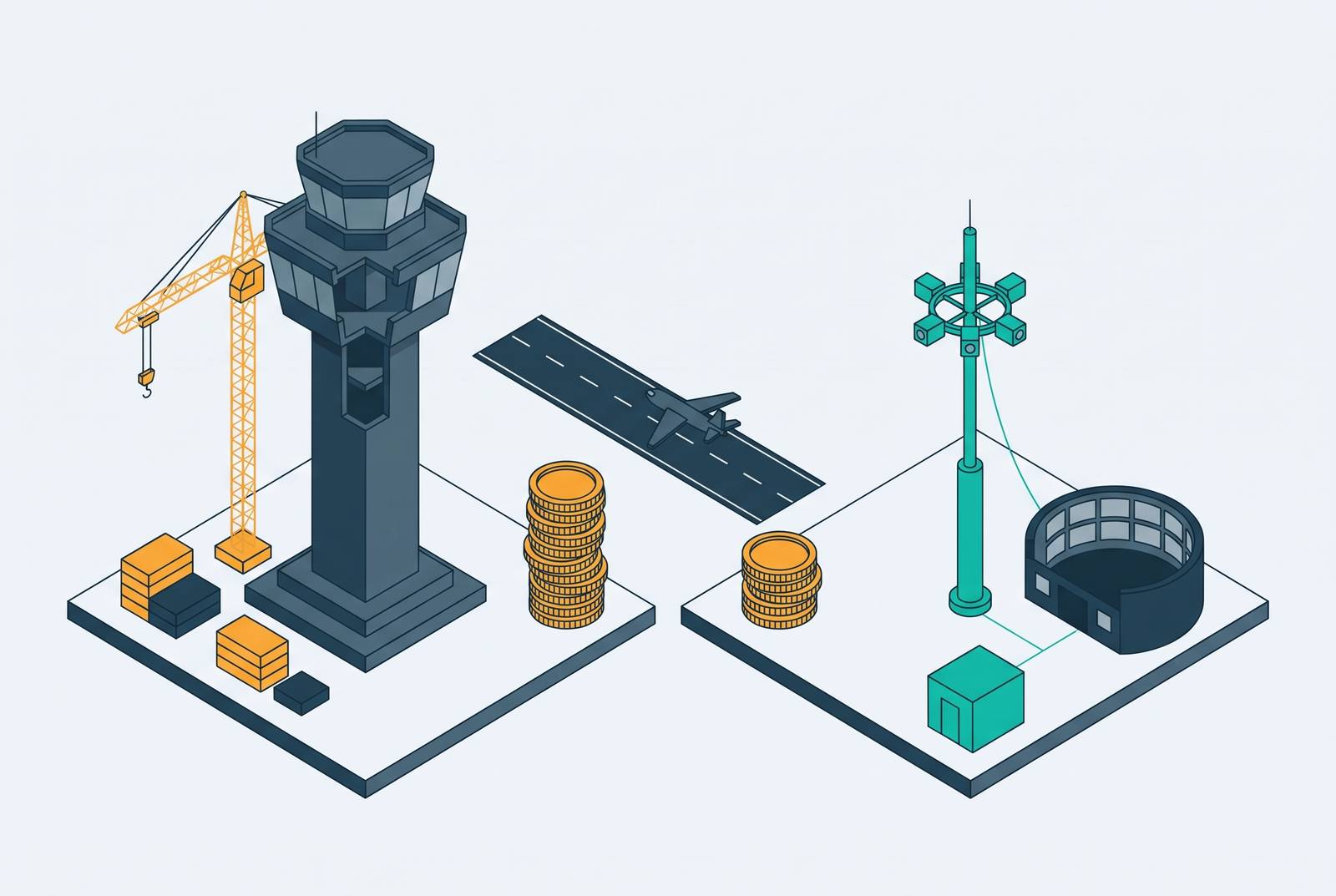
Why airport towers cost what they do: the structural and staffing foundations of the traditional model
- Role: Opens the argument by establishing what drives the cost of a conventional ATCT, so every comparison that follows has a clear baseline to push against.
- A traditional manned control tower is expensive by design — its cost is baked into physical requirements that have no cheaper substitute within the conventional model.
- The defining feature of a traditional ATCT is the elevated cab: a structure tall enough to give controllers unobstructed line-of-sight across the entire airfield, which drives both structural engineering cost and foundation requirements
- Controllers must be physically present in that cab, which means the facility must support full-time on-site staffing — HVAC, power, communications, and building systems sized for continuous human occupancy
- Each tower serves exactly one airport; there is no architectural mechanism for sharing the facility's cost across multiple airfields
- Hanson Inc.'s digital tower overview lists the inherited limitations directly: fixed height and location, higher construction and maintenance costs, and service limited to a single airport
- Note: Keep this section grounded and factual — no drama about the "crisis" of tower costs; the point is simply that the cost structure is load-bearing for the argument that follows.
What a digital tower actually replaces and what it keeps
- Role: Bridges from the traditional cost baseline to the digital alternative by making clear what changes and what stays the same — preventing the reader from misreading "cheaper" as "lesser."
- A digital tower eliminates the physical cab and everything that requires it, while preserving every operational and procedural element that makes a tower a tower.
- The elevated cab is replaced by a sensor mast — cameras, infrared, pan-tilt-zoom, and audio equipment mounted on a comparatively modest structure — feeding a ground-level control room
- The control room displays a panoramic, real-time view of the airfield stitched from high-definition camera feeds; Rotate Pilot's remote tower explainer notes camera resolution sufficient to identify aircraft types and read tail numbers
- The FAA recently updated its terminology from "remote tower" to "digital tower," removing the implication of an off-airport location and allowing deployment both on-site and at a distance — a distinction that matters for airport operators evaluating options
- Controllers work under identical procedures: same radio frequencies, same sequencing, same clearances; Rotate Pilot confirms pilots notice almost no procedural difference
- Augmented capabilities — infrared in low visibility, zoom on final approach, bounding-box aircraft tracking — are built in by design, not add-ons; Hanson Inc. cites pan-tilt-zoom cameras with visual and infrared sensors and a bounding-box function for tracking in-motion hazards
- Note: Spend enough time here that the reader understands digital towers are not a degraded version of a real tower; this sets up the cost comparison as genuinely apples-to-apples on the safety and service side.
The capital cost gap between building a digital tower and building a traditional one
- Role: Makes the central quantitative claim of the piece — that digital towers cost roughly half as much to build as traditional ATCTs — and grounds it in named sources.
- The construction cost of a digital tower is substantially lower than that of a traditional ATCT, and the gap is wide enough to change the economics of tower provision at small airports entirely.
- Hanson Inc. states directly: a digital tower costs about half as much to construct as a traditional ATCT
- Reason Foundation's 2025 policy brief characterizes construction costs for remote towers as "a fraction" of those for conventional towers, and notes significant capital cost advantages as a primary finding
- The cost differential traces to the physical structure: what a digital installation needs is a sensor mast and a ground-level control room, not an engineered tall-structure building with a panoramic cab, foundation-to-top structural steel, and the civil works a full ATCT requires
- Note: Do not state specific dollar figures in the article text — the editorial plan reserves the single best-sourced figure for attachment at a later step. Write the claim in directional terms ("roughly half," "substantially less") consistent with what Hanson and Reason Foundation establish.
Where ongoing maintenance costs diverge — and where they may converge
- Role: Advances the argument past the one-time capital question to the recurring cost picture, and handles the strongest counterargument honestly rather than sidestepping it.
- Digital towers carry lower maintenance costs than traditional ATCTs in the aggregate, but the advantage is real only when the technology stack is managed well — a condition that must be named, not hidden.
- Hanson Inc. states maintenance costs for a digital tower are "a fraction" of those for a traditional ATCT
- The maintenance profile of a traditional ATCT is dominated by structural upkeep of a tall building — roofing, glazing, elevator systems, HVAC for a staffed cab, and the civil infrastructure supporting it; these costs are largely fixed regardless of traffic volume
- A digital tower's maintenance profile is different in character: it involves cameras, software, fiber connectivity, and sensor hardware rather than structural building systems
- The honest counterargument: a technology-heavy system with dozens of cameras, software patches, and network dependencies can accumulate maintenance costs over time; this is a real consideration and not a reason to dismiss digital towers, but a reason to evaluate total lifecycle cost rather than construction cost alone
- The counterargument weakens at small airports with low traffic: the recurring costs of maintaining a staffed physical building — regardless of how little it is used — do not scale down with activity, while a digital system's cost basis can be distributed across multiple sites
- Note: Address the counterargument in a single, direct paragraph — acknowledge it, explain why it matters less at the airports this piece is about, and move on. Do not linger here in a way that undermines the section's claim.
How multi-airport operation from a single control center changes the cost per airport
- Role: Introduces the scaling dimension — the argument that the true economic advantage of digital towers only fully appears when a single center serves multiple airports — which no traditional tower can do.
- The most consequential cost advantage of digital tower technology is not what it saves at one airport but what it enables across many: a single control center serving multiple airfields in a way that is structurally impossible with physical towers.
- Hanson Inc. describes a digital tower control center designed to accommodate multiple airports' digital towers, explicitly reducing each facility's operational costs
- Reason Foundation notes that when several low-activity airports are controlled from a single remote tower center, air navigation service providers can realize significant staff and operating cost savings
- Controllers at a multi-airport center are certified for multiple airfields and direct traffic at one airport at a time, with easy handoff as demand shifts — maximizing productive use of a limited national controller pool without reducing safety
- Adding a new airport to an existing digital network requires installing sensors at the field and adding a position at the operations center — not designing, permitting, and constructing a new building
- Note: This is the section where the argument shifts from "digital is cheaper per tower" to "digital changes what is even possible at small airports" — make sure the writer lands that distinction clearly before closing the section.
What the cost gap means for the 90 percent of U.S. airports that have no tower at all
- Role: Connects the cost comparison to its real-world consequence — the large population of uncontrolled U.S. airports for whom a traditional tower was never financially viable, and for whom digital changes that calculation.
- The cost gap between digital and traditional towers is not an abstraction; it is the reason airports that have operated without any ATC coverage can now realistically consider adding it.
- The vast majority of airports in the U.S. National Airspace System operate without a control tower; the cost and staffing demands of traditional ATCTs have historically placed tower services out of reach for these airports
- Reason Foundation frames the issue directly: remote towers can provide ATC services to airports that currently have no tower, improving safety without requiring the capital expenditure of a physical tower
- Alternative funding mechanisms — Passenger Facility Charges, revenue bonds — favor larger airports whose financial capacity and enplanement volume can support debt service; small airports dependent on federal grants face a structural funding gap that makes traditional tower construction even less accessible
- Digital towers are specifically suited to low-activity airports: their cost basis scales with the traffic environment in a way that traditional towers, with their fixed structural and staffing overhead, do not
- The FAA's System Design Approval process remains a real barrier — it is an expensive and time-consuming certification path — but it is a procedural obstacle, not a cost argument against the technology itself
Policy momentum and the funding environment that makes adoption more feasible now
- Role: Moves the argument forward in time — showing that the cost case for digital towers is being recognized at the policy level, and that the funding environment is shifting in a direction that makes the comparison increasingly actionable.
- Federal investment and FAA policy are beginning to align with what the cost comparison has long made clear, creating a near-term window for airports that have previously seen digital towers as a future possibility rather than a present option.
- The 'One Big Beautiful Bill,' signed in July 2025, allocates $50 million for remote towers as a standalone line item alongside the broader NAS overhaul funded under the FAA's Brand New Air Traffic Control System (BNATCS).
- The FAA's Flight Plan 2026 includes a stated goal of deploying digital remote tower technology at the first key site — a shift from years of inconsistency on the issue that Reason Foundation documents in detail
- The FAA NPIAS 2025–2029 identifies a very large volume of eligible airport infrastructure needs over five years; IIJA supplemental airport funding expires at the end of FY2026, which means airports planning capital programs should factor in reduced federal funding availability beginning FY2027
- That funding cliff makes the capital cost advantage of digital towers more consequential, not less: airports facing tighter federal grant availability will find the lower construction cost of a digital installation more attractive relative to a traditional ATCT
- eVTOL and advanced air mobility operators already plan to use digital/remote tower technology at vertiport infrastructure, creating additional demand that will accelerate FAA certification activity and help drive down system costs further
- Note: Keep the FAA's historical hesitancy brief — it is context, not the main point. The section's job is to show that the policy environment is moving in the right direction and that the timing for airport operators to act is better now than it was.
How to evaluate the full cost picture when a specific airport is making the decision
- Role: Closes the argument by giving airport operators and decision-makers a practical frame for applying everything the piece has established — moving from industry-level cost comparison to site-level decision-making.
- The cost case for a digital tower is strongest when evaluated across the full lifecycle and across the right comparison set — not just construction cost versus construction cost, but total cost of serving an airport with ATC coverage versus leaving it uncontrolled.
- The relevant comparison for most small airports is not "digital tower versus traditional tower" — it is "digital tower versus no tower at all," because traditional tower economics have already ruled out the conventional option
- Lifecycle evaluation should include: capital cost of sensor installation and control room; connectivity and fiber infrastructure; ongoing camera, software, and network maintenance; staffing under a shared-center model versus dedicated on-site staffing; and certification costs under the FAA SDA process
- Hanson Inc. offers a design-build turnkey approach that bundles structural, electrical, fiber, and technology coordination — the kind of integrated delivery that simplifies cost estimation and project management for airport operators without in-house expertise in digital ATC systems
- The multi-airport model, where costs are shared across a network of airfields served from a single center, should be part of any regional or state-level evaluation — the per-airport cost in a shared-center configuration is materially lower than a standalone installation
- For airport operators, the practical starting point is understanding what FAA certification requires and what federal funding is available in the current cycle, before the IIJA supplemental window closes at the end of FY2026
- Note: Close on the actionability of the decision, not on a summary of everything the article covered. The reader who reaches this section should leave with a clear sense of the next question to ask — not a recap of what they just read.
Sources
Filed underTechnology Review
More in Technology Review
Lessons From Failed or Stalled Remote Tower Programs
Marcus Oduya
Traffic Awareness Technology Retrofits for Uncontrolled Airports Below the ATC Threshold
Priya Subramaniam
Autonomous Traffic Alerting Systems as Staffed Tower Substitutes at Untowered General Aviation Airports
Deshawn Kimura