Traffic Awareness Technology Retrofits for Uncontrolled Airports Below the ATC Threshold
Small airports can add collision safeguards without full control towers.
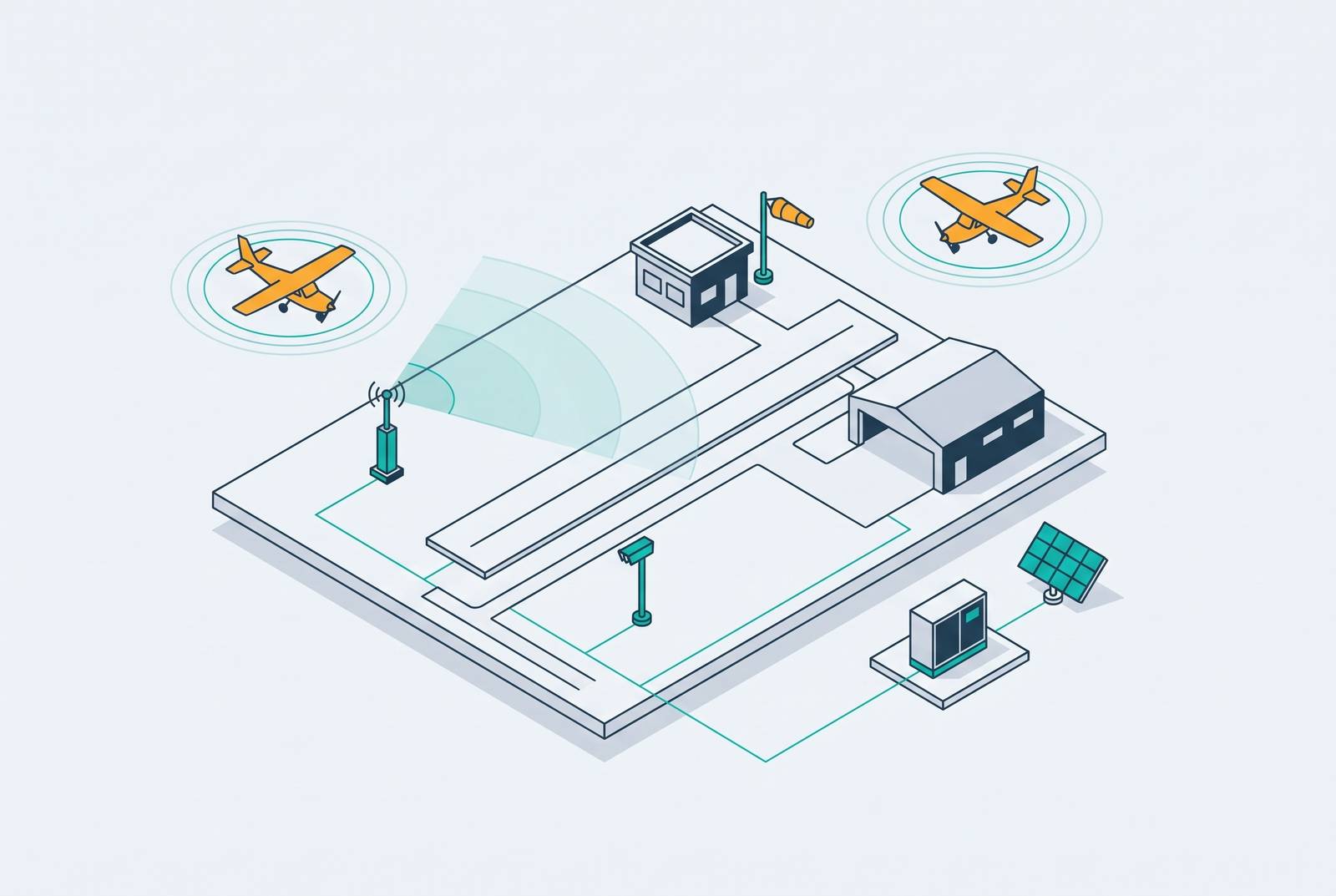
Non-towered airports can add traffic awareness without a full ATC facility through ADS-B ground receivers, UNICOM-integrated displays, surface detection and cockpit alert tools. These retrofits address different collision risks, so affordability depends on matching the technology to the field’s traffic, equipage and staffing. A staffed digital tower adds authoritative control that those tools cannot provide, but airports below the ATC threshold need not wait for one to improve safety.
Why the safety signal at uncontrolled airports is harder to read than the headline numbers suggest
A flat overall runway incursion count appears reassuring. Yet the number of severe Category A and B incursions rose sharply in fiscal year 2025 even as the total count fell slightly. That divergence separates the frequency of reported events from the danger of the most serious encounters. It also exposes a measurement problem at airports without controllers, where the classification system loses part of its basis for observing and recording events.
The FAA’s classification framework assumes a controller is somewhere in the loop. At a non-towered airport, the operational incident category, which requires a controller, disappears. Pilot deviation and vehicle/pedestrian deviation remain, but neither has an external authority routinely catching and recording it in real time. Pilot deviations already account for close to two-thirds of U.S. runway incursions. At uncontrolled fields, that category absorbs much of what goes wrong without the same monitoring infrastructure.
The fatal record gives a different signal. There were only three fatal runway incursion accidents in recent years, all at non-Part 139 airports without control towers. That concentration within a small total is consistent with low-frequency, high-consequence risk. The DOT Inspector General’s March 2025 audit found that the FAA has no joined-up way to analyze runway incursion data, which further limits what national totals can tell about risk at each airport.
How self-separation actually works at a non-towered airport, and where it reliably breaks down
Pilots work with one another by making position and intent calls on a Common Traffic Advisory Frequency, looking for traffic and following established circuit procedures. The model works much of the time. Its weakness is that voluntary radio coordination has no external monitor verifying that every aircraft participates or that every pilot shares the same traffic picture. Skill cannot supply information that never arrives.
Under 14 CFR 91.126 and 91.127, the two-way radio requirement applies at airports with operational control towers, rather than most non-towered fields in Class G or E airspace. Ultralights, gliders and some legacy aircraft can therefore operate legally without radios. Other aircraft may transmit on the wrong frequency or enter without calls. Australia’s Transport Safety Bureau found that three-quarters of near-collision reports were about flights within ten nautical miles of a non-controlled aerodrome, and near-collisions happened twice as often when there was no prior radio warning.
Airport familiarity adds another source of uncertainty. Transient pilots may not know local patterns, while departures from standard procedures and taxi distractions receive no controller’s corrective intervention. Failure to follow ATC instructions cannot occur where there is no ATC, but the remaining failure modes persist. Missing traffic, misunderstood intent and uncorrected conflicts are the targets for retrofit technology.
What the retrofit technology landscape actually covers — and what it leaves out
The failure chain begins when someone moves without awareness of other traffic. It continues when other traffic remains unaware of that movement, with no external authority catching the developing conflict. The available technologies intervene at different points. None closes the chain on its own.
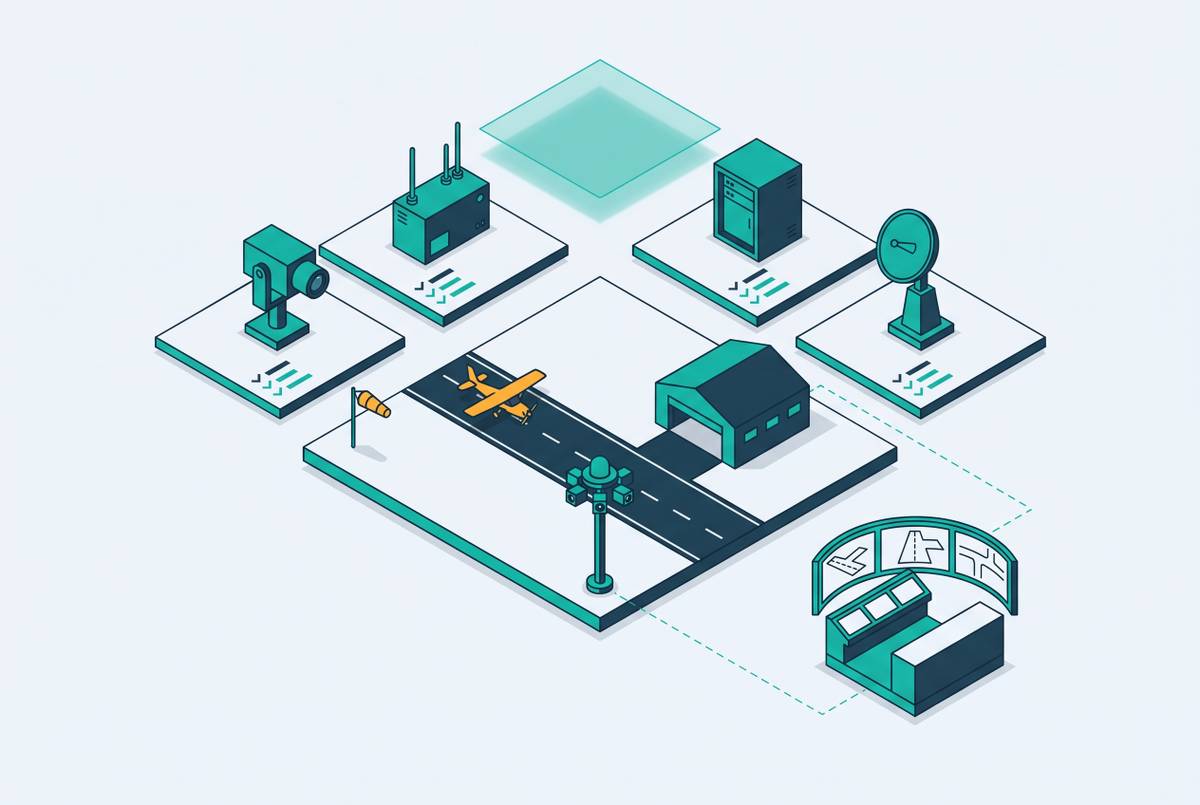
ADS-B ground receivers and displays reveal transmitting aircraft to people on the ground. UNICOM-integrated displays show that picture to advisory personnel who can pass the information on. Surface detection adds observations of runway and taxiway activity, with cameras and radar able to cover aircraft that do not transmit. Pilot alert tools deliver traffic information inside the cockpit, reducing dependence on hearing and interpreting radio calls.
These distinct functions have different limits: a display does not create a monitoring service, and a sensor does not confer authority to separate aircraft. A digital or remote tower sits above these point solutions because it combines surveillance with staffed ATC capability from a remote location.
ADS-B receivers and ground-based traffic displays — what they provide and where their coverage ends
With ground-based ADS-B, the receiver and display are at the airport, while the transmitter is aboard the aircraft. The receiver picks up ADS-B Out broadcasts that carry position, altitude and identification data. Airport management, fixed-base operators and advisory personnel can then see equipped traffic without modifying aircraft to use the ground display. It is an accessible first layer of awareness.
The display is not a complete traffic census. Ultralights, gliders, balloons and older aircraft may not transmit ADS-B Out. Cockpit ADS-B In can also show some transponder-equipped aircraft through TIS-B ground-station rebroadcast, but aircraft without transponders still do not appear in that picture.
Georgia Tech research demonstrates why position data alone can be insufficient. Its system for interpreting pilot radio calls substantially reduced average trajectory prediction error compared with position-only models, showing the operational value of intent information. The Air Traffic Situational Awareness Enhancement Act would equip more than 90 towers lacking radar or other surveillance with a solution based on aircraft-broadcast position data. That proposal supports ADS-B’s role as a near-term layer. Uneven mandate coverage and lawful non-equipage make the blind spot structural.
UNICOM-integrated situational displays and what a human monitoring layer adds — and cannot do
A traffic display in a UNICOM workspace gives advisory personnel an objective picture they would otherwise lack. Its usefulness depends on its inputs. ADS-B shows traffic that transmits, while cameras and surface sensors can show traffic beyond that feed. A person watching the combined picture can flag a potential conflict to inbound traffic in plain language.
The ATSB finding about prior radio warning supports the value of making traffic known, although it does not establish a measured safety benefit for a particular UNICOM display. A human advisory layer adds a chance for pilots to receive and act on information they missed. It does not add ATC authority.
UNICOM personnel, who are usually fixed-base operator staff, cannot issue clearances and do not have a controller’s legal responsibility for separation. Pilot responsiveness remains essential because an advisory is not a binding ATC instruction. A UNICOM installation that uses only aircraft-broadcast position data has the same blind spot for non-equipped aircraft as the receiver that feeds it.
Surface detection systems — the only retrofit layer that sees non-equipped aircraft
Surface detection directly addresses the weakness of cooperative surveillance, but the sensor type determines what it can see. Cameras and surface movement radar can see aircraft that have no working transponders. Multilateration uses multiple ground receivers to locate emitting transponders, including older Mode C equipment, extending coverage beyond ADS-B while remaining limited to aircraft that transmit.
Camera arrays offer the lowest-cost entry into this sensor category. High-definition and infrared cameras can cover runways and taxiways, provide a visual record and feed human monitors or algorithmic alerts. Surface movement radar offers the most comprehensive equipage-independent surface detection, but it is also the most expensive option and has historically served large commercial facilities. These systems cover surface movement but leave some gaps in awareness of airborne traffic.
Leesburg Executive Airport in Virginia and Nav Canada’s Kingston installation use camera-based systems with integrated data feeds. Capital cost nevertheless remains substantial for small airports. Avinor’s Remote Tower Centre in Bodø, Norway, illustrates a shared-infrastructure approach, serving 14 airports and expanding toward 21 by 2027, with centralized monitoring reducing per-airport cost.
Pilot-side alert tools — what cockpit technology can and cannot fix from inside the aircraft
Portable ADS-B In receivers give pilots an affordable way to display traffic in the cockpit without having to install equipment. Panel-mount systems integrate traffic into the instrument scan but require installation and airworthiness compliance in certified aircraft. Both improve access to available traffic data. Neither creates information about an aircraft that the surveillance system cannot see.
Audio conflict alerts address a different constraint. By generating verbal traffic calls from ADS-B data, they reduce the need to interpret a display during high-workload approach and departure phases. This changes how information reaches the pilot, rather than expanding the population of aircraft detected. The underlying surveillance limits remain.
The Georgia Tech research points toward a further layer that parses CTAF transmissions for position and intent. Such a system could extract information about an aircraft that uses a radio but does not transmit ADS-B. It remains at the research stage. If conflicting traffic neither transmits usable surveillance data nor makes radio calls, the cockpit tools described here cannot reveal it.
How can a non-towered airport choose affordable traffic awareness without a full ATC facility?
Equipment choices should start with the airport’s operational profile. Traffic density, fleet mix, operating hours and staffing determine which gaps dominate. The Transportation Safety Board’s 2025 Watchlist found that incursions cluster at a small number of airports, many of them flight-training facilities. Those airports where incursions cluster have more reason to use a full set of sensors than a rural strip with little traffic.
Fleet composition determines the return from ADS-B. Predominantly modern fleets offer broader effective coverage, while significant ultralight, glider or legacy traffic strengthens the case for cameras or other surface sensors. Night and instrument meteorological conditions favor infrared and all-weather detection. Airports where flights take place only by day and under visual flight rules can get useful coverage from cameras, while staffed fixed-base operations can add displays to the advisory service they already provide at little extra cost. Unstaffed fields need automated alerting.
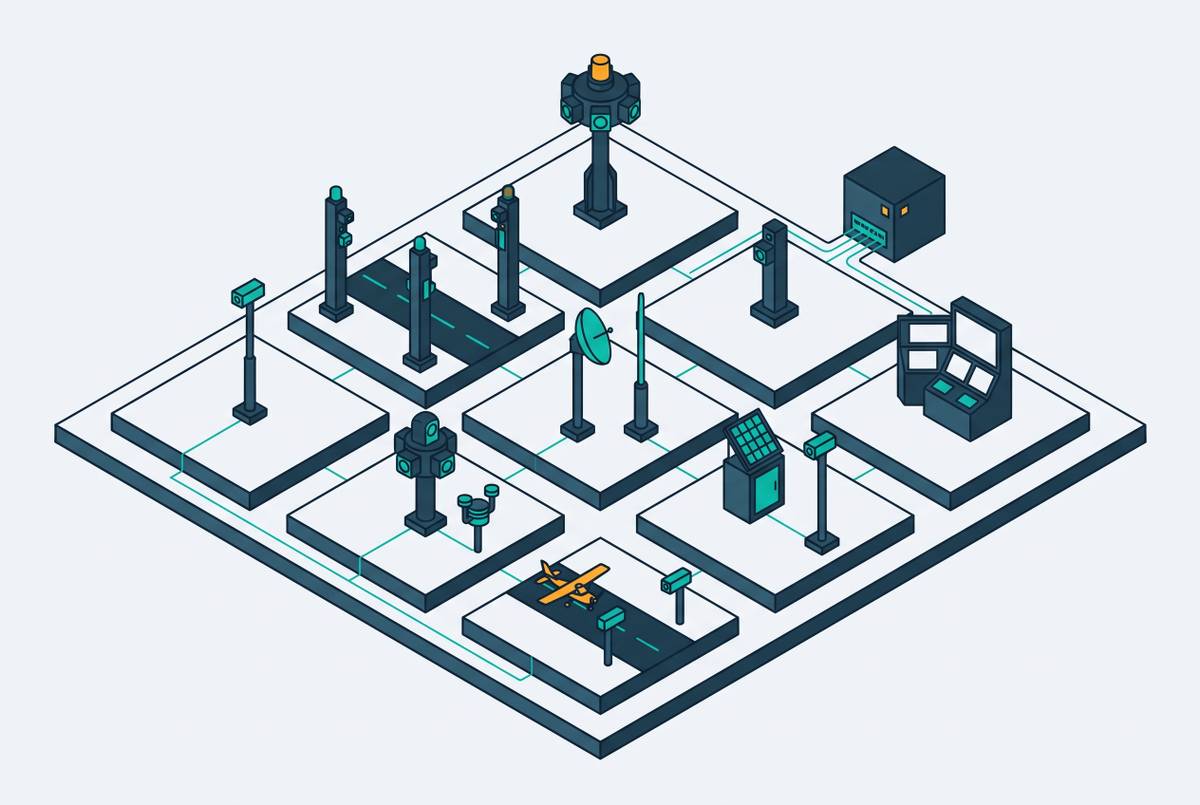
The recommended layering approach begins with ADS-B ground receivers and pilot tools, adds UNICOM monitoring where staff are available, and introduces surface sensors as exposure and budget justify. A staffed digital tower is the higher-capability endpoint. The FAA’s Federal Contract Tower Program offers funding in fiscal year 2026, and airports that qualify are expected to have funding available each year through fiscal year 2029. The FAA’s pursuit of proposals for up to 50 remote tower units over five years also gives the procurement pathway greater definition. These funding routes do not establish a universal cheapest solution.
What digital tower technology adds that point solutions cannot replicate
A staffed digital tower changes the operating model. Controllers can issue clearances and instructions rather than advisories, with legal authority and accountability for their ATC function. They integrate surface and pattern activity across data sources and can recognize a developing conflict that no individual sensor has flagged. Hardware alone cannot perform that institutional role.
Leesburg demonstrated error-free ATC performance while annual traffic grew substantially. That is evidence of capability at a small airport, rather than an assumption transferred from a major commercial facility. The international deployments also demonstrate that the monitoring location need not be at each airport. Together, these examples distinguish demonstrated remote operation from a proposal to place more displays in an advisory workspace.
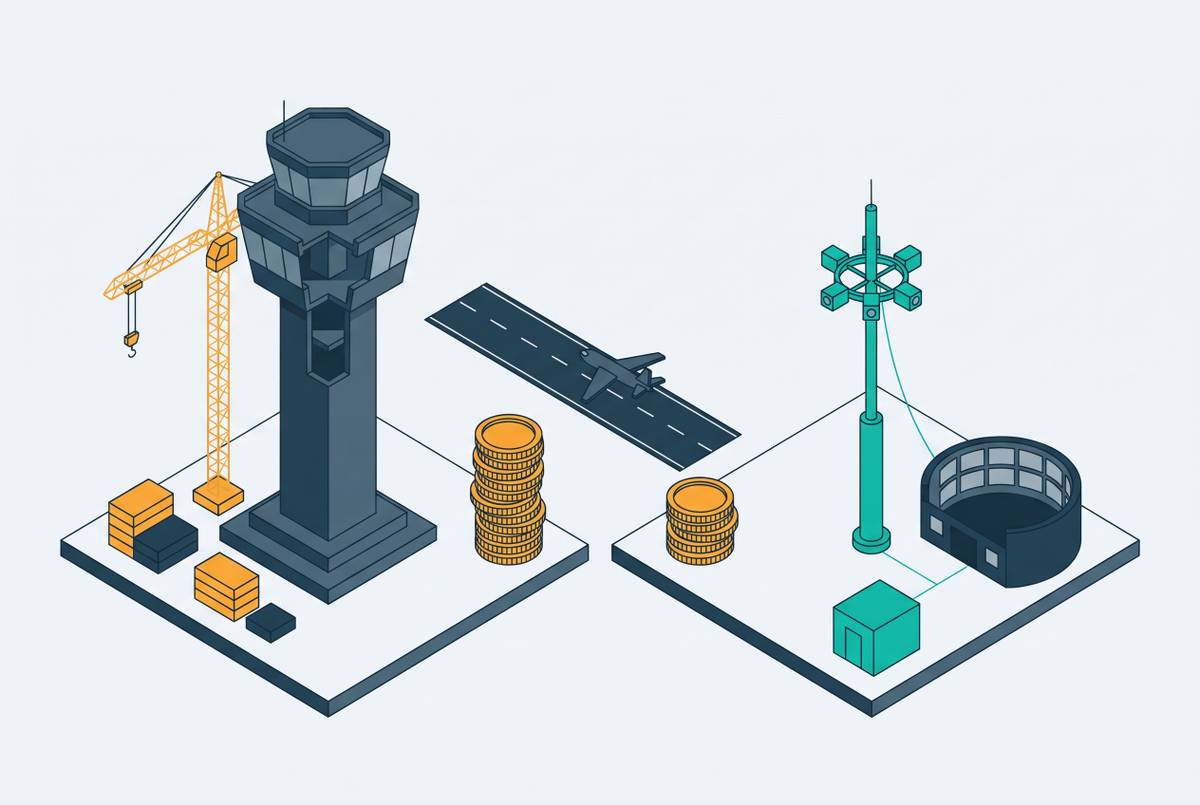
Cost still constrains access to that capability. A conventional tower can cost many millions of dollars, while a full remote setup costs a fraction of that, although the available figures do not support a precise price ranking. Digital towers also connect small-airport investment to National Airspace System modernization. Advanced air mobility operators plan to use remote tower technology for vertiports, while bringing UAS into operations adds to the need to coordinate and monitor traffic.
What operators and pilots should take away from the current state of retrofit options
The available evidence supports deployment decisions before conventional towers are available. For pilots, portable ADS-B In and audio alerts are accessible improvements that should be treated as standard equipment for non-towered operations, with a clear understanding of their detection limits. An absent target is not proof of absent traffic.
For operators, the lesson is to assess local exposure before procurement. A camera-and-display installation serves a different need from a comprehensive surface detection system, and neither substitutes for staffed control where traffic and risk justify it. For policymakers, the Federal Contract Tower Program, AIP grants and PGL 26-06 provide routes toward digital tower deployment. Turning those mechanisms into operational capability requires eligibility and execution.
The reporting gap strengthens the case for that work. Airports without monitoring infrastructure also lack some of the means to gather reliable incident data. Published totals therefore cannot serve as a sufficient reason to defer improvements at fields with identifiable communication, equipage or observation gaps.