Alert Design and Nuisance Alert Management in Digital ATC Displays
Accurate detection alone does not guarantee controllers will trust safety alerts.

The central challenge in alert design for digital ATC displays is distinguishing hazards that need intervention from technically valid alerts that need none. Depending on how nuisance alerts are managed, added detection capability can help a controller respond or teach the controller to ignore the signals that make the system safe.
What nuisance alerts are and why they are not the same as false alarms
A false alarm occurs when an alert fires even though its threshold has not actually been exceeded. A nuisance alert occurs when the threshold has correctly been exceeded, but no controller action is needed or possible. The first is an error in detection against the stated threshold. The second is a mismatch between a correct detection and its operational meaning. An alert can therefore be technically accurate without being useful to the controller.
That distinction separates different engineering problems. Suppressing true false alarms is a sensor-calibration problem, while suppressing nuisance alerts is a human-factors and display-logic problem. Threshold-based automation identifies when specified parameters are crossed, but that logic alone cannot distinguish a conflict that will resolve itself from one that requires intervention. The system can correctly identify the condition and still signal too late to help, or signal when no help is required. Treating both outcomes as false alarms obscures why accurate detection can still produce an ineffective alert system.
How large the nuisance alert problem actually is in operational ATC
FAA Human Factors Analysis of Safety Alerts studied Conflict Alerts and Minimum Safe Altitude Warnings at en route facilities while they were in use. It found that the vast majority of Conflict Alerts were nuisance alerts or unnecessary. In those cases, the situation had already resolved before the alert fired, or it resolved without controller action.
The same study found that the share of alerts that were nuisances was even higher for Minimum Safe Altitude Warning than for Conflict Alert. The alert function with the greatest imbalance was thus one that deals directly with terrain separation. An alert’s safety importance does not protect it from becoming operationally unhelpful through repetition. Instead, the controller must distinguish the unusual warning that matters from an overwhelming share that does not. The asymmetry is therefore part of the working environment.
FAA Human Factors Analysis of Safety Alerts also documented a response to this burden. Most ATC facilities disable MSAW on the transponder code blocks assigned to VFR aircraft to reduce nuisance alerts, on the rationale that ATC is not responsible for terrain separation of VFR traffic. This removes the unwanted signals by removing coverage for that category of traffic. Operational suppression becomes a substitute for filtering that the system does not provide.
What repeated nuisance alerts do to a controller's ability to respond
FAA ATC Signaling Systems frames alert fatigue as a form of desensitization. Repeated exposure to signals that demand no action reduces responsiveness to signals that do. The system progressively weakens the expectation that its next signal deserves a response.
That adaptation should not be confused with laziness or simple inattention. A controller who keeps seeing alerts that call for no action has reason to doubt the next one. Once that doubt becomes habitual, the controller may ignore or deactivate a signal. When a genuine hazard eventually produces the same signal, the learned response is already in place. High nuisance volume thus creates safety exposure through both the behavior it trains and the time each interruption consumes.
FAA Human Factors Analysis of Safety Alerts found that nuisance alerts directly add to workload, cause distraction, and lead to desensitization, which in turn affect how well controllers do their work. Display interference adds to that burden when alert overlays crowd or hide information needed for other tasks. The controller then bears a cost even when the alert requires no intervention, because its presentation interferes with work that does. Alert fatigue in ATC is therefore both an immediate display problem and a cumulative credibility problem. Removing the distraction alone would not restore trust in a signal that still fires without operational purpose.
Why digital tower architecture makes nuisance alert management a different and harder problem
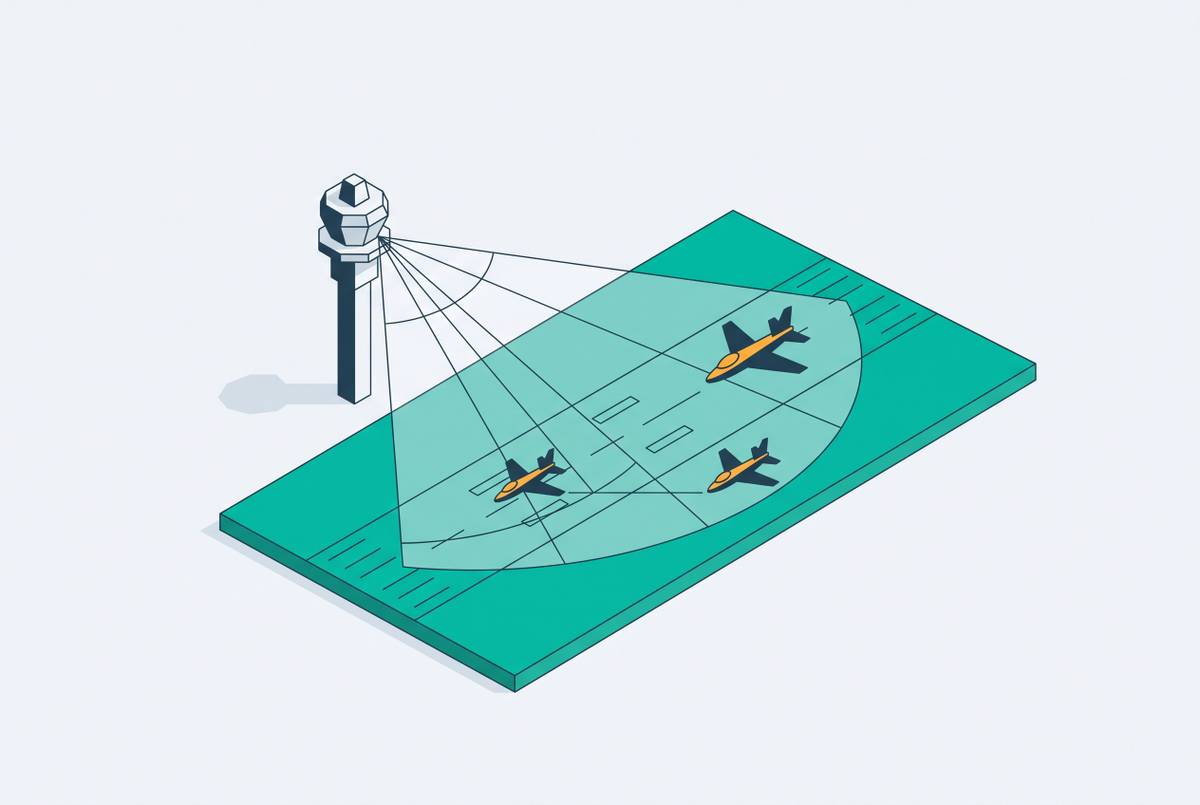
In a conventional tower cab, the controller can look directly at traffic to understand what is happening. That view can help resolve conflicts independently of an automated alert and partly bypass an unhelpful signal. A digital tower changes that relationship by placing the visual information needed for control on dedicated displays. Cameras and sensors provide what the cab windows previously provided. The alert system and the controller’s view of the airport consequently meet on the same display surfaces.
FAA CertAlert 26-04, issued September 28, 2026, states that digital tower technology eliminates the need for controllers to look out a physical window. The controller instead uses only dedicated digital displays to control traffic. An overlay that obscures those displays therefore interferes with the channel carrying the airport view itself. There is no direct window view to compensate for that interference.
Existing alert logic keeps its weaknesses when it moves to a different medium. TCAS and legacy Conflict Alert tools have been observed to give false alarms to pilots and controllers when aircraft fly close together. Additional AI capabilities, including anomaly detection, aircraft configuration monitoring, and continuous multi-target tracking, expand what automation can detect. Without nuisance-alert filtering matched to those capabilities, they also add signals to the surfaces on which the controller depends. As systems detect more, choosing which alerts to show and how to show them becomes more important.
Why non-towered and small airports are the sharpest test case for alert design getting this right
The dependence on a screen-mediated view matters most where tower services would fill a large monitoring gap. Roughly nine in ten U.S. airports have no control tower and rely on pilot self-separation. Digital towers offer a way to supplement or replace that model where a conventional structure would be difficult to justify. At those airports, an alert system is not merely another warning source added to an established tower operation. It becomes part of the monitoring capability that was previously absent.
The distinction between that potential and initial deployment is important. FAA CertAlert 26-04 says that digital tower systems will first be added to airports in Class D airspace at Airport Sponsor owned Non-Federal Contract Towers and FAA Contract Towers. Nevertheless, non-towered and small airports remain the sharpest test of the safety value such systems could deliver. Where there are fewer backup safety layers, there are fewer chances to catch the effects of alerts that fail to help.
Fatal runway incursion accidents have been concentrated at non-Part 139 airports without control towers. Three-quarters of near-collision reports filed by pilots involve operations within ten nautical miles of a non-controlled aerodrome. Near-collisions occur twice as often when a pilot had no prior radio warning of other traffic. These patterns make the absence of monitoring consequential without turning low-frequency fatal events into a claim that every operation is unsafe.
A digital tower costs a fraction of a conventional brick-and-mortar ATCT, making it a realistic route to coverage for airports that cannot justify a traditional structure. Yet affordable coverage has limited safety value if recurring nuisance signals train the controller to disregard the monitoring it provides. The relevant measure is whether an airport’s detection capability produces information a controller can trust and act on when intervention matters.
What alert design principles the research identifies as effective responses
FAA human-factors research points to graded and likelihood-based alerts as ways to reduce the effects of nuisance and false signals. The governing principle is that presentation should reflect the severity and imminence of a hazard rather than treat all threshold crossings as equivalent. A minor problem projected far into the future receives the lowest signal level. A potentially life-threatening hazard projected to occur very soon receives the highest. Presentation varies with urgency and severity, giving the controller information about the importance of the condition as well as its existence.
Graded urgency addresses habituation by preserving the meaning of the strongest signal. When low-level conditions are shown with signals that convey less urgency, they need not teach controllers to respond as they would to an urgent hazard. The system can retain useful early information without requiring it to compete at the highest priority.
FAA ATC Signaling Systems supports that principle with foundational requirements for signal design. Signals must be easy to identify, consistent across the equipment a controller uses, and presented without hindering other display elements. These requirements make graded urgency legible in practice. Likewise, an accurate and appropriately graded alert still fails the display standard if it obscures primary situational awareness information.
The research also identifies a gap between this design approach and operational practice. FAA human-factors research notes that graded and likelihood-based alert technology had yet to be incorporated into operational ATC systems. The FAA commissioned the ATC Signaling Systems review because relevant guidance for developing, integrating, and training for alerts was absent. These findings establish the problem as one of system design and integration.
What separates a digital tower system that manages nuisance alerts well from one that replicates the legacy problem
A digital tower system’s safety value depends on what its detection capability asks the controller to do. A system that detects more conditions but presents them at equal priority reproduces the central weakness of threshold-based alerting. Evaluation therefore turns on whether the system implements graded urgency and whether its logic accounts for context, including aircraft type, phase of flight, and controller workload state. It also turns on whether alerts preserve the primary display surface. These are tests of the alert architecture.
AI-assisted detection does not change those tests. Configuration monitoring and continuous multi-target tracking may help a system recognize conditions, but their alerts can cause the same nuisance problems as legacy automation. The relevant distinction is whether the surrounding architecture filters and grades the added detections. Recurring alert types that controllers habitually ignore, or coverage that facilities disable to make the system tolerable, indicate that built-in filtering has failed. A well-designed digital tower system should make those workarounds unnecessary.
Policy makes that distinction material to procurement. FAA CertAlert 26-04 and charting notice SA 26-05 show that digital towers are moving into use. U.S. Senate legislation introduced September 28, 2026, seeks a large amount of new funding for ATC modernization, including digital tower technology. Airport operators evaluating systems should therefore treat alert management as the capability on which the safety case rests. In a screen-mediated operation, a warning system that trains controllers not to respond has failed at the point where detection must become action.