Situation Awareness Loss During Remote Tower Contingency Events
Remote tower outages can suddenly erase a controller's situational awareness.
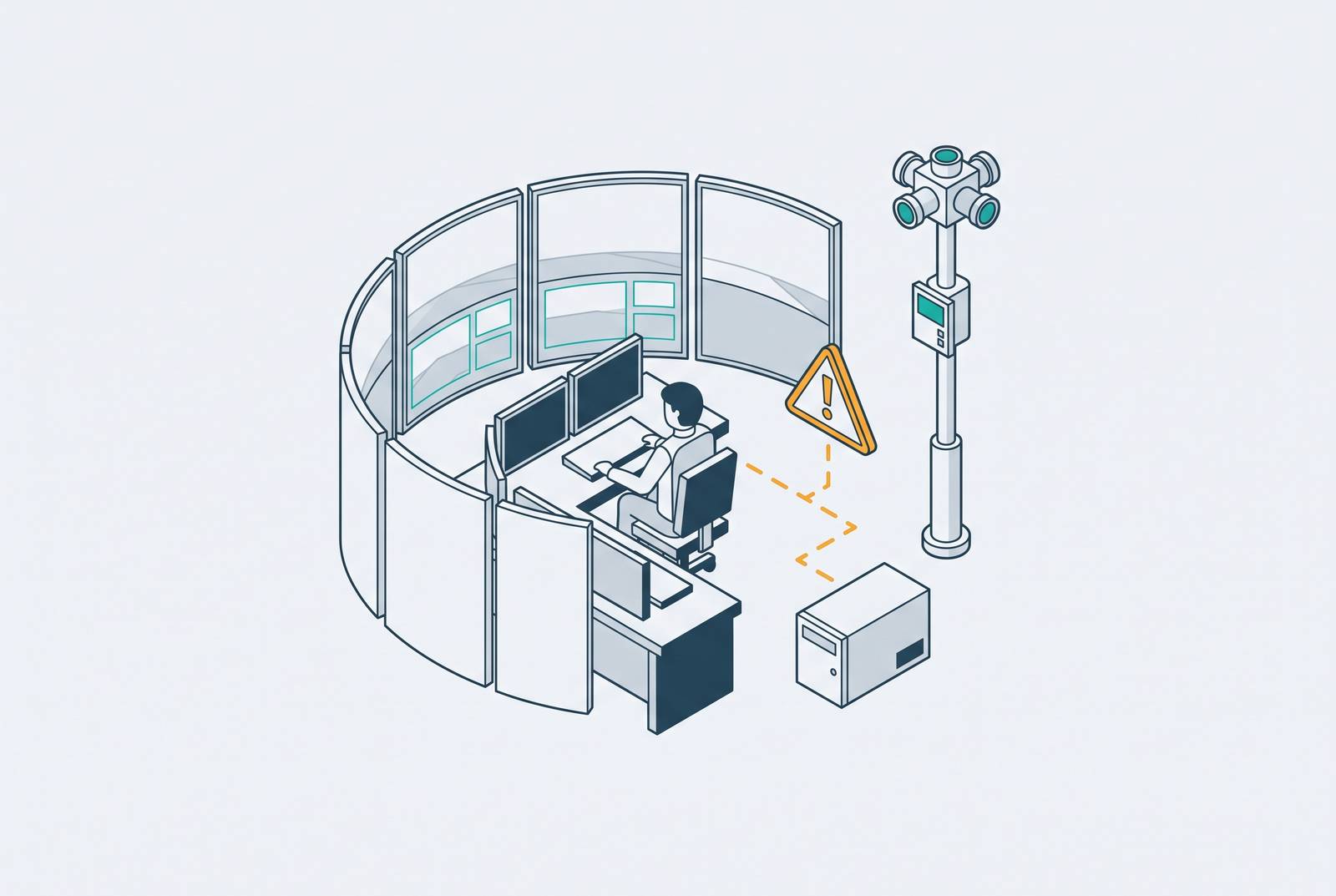
Remote tower contingency events expose a structural vulnerability in situation awareness (SA). The digital infrastructure that gives controllers their working picture can degrade or disappear precisely when they need it most. Safer contingency protocols therefore depend on understanding how that picture fails, how the failure affects controller performance, and who has authority to respond.
Why remote tower design makes SA loss a structural risk, not an edge case
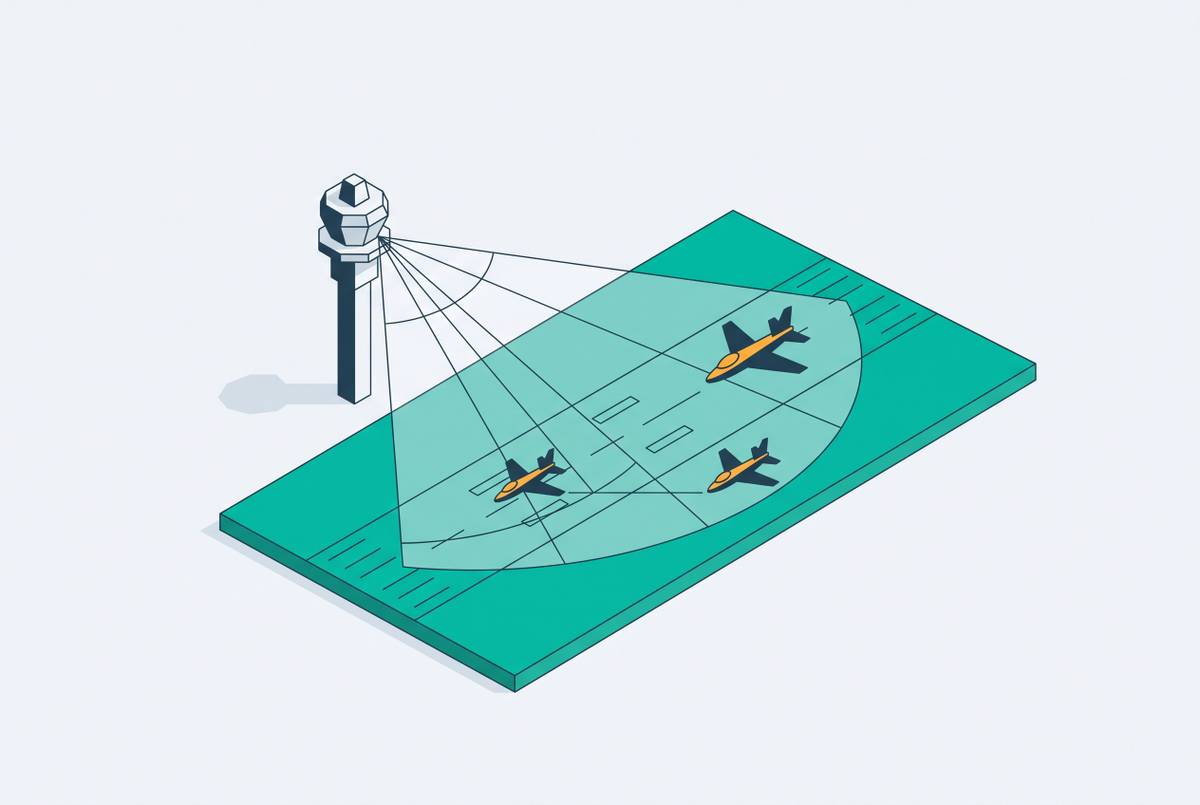
The technology that enables normal remote tower awareness is also the layer whose disruption can erase it. Cameras, sensors, data links, and integrated displays replace the controller’s direct out-of-the-window view with a digitized environment at an off-site Remote Tower Centre (RTC). The controller still needs to understand the aerodrome, but access to that environment now depends on a technology stack. Its availability is therefore a condition of awareness.
This dependence changes the nature of the fallback. A controller in a conventional tower can still see and hear the aerodrome when information from technical systems fails, as long as conditions at the site allow it. A remote controller cannot turn away from a failed display and look at the aerodrome itself. Any replacement for that view must also reach the controller through a technical system. Remote towers place another essential layer between the controller and the activity being controlled.
Pan et al. (2025) identify new challenges to controllers’ situational awareness in the digital and virtualized remote tower environment. Experience and knowledge of procedures still matter, but neither can bring back a lost source of information. Contingency design must therefore address the conditions under which awareness is possible and prescribe how a controller should act after it deteriorates.
How the remote tower's information architecture creates the conditions for sudden, total SA collapse
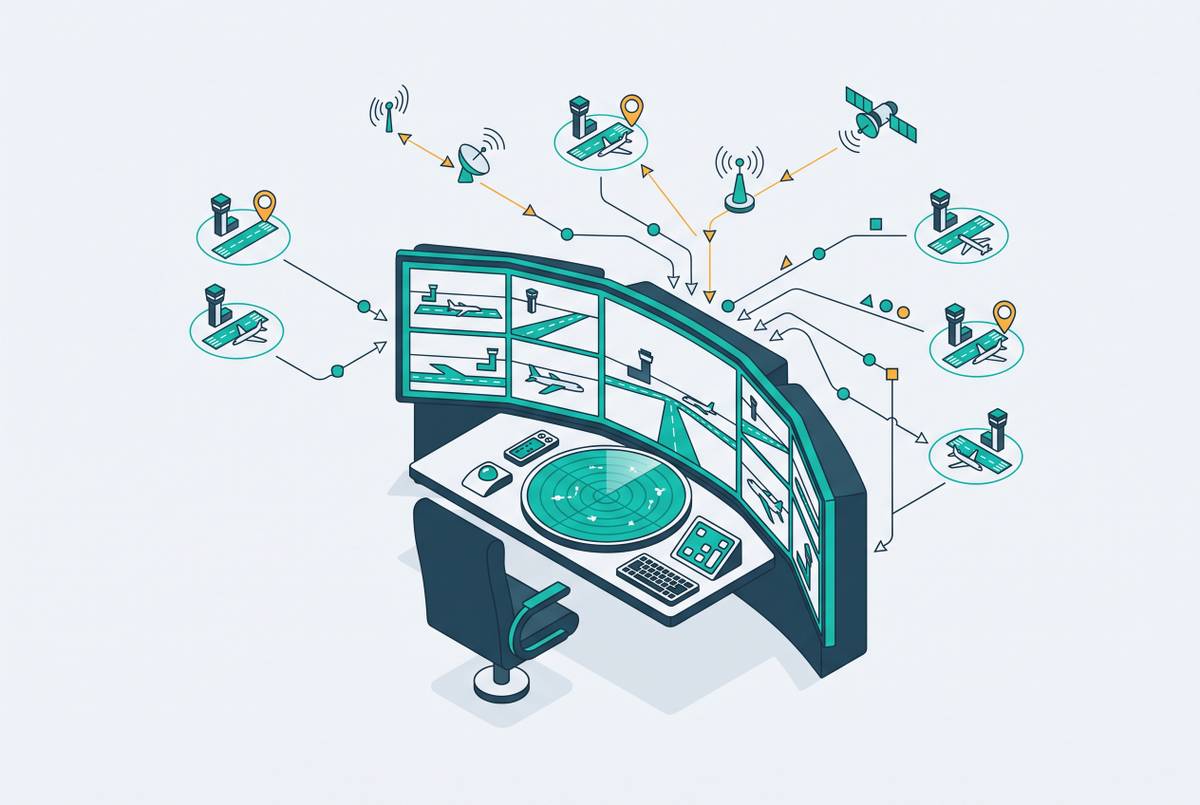
The remote tower picture is built from several layers of information. High-definition camera feeds provide the panoramic aerodrome view, while pan-tilt-zoom functions replace binoculars. Overlaid data labels, tracking highlights, and augmented display tools help the controller make sense of the images. Integrated radar, transponder, and weather feeds add information that the view alone does not give. Voice and data communication links connect the controller to aircraft and ground vehicles.
These layers appear distinct at the display, but their independence depends on the paths that carry them. In the shared-pipeline architecture described here, the data link between the aerodrome and the RTC is the common conduit. Conventional tower inputs, including direct vision, sound, radio, and radar, do not all depend on that conduit. At a remote tower, a failure of the shared path can remove several sources together. Diversity of information on a screen is therefore not the same as independence of supply.
The dependencies also extend from one display function to another. Camera feeds supply the scene on which visual augmentation depends, so losing the feeds deprives those tools of their live reference. Pan-tilt-zoom, overlay labels, and frame highlights can improve SA when the picture is sound. Yet an overabundance of tools without standardized operational guidance can increase workload and reduce SA. When the picture becomes partial, that complexity can become a cognitive liability.
A controller may have many ways to examine the aerodrome while still relying on one path to receive it. Where the layers share that path and depend on one another, disruption can cascade through the composite picture. The sophistication that enables remote control does not itself provide resilience against the loss of its foundation.
What a data link failure or RTC outage actually removes from the controller's picture
A data link failure removes information according to what depends on that link. Camera feeds may freeze or drop, taking away the controller’s replacement for the out-of-the-window view. Augmentation and overlays then lose the live scene that gives them meaning, or disappear with it. Radar and transponder feeds also degrade if they use the same route. Aircraft communications may also fail or degrade, limiting contact with pilots just when they most need to coordinate with the controller.
This sequence describes a chain of dependency. If the shared link fails outright, several layers can disappear together rather than giving the controller time to compensate for each loss. A failure can abruptly remove the visual and sensor environment on which control was based. A contingency procedure that assumes gradual degradation would not match that mechanism.
What remains is procedural knowledge and whatever radar or communication feeds use independent paths. Those surviving sources may support a response, but they do not automatically reproduce the normal operating picture. Their value depends on their actual independence from the failed infrastructure.
An RTC outage extends the loss from the connecting path to the facility providing the service. Technical failure, power loss, or severe weather affecting the RTC can interrupt service at every aerodrome managed from it. If the same RTC is also the designated contingency hub for those aerodromes’ alternates, those arrangements are affected too. A fallback location does not provide independent protection when it depends on the facility that has just become unavailable.
How Multiple Mode Operations concentrates contingency risk across aerodromes
Multiple Mode Operations (MMO) places two or more airports under the simultaneous control of a single ATCO at one RTC. This arrangement is a legitimate means of improving cost and workforce efficiency. Copenhagen Economics links the remote tower concept’s cost-saving potential to connecting more than one airport and operating multiple remote towers simultaneously. The safety question is narrower than whether that model has value. It concerns how concentrating service also concentrates exposure to disruption.
At the controller level, MMO adds demands on workload and the division of attention. A runway incursion, communications failure, or rapidly developing weather event at one aerodrome can demand the controller’s full attention. Attention committed there is then unavailable for maintaining the picture at the other aerodromes. SA can consequently degrade beyond the airport where the initial problem occurs, even while the other airports’ information feeds remain available.
An infrastructure contingency creates a different form of concentration. If the RTC becomes unavailable, all aerodromes dependent on it lose service together. The controller cannot resolve that loss simply by giving one airport priority, because reallocating attention does not restore the shared infrastructure. The event exceeds the scope of an individual traffic problem and becomes a coordinated service-loss problem.
MMO thus depends on two things that airports share, the controller’s attention and the technical support. A local event can strain the first, while an RTC event can remove the second across all the airports involved. MMO can still be acceptable with these risks, but its contingency plans must deal with both. The economic logic and the safety risk are structurally linked because both arise from concentrating resources.
Why responsibility for maintaining SA during a contingency event is structurally unclear in the remote tower model
Conventional tower contingency responsibility is locally anchored. The controller is present at the facility, can escalate to a supervisor on site, and activates procedures from a known physical position. That arrangement co-locates operational accountability with the problem. It gives the response a clear local centre.
The controller, technical infrastructure, aerodrome, and responsible authority may occupy different locations and work under different operational frameworks. During normal service, those boundaries may not obstruct the controller’s work. During a contingency, however, people may need to work across them to bring information back and decide how operations can continue. Existing procedures do not always define responsibility for that distributed response.
The practical gap concerns authority as much as technical recovery. A controller may face an undefined procedural response or unclear authority to depart from normal operations. The resources needed to restore service may belong to parties who are not yet aware of the disruption. Knowing that SA has degraded does not, by itself, establish who must act or what decisions the controller is authorized to make.
This is a structural lag between the operating model and its governance by Air Navigation Service Providers (ANSPs). Understanding the failure mechanism is necessary, but it cannot guarantee a response where responsibilities remain unresolved. Responsibility for the controller’s immediate problem must extend to the parties who can change the state of the service. Otherwise, a technical loss of information is compounded by uncertainty over the response.
What the cognitive science of SA degradation reveals about remote tower controllers under contingency stress
Remote tower controllers see the aerodrome through a display. That mediation introduces latency, framing effects, and dependence on display quality into the visual working environment. The controller must build an understanding of events from what the system presents. When its presentation deteriorates, the task changes even if traffic demands do not. SA therefore depends on both the available information and the controller’s capacity to interpret it.
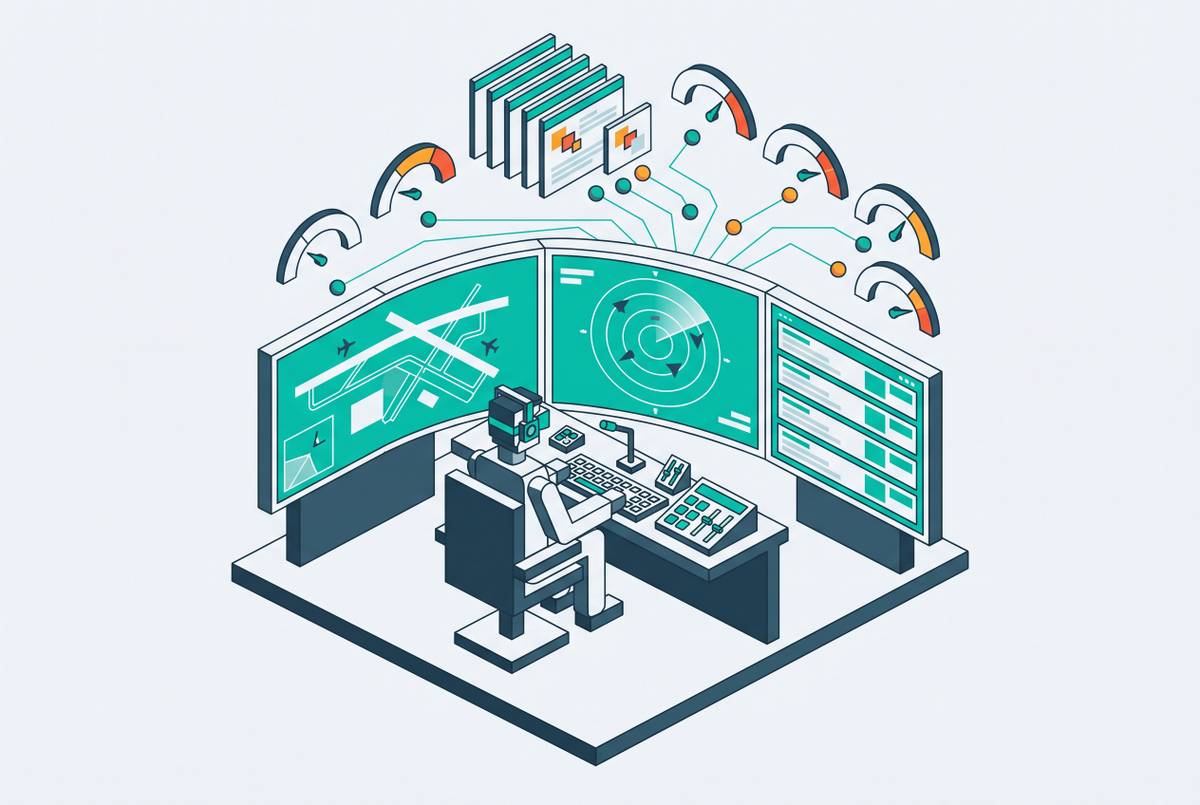
Pan et al. (2025) show that physiological and eye-tracking data can predict SA levels in remote tower controllers. Their study identifies gaze entropy and heart rate variability features, specifically the LF/HF ratio, as significant predictors. These findings support treating SA as a measurable, dynamic state rather than a fixed property of a qualified controller. They do not, by themselves, establish that a particular outage causes a specified physiological response or a given amount of SA loss. Prediction is evidence of a relationship.
A shared-link failure can remove inputs abruptly, while the controller’s understanding can also deteriorate incrementally as information quality declines. A controller already managing a busy picture has less spare capacity for diagnosing disruption and rebuilding an understanding from partial sources. The contingency concern is therefore not confined to the instant when a screen goes blank.
The event also imposes new tasks while removing the information needed to perform them. The controller must diagnose the failure, manage traffic already in the system, communicate through whatever capability remains, and activate contingency procedures. Stress adds to this burden, while heart rate variability provides a physiological measure relevant to the study’s predictive approach. The evidence does not justify treating that measure as a direct reading of operational safety. It does establish a basis for examining the interaction between controller state and a degraded information environment, precisely when workload rises and information becomes scarce.
What safer contingency protocol design requires, given these specific failure mechanisms
Each failure mechanism points to a corresponding requirement for contingency design. Shared-pipeline dependency requires independent fallback communication and surveillance paths that do not use the primary data link. Without that separation, contingency awareness rests on the infrastructure the event has disabled. Redundancy must therefore preserve access to information. Generic emergency procedures inherited from conventional tower practice cannot substitute for that architectural requirement.
When responsibility is shared, roles and handoff procedures must be clear before an event occurs. Those procedures must state who leads the response and how responsibility passes from one party to another. MMO plans must likewise treat multi-aerodrome service loss as one event with a shared response, with local emergencies handled as parts of that event.
The cognitive mechanism requires equally specific treatment. Display degradation protocols must state what controllers should do, and stop doing, when their information becomes partial. That guidance reduces the burden of deciding how to work with a damaged picture while also managing traffic. Pan et al. (2025) offer evidence on which to build SA monitoring tools that could show supervisors SA levels in real time and help them step in when needed. Their predictive findings support work on those tools, but do not guarantee how well the tools would work during a contingency.
These requirements apply whether digital ATC serves a major international hub or a small uncontrolled field that has never had ATC coverage. A single-airport deployment still depends on a link and system whose loss can leave pilots without service. Redundant paths, pre-validated fallback procedures, and SA monitoring therefore belong in the design from the outset, rather than as refinements after primary operations begin. Understanding the mechanisms of SA loss makes it possible to write protocols that interrupt them. The quality of that contingency design separates a digital tower that genuinely extends safety from one that relocates the risk.