Multi-Airport Tasking and Controller Workload in Hub Remote Facilities
Remote towers expand controller capacity by managing multiple airports from a single hub.

Hub remote facilities make multi-airport tasking possible by sharing the work as well as moving controllers away from tower windows. Their promise rests on a balance of supervisor-led assignments, airport-specific certification, and digital tools that support situational awareness. Understanding that balance is essential to judging both the coverage these facilities can provide and the limits that technology alone cannot remove.
The structural problem that hub remote facilities are designed to solve
The U.S. controller shortage is a structural constraint on airport coverage. Between February and May 2025, there were 334 "ATC zero" events nationwide, when contract towers had to shut down for lack of controllers. Those interruptions show how directly a shortage can become a loss of service. Low-activity airports bear that pressure because their need for coverage does not disappear when traffic is light.
At the same time, total system flights have grown, leaving fewer certified controllers to manage more traffic. The traditional one-tower, one-controller model is therefore getting harder to maintain at small airports. A controller assigned to a quiet field cannot make that posting more productive merely because another airport needs service. The vast majority of U.S. airports have no control tower, so pilots must self-separate in uncontrolled airspace. Extending coverage requires moving beyond treating every airport as an isolated staffing commitment.
What a hub remote facility actually is and how it differs from a single remote tower
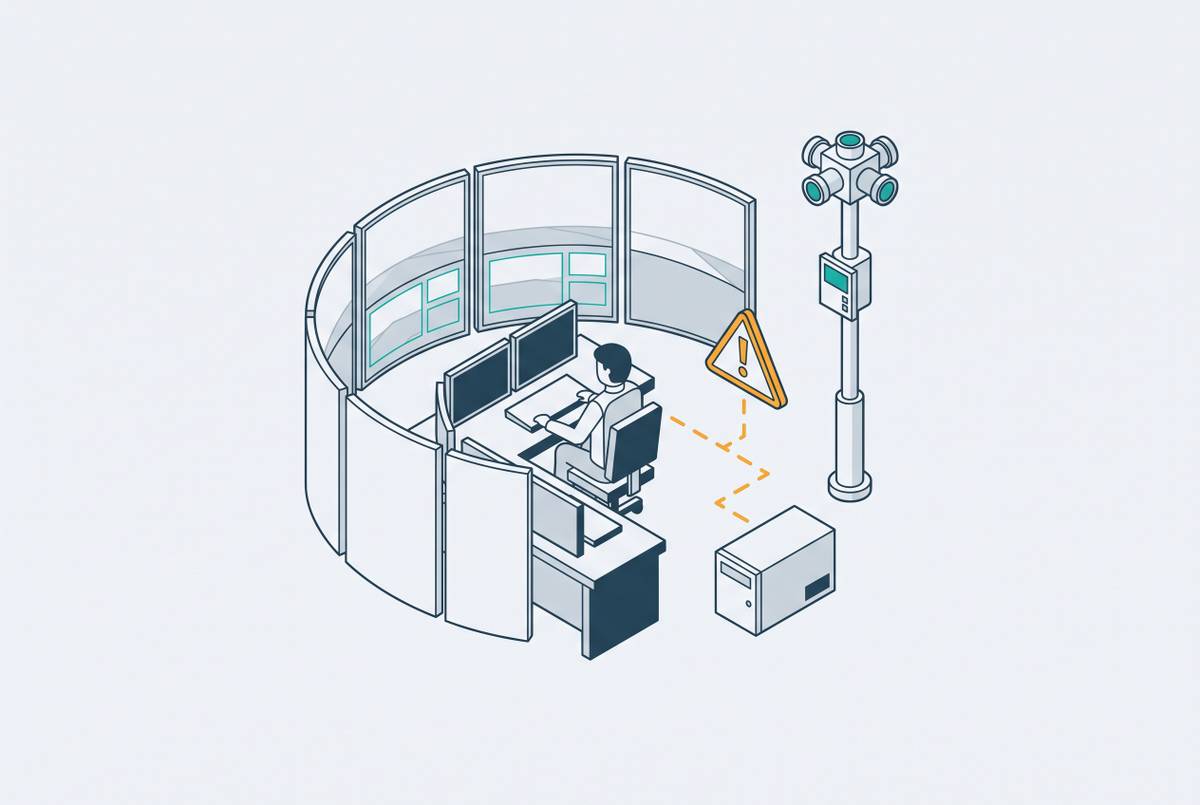
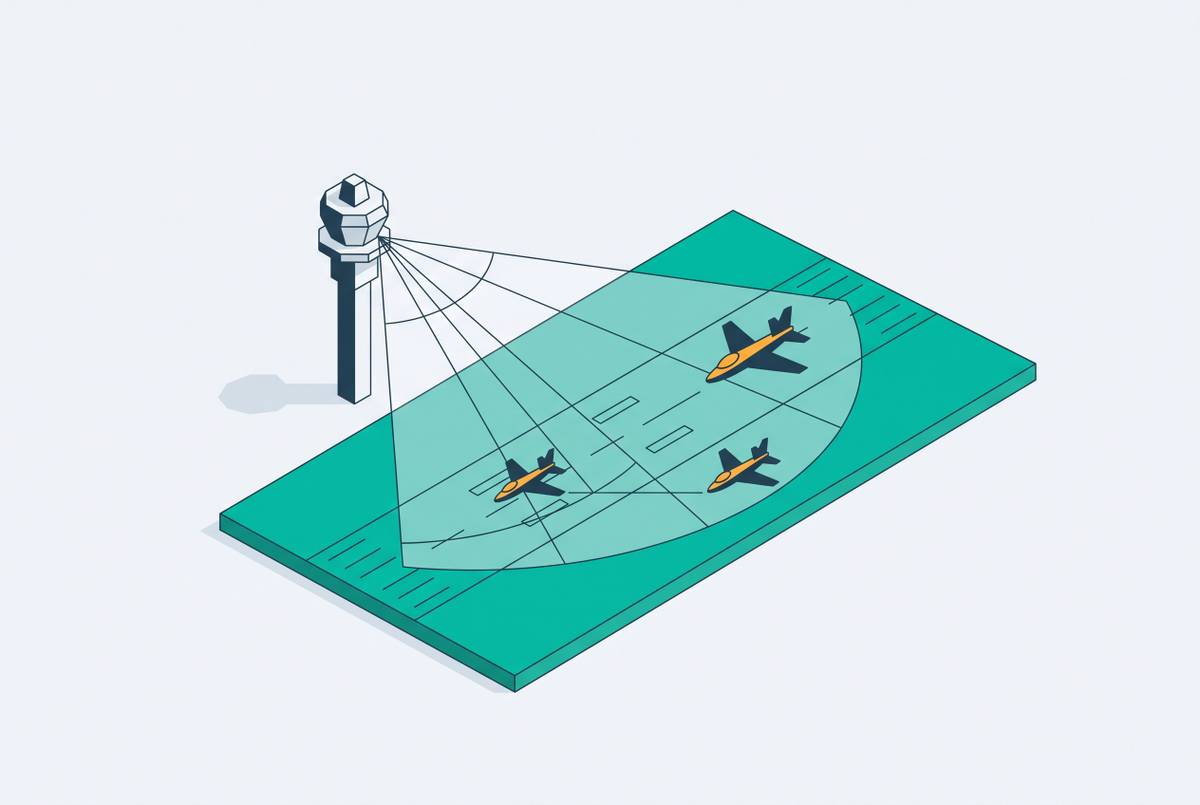
DLR's Remote Tower research describes a Remote Tower Centre as a place where sensor data from several airports comes together. A hub remote facility is the purpose-built control room that receives those feeds and presents them to controllers. Optical sensors replace the direct view through the tower window, so the controller need not sit at the airport. The traffic procedures are the same as in traditional tower operations. What changes is the controller's location and the means of delivering the operational picture.
The distinction between a single remote tower and a hub is the scope of the assignment. In the Single Remote Tower concept, one controller manages one airport from a remote location. In the Multiple Remote Tower concept described by DLR, a controller can cover several airports, though only one at a time. Certification for multiple airports allows that controller to work across the centre's airport pool. Control of an airport can also transfer to a second controller as demand shifts, making the pool more productive without reducing its size.
How workload is distributed inside a hub facility and what the supervisor role makes possible
The supervisor is the central mechanism that turns a shared room into a shared operating resource. In DLR's Multiple Remote Tower research, the supervisor watches the workload across the facility and assigns airports to controllers who are available. The model does not simply ask one person to watch every airport at once. It separates responsibility for the facility-wide picture from responsibility for active control at an individual airfield. That division is the conceptual core of hub workload management.
DLR researchers are building digital planning tools to help the supervisor see what is happening across airports. Those tools are meant to keep the full operational picture in view while each controller focuses on the airfields they are assigned. When demand changes, control of a particular airport can pass to a second controller. This provides a way to absorb traffic spikes without requiring one controller to conduct simultaneous active communications at two airports.
Multiple-airport certification makes that flexibility useful during quieter periods as well. A controller can become productive at a second airport when the first goes quiet. Enhanced displays support this allocation by reducing the effort needed to identify traffic and understand conditions. DLR identifies improved situational awareness as a way to reduce workload.
What the technology layer adds beyond the camera feed
The panoramic video display provides the visual foundation, but it is not the whole working interface. DLR's Remote Tower research describes pan-and-tilt zoom cameras that let controllers bring a particular area of the airport into sharp focus. Infrared and low-visibility sensors extend the view into darkness and fog, where unaided vision in a traditional cab can be challenged. These functions give the controller different ways to inspect the same operating area.
Aircraft identification tags show which aircraft is which directly on the visual feed. That overlay reduces the cognitive work of matching a strip to a physical aircraft on the apron. Radar, weather, and transponder data are also integrated into the display. The controller can therefore use a single interface for information that a traditional tower distributes across separate screens, radio, and the window. This consolidation supports the workload model by reducing cross-referencing within an airport assignment.
The interface must also support recognition of abnormal events. DLR's research laboratory can simulate gear problems, deviations from clearances, and engine fires. These scenarios allow researchers to test whether the digital presentation supports early and reliable detection. Simulation is consequently part of validating new procedures before live deployment. It tests the relationship between the display and the controller's response, which a clear camera image alone cannot establish.
What operational deployment looks like: the Avinor and Fintraffic cases
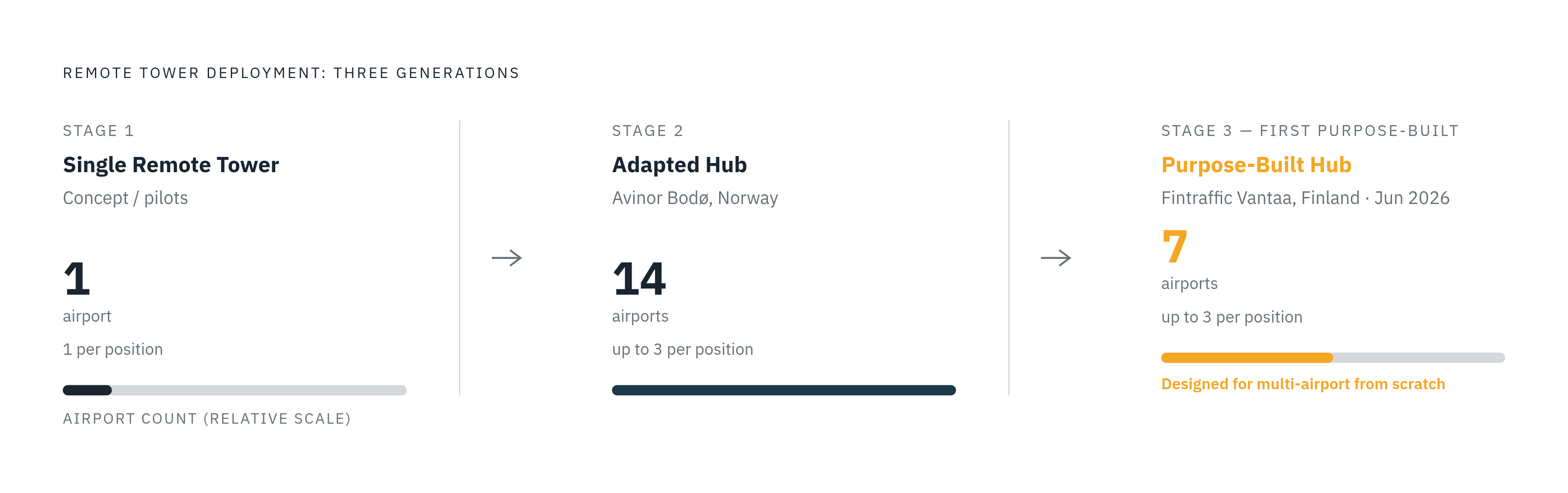
Avinor's Remote Tower Centre in Bodø oversees 14 regional airports, giving the hub model a concrete operating scale. Its system has been upgraded so that each work position can operate up to three airports at the same time. In February 2026, Avinor began a trial of multiple operations that enabled one AFIS representative to handle more than one airport from the same working position. The trial used four selected airport pairs, namely Rørvik–Namsos, Mehamn–Hasvik, Vardø–Berlevåg, and Røst–Svolvær.
Avinor's deployment makes it the first company in the world with multiple operations for digital towers in live service. Its stated aim is to operate a substantial number of towers remotely from Bodø by 2027. A position capable of operating several airports does not, by itself, establish how simultaneous demands are managed. The AFIS trial is evidence of a specific multiple-operations deployment, rather than a reason to treat every remote service as an identical control task.
Fintraffic ANS represents a different stage of development. In June 2026, it signed a contract for what will be the world's first digital remote tower centre purpose-built specifically for multi-airport operations. Controllers at the Vantaa centre will be able to manage up to three airports from a single work position. The centre will remotely control seven airports, including Mariehamn, Turku, Vaasa, Kittilä, Ivalo, Kuusamo, and Oulu. Whereas Bodø evolved into multiple operations, Vantaa is being designed for that mode from the ground up. Together, the cases show a progression from adapting an operating hub to building around multi-airport workload from the outset, although Vantaa's planned capacity is not yet an operating result.
Where the U.S. stands and why the deployment picture is more complicated
The United States has both a coverage need and early technical evidence, but its deployment path remains uneven. FAA Administrator Bedford said in December 2025 that work on remote tower systems was moving ahead in Bartow and Winter Haven, Florida. He highlighted the ability of high-definition camera arrays to expand controller visibility and create new pathways for staffing retention. These projects indicate movement toward practical use. They do not yet represent the scale of hub operations demonstrated at Bodø.
The FAA issued a request for proposals in April 2026 for remote air traffic control tower systems over five years. Its September 28, 2026 memorandum, PGL 26-06, also clarified the funding position for Digital Tower systems. The memorandum states that these systems have been eligible under the Airport Improvement Program since the 2018 Reauthorization Act, with additional requirements added by the 2024 Reauthorization Act. That clarification removes a policy ambiguity that had slowed airport operators. Procurement and funding rules thus affect deployment.
The airport-level economics show what delay can mean. Johnston Regional Airport and Raleigh Executive Jetport in North Carolina both have FAA approval for ATC towers that are expected to cost tens of millions each if built in the conventional way. The Johnston Regional director estimates that a digital remote tower would cost roughly half as much. That estimate illustrates the potential difference in construction cost, rather than establishing a universal price for remote service. Regulatory caution and procurement inertia can nevertheless leave airports facing conventional capital costs while the alternative remains difficult to deploy.
The genuine limits and objections that the engineering cannot fully resolve
The workload design answers an important objection, but it does not answer every objection. In DLR's model, multiple-airport certification lets one controller cover several airports one at a time. Alertness is a different matter. Moving to a desk-based digital environment raises genuine questions about maintaining the focus and peripheral awareness developed in a physical cab, and training and simulation can address those questions without eliminating them.
NATCA president Nick von Schoenberg has described the remote tower model as potentially providing "equivalent service but not necessarily safer travel". That distinction separates service equivalence from a claim of safety improvement. It also signals labor concerns that cannot be resolved by demonstrating camera quality or display integration. Adoption requires honest engagement over how controllers work, how assignments are managed, and what counts as adequate staffing. Union skepticism is therefore a substantive operating consideration.
A remote facility's continuity depends on the integrity of camera arrays, data links, and networks in ways that a cab with a window does not. Better imagery does not remove those dependencies. Strong cybersecurity, robust training, and transparent oversight are therefore conditions of responsible adoption. The digital system must be evaluated as an essential service chain.
Staffing policy also shapes whether efficiency leads to wider coverage or lowers only the number of controllers required on paper. The FAA's 2026–2028 Workforce Plan lowered its certified controller requirement, citing "modern staffing models and scheduling tools". Critics note that this reduction coincides with a significant staffing shortfall. Their concern is that efficiency language may rationalize understaffing. The hub model does not invalidate that concern, because making a controller pool more productive and deciding how large that pool should be are separate judgments.
Why the hub model matters specifically for the airports that currently have nothing
The strongest case for hub facilities concerns airports that have no tower coverage to begin with. The ATSB identifies insufficient communication between pilots operating in the same area as the most common cause of safety incidents near non-controlled aerodromes. NASA's technical report on Part 139 airport safety says that all fatal runway incursion accidents in the period it studied happened at non-Part 139 airports without control towers. These findings focus attention on the coverage gap, though they do not establish a measured safety benefit for remote towers. NASA also cautions that voluntary ASRS reports cannot establish the prevalence of a problem across the system.
Lower construction costs reduce the capital barrier, while shared staffing makes controllers productive across several low-activity airports. The same infrastructure can also support nighttime service and backup during outages, extending coverage beyond the hours a conventional tower might operate. The benefit is not simply a cheaper tower, but a service model that can reach airports otherwise left without one.
The FAA's April 2026 request for proposals for up to 50 remote tower units and PGL 26-06's clarification of AIP eligibility provide a clearer procurement and funding path. The remaining task is to use that path without weakening the staffing, training, reliability, and labor conditions on which responsible deployment depends. For airports that currently have nothing, the barrier is no longer an unexplained technical concept, but the policy and operating decisions required to put it into service.