LFV Sweden Remote Tower Program Technical Performance Review
Sweden's remote tower program proves digital ATC matches conventional safety at lower cost.
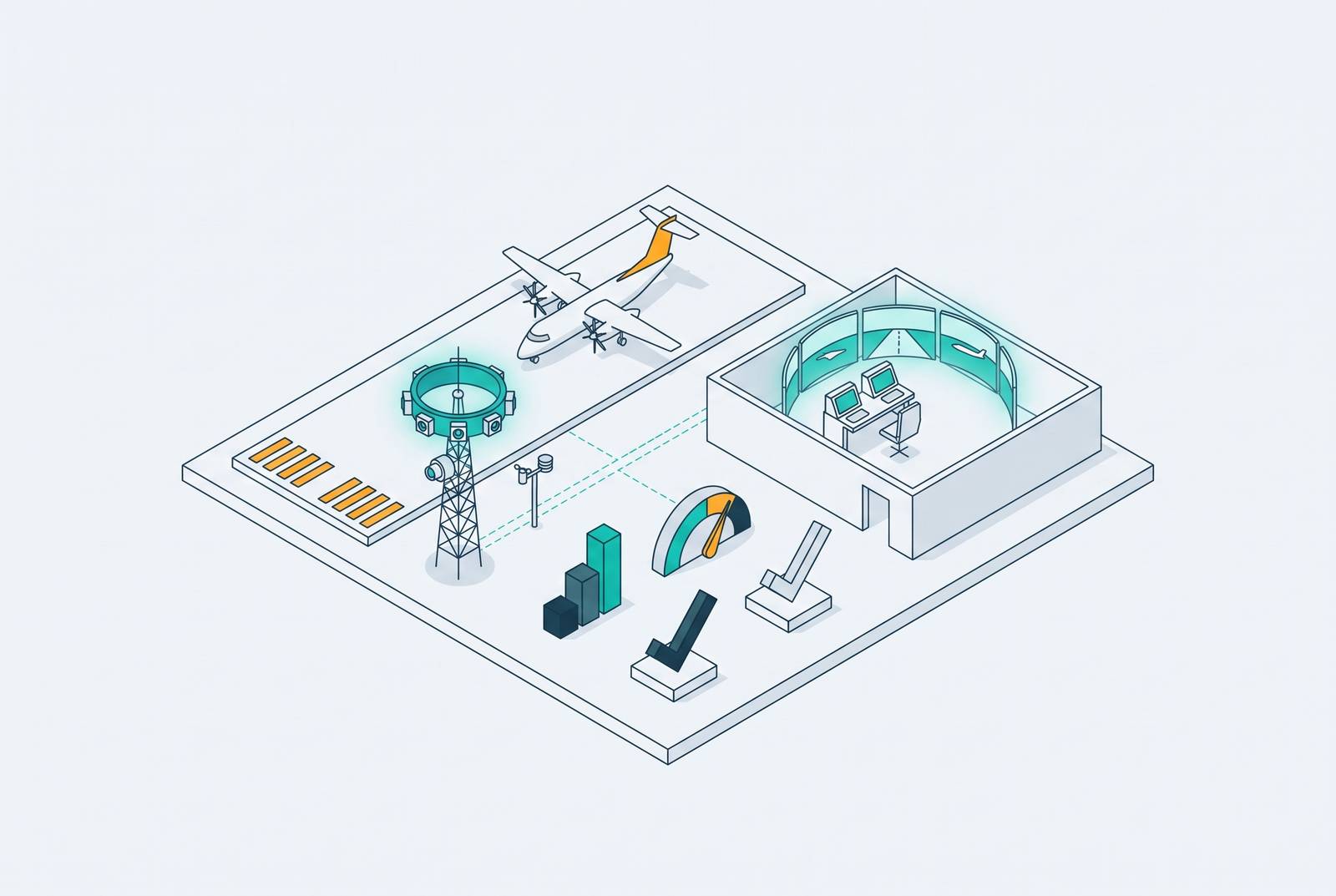
LFV Sweden’s remote tower program shows that digital ATC can be as safe and efficient as a conventional tower in live operations, at costs that suit smaller airports. This technical performance review examines the operational evidence behind that conclusion. Its central distinction is between established remote control of individual airports and the more demanding, still-developing model in which one controller manages several airports simultaneously.
What LFV's remote tower program is and why its performance record is worth examining
LFV, Sweden’s state-owned air navigation service provider, was the first organization in the world to offer remote air traffic services. Its program is the world’s longest-running operational example, with experience extending from the mid-2010s through years of service at multiple airports. That history gives it unusual evidentiary depth. Live operations test the service against day-to-day demands over time in ways that a simulation or a limited demonstration cannot.
LFV’s organizational profile identifies four airports controlled remotely from RTC Stockholm, namely Kiruna Airport, Åre Östersund Airport, Umeå Airport, and Malmö Airport. Their inclusion extends the record beyond the circumstances of the first deployment. What does that record establish about safety equivalence, efficiency, controller workload, and scalability, and where does the evidence remain incomplete?
How remote tower technology works at LFV — the hardware, software, and operating model
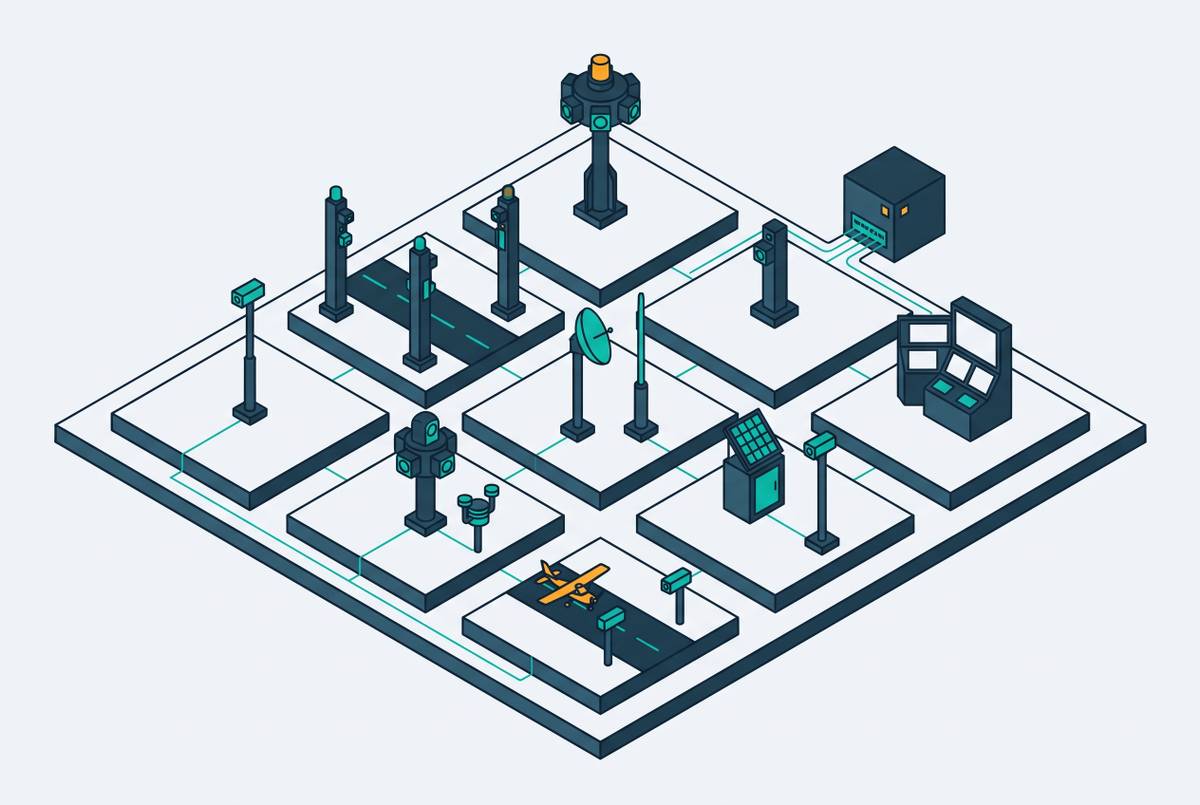
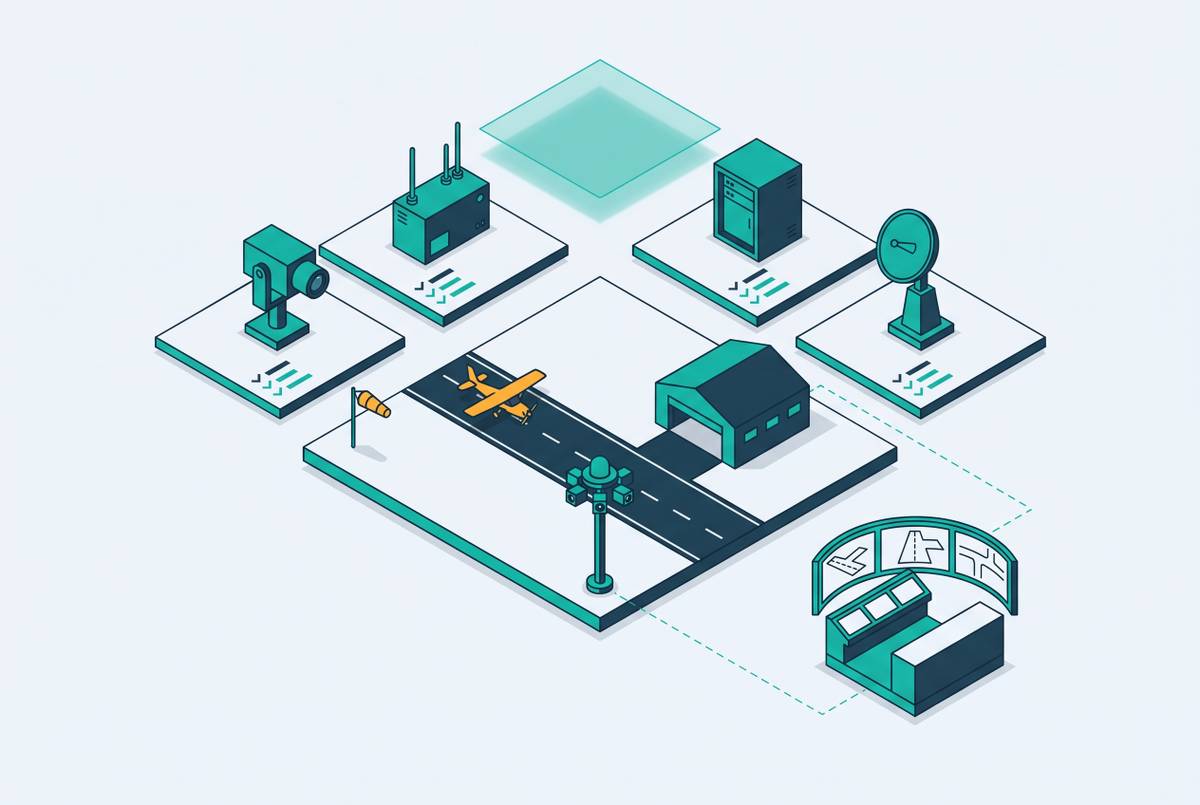
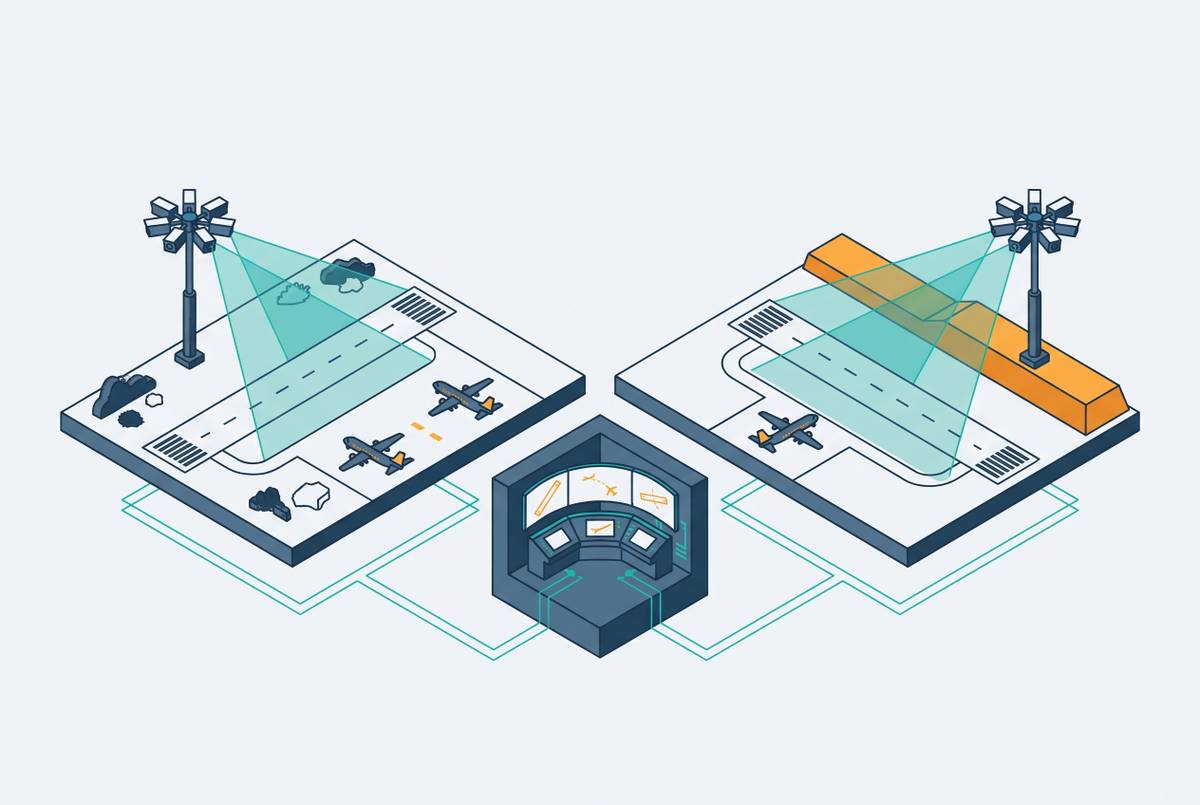
The remote tower centre replaces the physical cab as the controller’s workplace. Panoramic screens present a continuous 360-degree view assembled from ultra-high-definition cameras, optical zoom sensors, and infrared lenses on strategically placed masts. The airfield remains visible, but through a digital interface. Software overlays flight data, meteorological updates, radar tracks, and aircraft callsigns on the live video, bringing together information otherwise gathered from separate instruments and direct observation.
Infrared and optical zoom let controllers see more than the unaided eye can in darkness and low visibility. These capabilities change the information available to the controller. Their value must therefore be assessed as part of the complete operating system, including the human interpretation of the display.
LFV’s Remote Tower Services page describes an operating model in which one or numerous towers can be run from another location irrespective of distance, with flexible “on demand” opening hours. The FAA’s Digital Tower Systems page also describes a change in terminology from “Remote Tower” to “Digital Tower.”
How LFV built the program's evidentiary foundation, from first approval to operational launch
LFV received operational approval for its first Remote Tower Centre in Sundsvall by the end of October 2014. The centre served Örnsköldsvik Airport over 150 km away, with 24-hour operations beginning in April 2015. Approval preceded the live operational record. The subsequent service therefore tested an already developed safety case rather than substituting operating experience for pre-operational validation.
LFV’s services page states that approval rested on more than 250 validation, safety, human factors, system descriptions, and reports. Close interaction with the National Supervisory Authority helped bring these elements into an integrated evidence base. This process looked at how equipment, people, and procedures worked together, with camera performance as one part of the proof that the service was safe.
LFV describes the path from idea to approval as having been completed “in record time.” It also states that its accumulated work can help new operators reduce time-to-operations by at least two years compared with starting from scratch. That is a claim about the value of reusable experience, with local approval still required.
The one-year safety verdict at Örnsköldsvik — what the first sustained operational data showed
After one full year of H24 remote tower operations, Robert Gyllroth, CEO of Örnsköldsvik Airport, stated that “there is no detectable difference since the switchover.” He added, “Safety and efficiency are as high as they were with conventional air traffic control.” The assessment’s significance rests on the airport operator’s experience of the service at the facility under remote control.
By then, the centre had accumulated thousands of recorded operational hours. That provided a sustained operational basis for the assessment, rather than an impression drawn from the first days after commissioning. In a safety-critical service, no detectable difference is a demanding result. The initial objective was to preserve the established standard while changing how the service was delivered.
The statement supports equivalence in safety and efficiency but does not establish performance under every possible configuration of remote operations. International delegations visited during the first year because Örnsköldsvik offered a live proof-of-concept to study, but that interest is distinct from the operational finding itself.
Scaling from one airport to four — how the RTC Stockholm expansion extended the evidence base
LFV’s services page records the commissioning of RTC Stockholm on June 1, 2021, with Kiruna Airport as its first connection. Åre Östersund Airport followed on December 1, 2021. Umeå Airport and Malmö Airport were connected subsequently.
Each connection brought experience with different geography, types and levels of traffic, and distances from the control centre. Malmö also broadened the demonstrated scope to a commercial airport of meaningful scale, beyond the low-traffic regional setting often associated with remote towers. This enlarged the basis for assessing repeatability. It did not, by itself, provide a separate published safety-equivalence measurement for every airport.
LFV’s organizational profile says that all four airports are still controlled from Stockholm, where the network runs as an ongoing service. LFV identifies cost-efficient provision, flexible opening hours, and more efficient use of staff and infrastructure through co-location among the architecture’s operational benefits. It also identifies an upgrade path from AFIS to full ATC. These benefits concern service organization as well as the visual technology.
The controller workload question — what the multi-airport model reveals about human performance
Multiple remote tower operations, or MRTO, introduce a separate question from whether remote control works at one airport. A controller can hold certification for several airports and transition between them from a single workstation. Sequential control is not the same as simultaneous control. In some configurations, controllers handle more than one airport at once, while traffic procedures remain unchanged from traditional tower operations.
LFV program manager Lindsey Martenez Hermosilla has described the development as requiring consideration of airport complexity, traffic type, and individual controller workload. She frames it as “not only a work environment issue, but also an aviation safety issue.”
Research into workplaces supporting simultaneous management of two or three airports marks the frontier of the program’s evidence. The existence of the technology does not establish the safe workload for every combination of airports. At the same time, digital working environments have proved attractive to younger prospective controllers, and increased situational awareness has been associated with reduced workload and stress. Those workforce benefits can coexist with unresolved questions about simultaneous multi-airport responsibility.
What the safety record gains meaning against — the documented risk at uncontrolled airports
The comparison with conventional towers establishes technical credibility, but uncontrolled airports provide a different policy context. At those facilities, the alternative may be no ATC coverage. The baseline is therefore different for the adoption decision. Equivalent remote service could address an absence of control.
Severe runway incursions in the U.S. rose 44 percent in 2025 even as the total number of incursions fell slightly. The Department of Transportation Office of Inspector General found that the FAA “lacks an integrated approach for analyzing runway incursion data and identifying risks.”
Fatal runway incursion accidents have concentrated at non-towered airports, while near-collision reports cluster disproportionately close to non-controlled aerodromes. Dangerous encounters also occur more often when pilots have received no prior radio warning of other traffic. ATC addresses that information gap, including when delivered remotely. These findings establish the relevance of LFV’s record to coverage policy, but they do not demonstrate that its system would have prevented particular U.S. incidents.
Why the economics of small airports make the LFV model's cost structure a deciding factor
Most regional airports run at a loss, and the smallest often earn too little to pay their running costs without subsidies. Deployment depends on the cost of providing the service. A model requiring a separate staffed tower and dedicated infrastructure at every airport can be difficult to sustain where traffic is sparse.
LFV’s services page positions co-location as a cost-efficient alternative because it reduces staffing redundancy and allows opening hours to follow customer requirements. Remote provision also avoids the need for new physical tower construction or costly refurbishment. The economic change is structural, separating the airport receiving control from the dedicated building traditionally required to deliver it.
Long-term federal grant commitments put added pressure on small U.S. airports by requiring them to stay open for extended periods even when they lose money. LFV’s path from Flight Information Service, or AFIS, to full ATC without a new physical facility also supports incremental expansion of coverage. These features explain the model’s relevance to smaller airports, although they do not supply a universal deployment price or savings figure.
The legitimate objections to scaling remote towers and how the LFV record engages them
Network reliability and latency, cybersecurity, and human factors remain substantive objections to wider deployment. Remote control relies on data links between the airport and the centre, so it can fail in different ways from direct observation in a physical cab. A network disruption or cyberattack can interrupt the visual and communications connection. LFV addresses this dependency through redundant fiber-optic transmission and backup systems, but redundancy does not make the attack surface identical to conventional ATC.
Human performance requires its own continuing scrutiny. LFV continues to study how controllers maintain situational awareness through screens under different operating conditions and over long duty periods. The cautious approach to MRTO is particularly important because evidence from one-to-one remote control cannot automatically validate one-to-many operation.
Regulatory portability is another unresolved constraint. International authorities, including the FAA, have been slow to develop standardized certification frameworks, delaying deployment even where technical equivalence has been demonstrated. LFV’s validation record narrows the uncertainty, but its approvals apply to its operating environment. New deployments must establish their own cases for the infrastructure, procedures, workload, and regulatory setting involved.
What the LFV record means for airports operating today without any tower coverage
Airports that cannot justify a conventional tower can look to LFV for experience from a working service. Its record supports remote provision at the conventional service standard, while some digital capabilities extend what controllers can observe. The strongest finding is demonstrated service equivalence. Claims about controlling more airports at once must stay within what the ongoing studies of workload and approval can support.
LFV’s documented capabilities fit several requirements of smaller airports, including round-the-clock SAR and medical evacuation support, flexible opening hours, AFIS-to-ATC upgrades, and low-cost contingency provision. Digital towers also create enabling infrastructure for UAS integration into national airspace systems.
The FAA Reauthorization Act of 2024 Section 621 authorized remote tower program development, although implementation has lagged behind the safety urgency described in the incursion record. For airports where a physical tower is financially unattainable, the practical comparison may be remote control against continued absence of ATC. LFV makes that comparison concrete.
Sources
- LFV Sweden - CANSO
- Real-time processing of high-resolution video and 3D model-based tracking for remote towers
- ASRS Database Report Set Non-Tower Airport Incidents
- (PDF) Human performance assessment of a single air traffic controller conducting multiple remote tower operations
- Multi Remote Tower - Challenge or Chance? An Empirical Study of Air Traffic Controllers Performance