Vendor Capability Audit of Remote and Virtual Tower Systems Targeting Uncontrolled U.S. Airport Segments
A vendor audit must test cost, fiber, and FAA qualification together.
Digital ATC towers offer non-towered airports a path to controlled operations without constructing a traditional tower. Affordability, however, depends on cameras, fiber infrastructure, FAA qualification, staffing, and operating costs. A vendor capability audit must therefore test whether a system can close an airport’s safety gap within what it can spend and how it must operate.
Why the uncontrolled airport safety gap is structural, not statistical
Aggregate incident counts can suggest stability while obscuring where the most severe outcomes occur. Until March 2026, every fatal runway incursion accident in recent years had happened at a non-Part 139 airport without a control tower. A fatal incursion at the towered, Part 139-certificated LaGuardia Airport that month broke the pattern. Low-frequency, high-consequence risk requires an assessment of event counts and the conditions behind those events.
Pilot deviations account for approximately 62% of all U.S. runway incursions, but the category has a different meaning at uncontrolled airports. Without a controller, there can be no controller-generated operational incident, so pilot deviation becomes the near-universal default classification. That classification alone cannot explain where the system falls short. The February 19, 2025, midair collision between a Lancair and a Cessna 172 at Marana Regional Airport, Arizona, also demonstrates that collision risk at uncontrolled fields is not theoretical, although a midair collision is distinct from a runway incursion.
The Flight Safety Foundation 2025 Safety Report places these risks within a broader mismatch between growing airspace demand and the systems managing it. Operations are becoming more complex faster than those systems can handle, so how well they worked in the past does not show how well they will work in the future. That changes the standard for a vendor audit. A proposed system must add the missing safety functions as well as make traffic information easier to see. The oversight finding that the FAA lacks an integrated analytical framework adds a further limitation, because the regulator may not fully see what is driving the trend.
What the self-separation model at non-towered airports actually asks of pilots
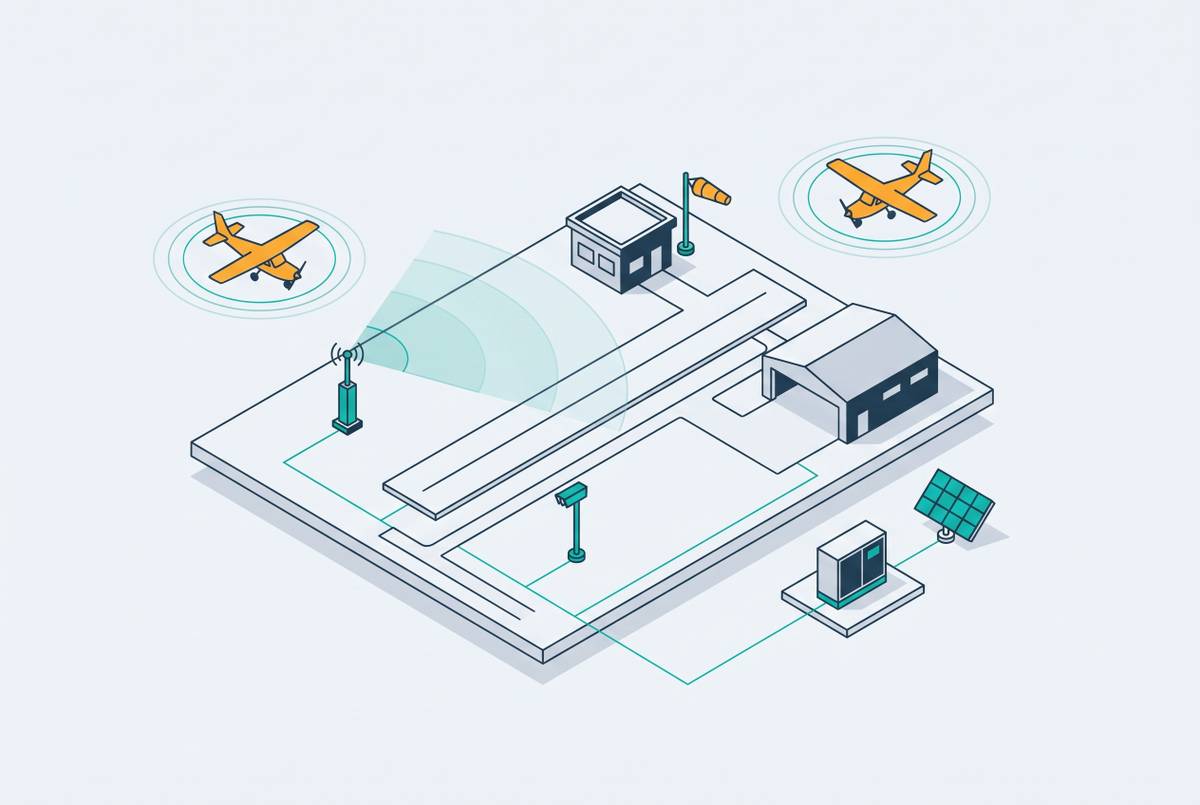
At non-towered airports, runway separation depends on pilots following established procedures, making CTAF radio calls, and watching for traffic. These actions lack external verification and the intervention of a controller. A missed call, an unfamiliar pattern, or a departure from standard procedures has no independent authority positioned to catch it.
Airport familiarity makes this dependence particularly consequential. Non-towered fields attract a disproportionate share of transient pilots unfamiliar with local patterns, while poor airport familiarity is one of the three leading drivers of runway incursions. The other two are failure to comply with ATC instructions and nonconformance with standard operating procedures. Without ATC instructions, the first category cannot occur. The remaining two operate without the controller’s compensating check. Adding awareness technology alone therefore is not equivalent to providing ATC service.
What a digital ATC tower system actually does and what it replaces
A Digital Tower System replaces the traditional tower’s cab-window view with optical sensors and displays. Controllers use what those sensors show to provide ATCT services without being at the airport. The controller remains central to the service. The technology changes how that controller sees the airport, rather than replacing air traffic procedures with a new form of pilot self-separation.
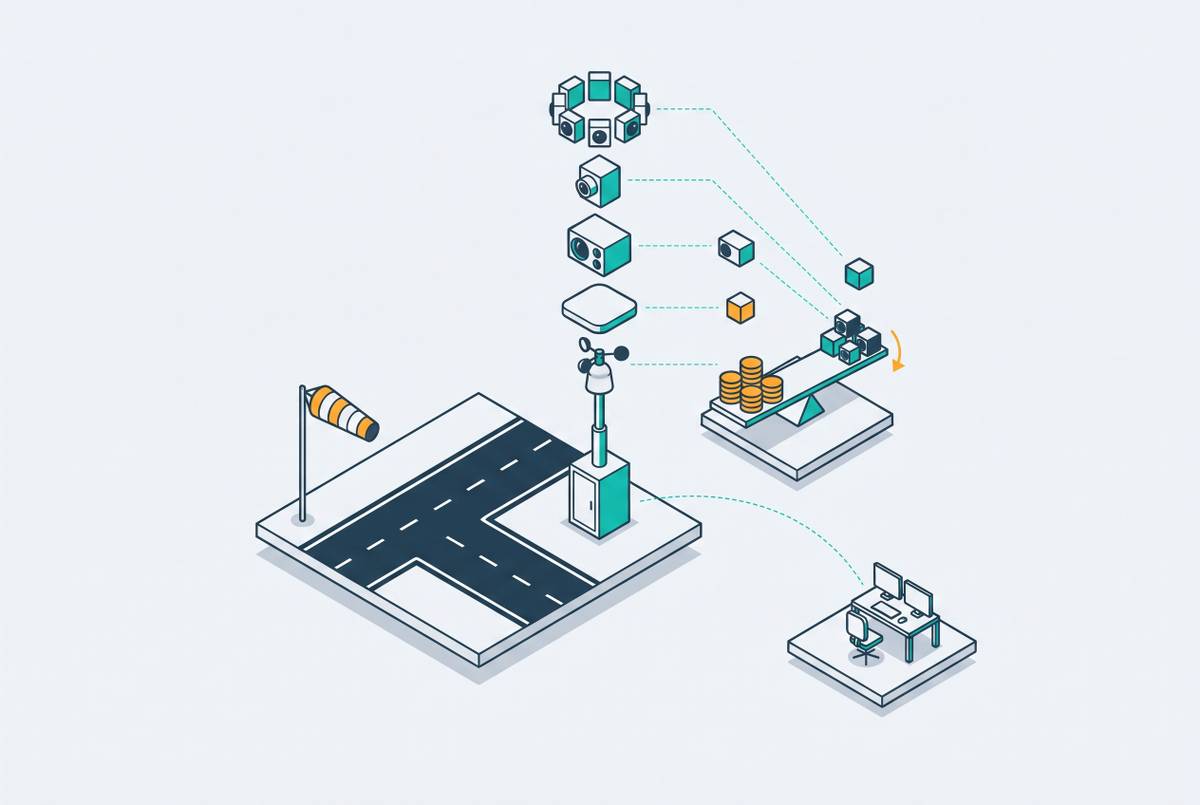
The sensors may include optical day/night cameras and infrared or thermal cameras. Infrared imaging supports visibility at night or in poor conditions, while enhanced zoom can help detect wildlife on runway surfaces that the naked eye would miss. These capabilities extend the visual information available from a conventional cab. Their practical value depends on whether they give controllers the information needed for the airport’s actual operating conditions.
For pilots, radio communication and phraseology are the same as at a staffed physical tower. Moving from uncontrolled to controlled status introduces controlled-airport procedures, but the digital delivery method does not create a separate set of ATC procedures. Controllers can be certified for multiple airports while controlling only one at a time. The U.S. is first bringing these systems into use at Class D airports, including airport owner-operated Non-Federal Control Towers and FAA Contract Towers. Systems may also be installed at Class E and G airports seeking to transition to Class D, which makes eligibility for that transition essential to the uncontrolled-airport market.
What digital tower options exist for airports that cannot afford traditional ATC infrastructure
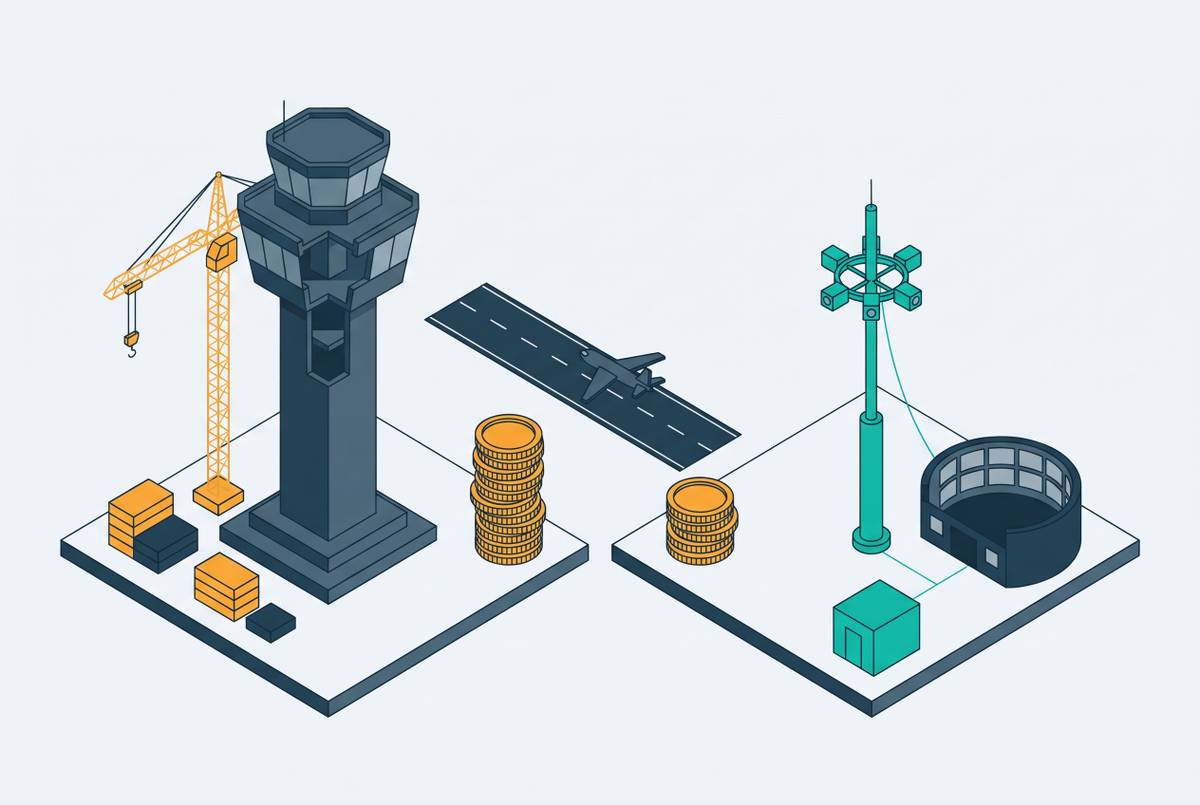
Building a physical ATC tower costs several million dollars, and staffing it costs millions more per year. The FAA has pointed to those costs as a reason to pursue digital towers at non-towered fields that cannot justify the cost of conventional infrastructure. Roughly ninety percent of U.S. airports have no towers. For those airports, the choice is often between digital service and staying without ATC, because funding for a conventional tower is not in place.
Remote towers remove the need to pay for a physical tower structure. They do not remove the cost of providing controlled service, including installation, telecommunications, and annual operations. A credible comparison must include the complete service and distinguish traffic awareness from qualified ATC capability. Without comparable vendor prices and airport-specific infrastructure costs, there is no defensible ranking of the cheapest systems.
Funding also limits what an airport can sustain. The BNATCS fifty-million-dollar carve-out provides a named policy commitment, but it is finite, and affordability must fit the AIP entitlement and BNATCS grant envelope available after the IIJA supplemental programs end. Capital assistance does not establish whether an airport can afford recurring costs. Digital environments that support multiple airports can also help attract staff, as air navigation service providers have found that younger recruits are drawn to them. Better situational awareness can also ease controllers’ workload and stress, helping keep trained staff.
The operational constraints that any U.S. digital tower deployment must satisfy
Deployment first requires establishing whether the airport has the required telecommunications infrastructure. FAA engineering guidance requires all data transfer over a closed, physical point-to-point network, with an independent fiber optic feed between the sensors and control room. Wireless communication is not currently permitted. For a rural airport without fiber, the audit must establish whether the proposed project includes the prerequisite network build and who bears its cost.
Qualification is a separate question from technical promise. The FAA requires vendor systems to undergo testing and evaluation at the William J. Hughes Technical Center in Atlantic City, New Jersey. Vendors must supply safety artifacts addressing integrity and continuity. A buyer therefore needs to establish whether qualification is complete, rather than treating a planned evaluation as deployment readiness. The resources and time required for that campaign are part of the delivery risk.
Continuity requires scrutiny beyond the normal operating demonstration. Repeated remote tower disruptions at Vigo, Spain, in July 2025 forced temporary reversion to the legacy tower. That event provides a concrete contingency reference without establishing that a cyberattack caused the disruptions. The relevant questions concern network redundancy, cybersecurity protections, and the airport’s fallback operational state. An uncontrolled airport has no legacy tower to resume service.
Staffing assumptions require equal care. Current U.S. procedures do not approve one controller managing more than one airport simultaneously from the same workstation. The service must therefore remain affordable with one-at-a-time control, independently of potential improvements from future simultaneous operations. The audit must examine how the vendor mitigates the situational-awareness challenges of a digital working environment. Those challenges differ from the conditions inside a physical tower cab.
What the Norway operational model demonstrates and where it does not transfer
Avinor’s remote tower program provides the most operationally advanced reference case, with airports across Norway managed from its Remote Tower Centre in Bodø as of April 2025. Avinor’s stated goal is to operate 21 of its airports remotely from Bodø by 2027. The program validates sensor and display technology at scale. Its original purpose, however, was improved service delivery and cost savings at airports that already had some form of ATC service, rather than first-time controlled service at uncontrolled fields.
That distinction changes the economic comparison. Consolidating existing services is not the same project as establishing a service, funding its infrastructure, and supporting an airspace transition. The Norwegian experience demonstrates operational feasibility without settling those U.S. requirements. FAA qualification and fiber infrastructure remain independent conditions for domestic deployment.
Avinor launched a multiple-operations trial in February 2026 to test whether one AFIS officer could manage more than one airport from the same workstation. Trial airport pairs include Rørvik–Namsos, Mehamn–Hasvik, Vardø–Berlevåg, and Røst–Svolvær. The results are not yet established in the supplied material. Current U.S. procedures also do not allow that way of working. Norway is therefore a useful calibration of technical maturity for a U.S. business case.
The capability dimensions that actually matter when auditing vendors for uncontrolled U.S. airports
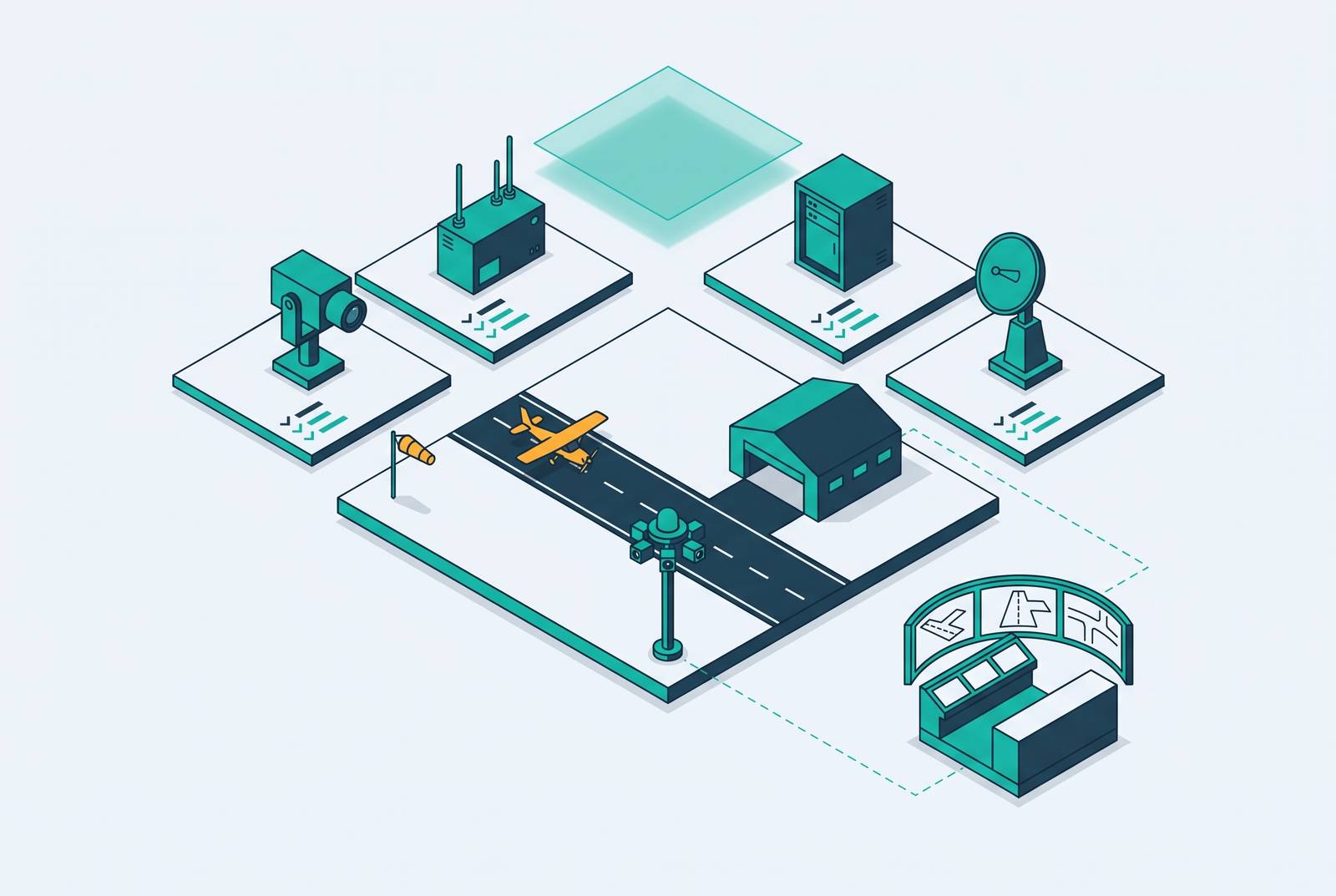
For airport operators, policymakers, and procurement teams, the audit begins with whether the sensors cover the conditions the airport actually faces. The relevant questions concern high-definition optical and infrared or thermal coverage for day, night, and low-visibility operations. Zoom capability should also be examined for runway wildlife detection. A specification alone is insufficient evidence. The buyer’s task is to connect each capability to the visual information controllers need.
The audit must check whether the vendor will provide fiber or coordinate that work, and whether the sponsor must pay for it separately. The audit must examine the redundancy architecture supporting service when a network component fails. Qualification then acts as a binary gate. The audit must establish whether the system has completed the FAA evaluation and whether its integrity and continuity documentation has been accepted, because technical merits cannot substitute for operational qualification.
Cybersecurity and contingency planning require a linked assessment. The buyer should ask what protections the system provides against attacks on networked infrastructure and what operational state the airport can adopt during disruption. Vigo makes the distinction concrete. A fallback plan that depends on returning to a conventional tower cannot simply be transferred to a field that has never had one.
Affordability concerns capital, installation, and annual operations together. Those costs must fit the airport’s available funding and its ability to support the service after installation. A digital system requiring capital outlays comparable to a traditional tower retains the economic obstacle in a different form. Airspace eligibility also matters, because a product limited to existing Class D operations cannot serve the full range of Class E and G airports seeking controlled status.
Two further questions concern future operations and supply. UAS readiness involves the situational awareness and coordination needed as uncrewed operations expand at small airports, but it should not displace today’s qualification and continuity requirements. Domestic sourcing is relevant to federal funding eligibility, policy alignment, and supply-chain risk. The audit should establish where the system is designed and built rather than infer domestic content from its sales presence.
How the first U.S. operational deployments change the audit conversation going forward
The FAA’s November 7, 2026, announcement identifies Bartow Executive Airport (KBOW) and Kenai Municipal Airport (PAEN) as the first operational non-federal control tower digital tower systems in the U.S. Those deployments change the evidence available to buyers. Systems operating there have cleared the qualification gate, allowing the discussion to move beyond proposed capability. Qualification, however, does not by itself establish performance at every airport or prove affordability for every sponsor.
The FAA identifies five airports next in line, including Winter Haven Regional (KGIF), Venice Municipal (KVNC), Montgomery County Airpark (KGAI), Johnston Regional (KJNX), and Durango-La Plata County Airport (KDRO). Their different market segments and geographies will broaden the operational evidence base. The relevant measures are sensor reliability in real conditions, network continuity, controller workload, and total cost through the first operational year.
Two operational installations do not resolve the coverage gap. The number of airports without ATC remains large, while the BNATCS allocation is finite and further policy investment will depend on the record these deployments build. Airport operators do not need to wait for that full record to begin evaluating options. The structural need is established, and the first domestic systems are operational. The next step is to apply the audit criteria to what vendors can demonstrate in the field.