Functional Requirements Mapping for Digital Tower Certification at Low-Activity U.S. General Aviation Airports
A requirements map for certifying digital towers at small airports.
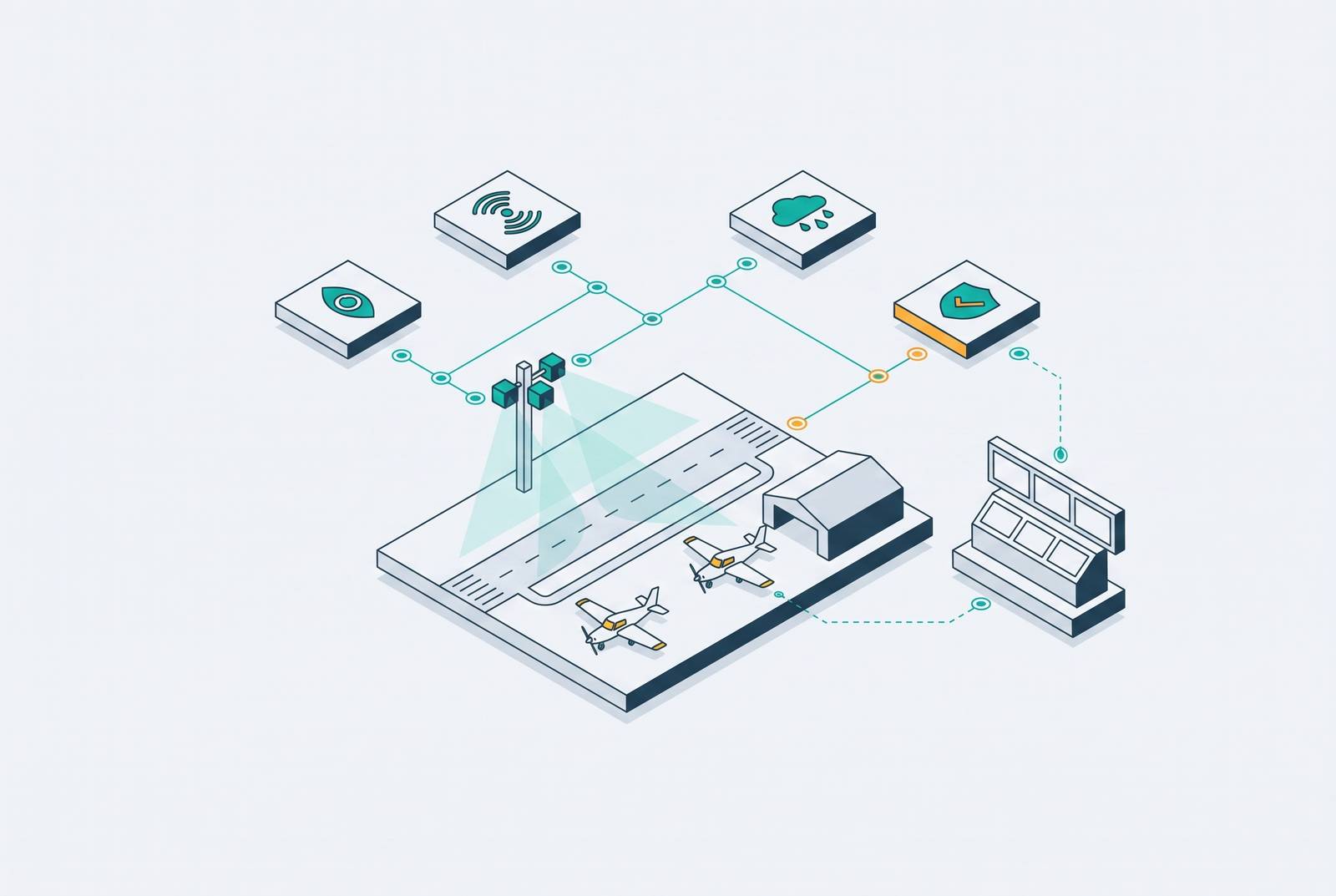
Digital tower certification at low-activity U.S. GA airports requires mapping traffic sequencing, runway conflict prevention, weather observation, and communication to discrete, verifiable FAA requirements. The viable system is a complete operational design whose sensors, communications, site infrastructure, and safety documentation support approval within the airport’s budget, whether through a dedicated facility or a shared Remote Tower Centre.
Why non-towered airports concentrate the safety risks that digital towers are designed to address
A non-towered airport lacks an external sequencing authority. Pilots must watch traffic, tell others what they plan to do, and resolve conflicts without a controller who can step in when those defenses fail. FAA Advisory Circular 90-66C explains that pilots take on the surveillance role when a controller no longer fills it. NASA ASRS CALLBACK Issue 548 describes why this changes the consequences of an oversight. An infraction that a tower controller might detect can develop without that independent safeguard.
The ASRS Database Report Set, Non-Tower Airport Incidents, updated June 17, 2026, shows how this happens in a 50-report sample. A DC3 crew reported lining up while a student pilot on the wrong frequency continued an approach, with the captain eventually taxiing into gravel. A CRJ-200 crew reported that an aircraft departed in the opposite direction during their landing rollout, while a PA28 instructor reported a near-midair collision on short final with another aircraft 100 feet below. These reports identify failure modes. ASRS reports are voluntary and uncorroborated, but they expose the functional gap that certification must address through independent observation and controller intervention.
What a digital tower actually does and the functions it must replicate
The FAA Digital Airport Traffic Control Towers page says a digital tower system provides the visual information that Air Traffic Control Specialists need to provide tower services. Cameras and sensors take the place of the view through physical windows, and controllers work entirely through dedicated digital displays. The building is not the essential function. The functions are observation and communication, supported by high-definition cameras, infrared cameras, aircraft identification tagging, microphones reproducing airfield sounds, and displays providing a continuous 360-degree view. Each element therefore needs its own requirement and evidence of performance.
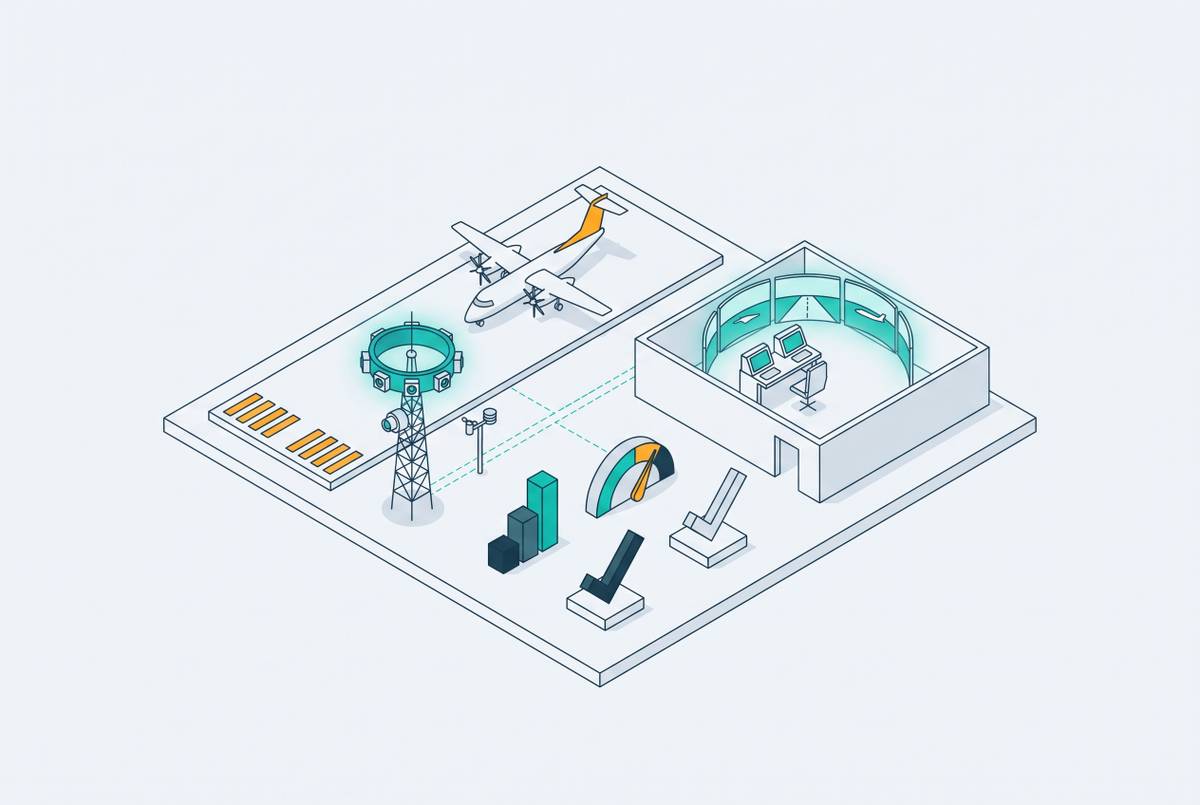
Bartow Executive Airport (KBOW), Florida, illustrates this separation between sensing and control. Cameras sit on a tower approximately 600 feet from the control room, where screens form an arc providing the full field of view. Florida DOT funded the system. The FAA announced on November 6, 2026, that Bartow and Kenai were operational as the first U.S. digital ATC tower deployments, although Bartow had been running since September 2026. Current FAA guidance requires a closed, physically point-to-point network with an independent fiber-optic feed between sensors and the control center, so this architecture cannot substitute wireless transmission for the required connection.
The certification pathway the FAA has established and what it demands of a system
System Design Approval (SDA) provides the framework for turning these capabilities into an approvable design. The FAA Reauthorization Act of 2024 mandated a clear framework and timeline for approval and deployment. Within that framework, checking the concept and requirements starts with Operational Visual Requirements (OVRs). Centralized testing and evaluation take place at the William J. Hughes Technical Center, Atlantic City. Safety artifacts must show integrity and continuity, and tests in real-world operations cover VFR and Class D airspace tasks.
The typical SDA duration is approximately 24 to 36 months, depending on product maturity and the engineering processes and documentation supporting development. A functional requirement must therefore connect an operational need to a defined system behavior and the evidence used to assess it. OVR validation checks visual coverage, and safety artifacts must show the integrity and continuity of the information the system presents. Operational evaluation then examines the system in the tasks it is intended to support.
FAA Engineering Brief No. 112, dated September 28, 2026, also treats physical security and cybersecurity as interdependent requirements. Airport sponsors must assess local conditions when they put security measures in place and meet the standards that apply. Current FAA guidance also calls for more work before systems can be deployed at federally owned ATCTs, so airport sponsor-owned GA facilities are the near-term market for deployment.
Mapping traffic sequencing and runway conflict prevention to verifiable requirements
Runway conflict prevention begins with continuous, unobstructed visual coverage of active runways and taxiways. Resolution and frame rate must let controllers identify aircraft type, position, and direction of travel in the conditions in which the system is meant to work. This requirement maps directly to OVR validation. The test must show that the controller gets the visual information needed to recognize conflicting occupancy, which takes more than an attractive camera image. The DC3 and opposite-direction departure reports provide concrete operational failure modes against which that requirement can be framed.
Aircraft identification tagging addresses a related but distinct problem. It supports tracking through the pattern without relying on radio call-sign confirmation alone, including when an aircraft is on the wrong frequency or makes no calls. Infrared or thermal imaging helps controllers see during night operations and reduced visibility. That capability is relevant both to Kenai’s operating environment and to the night-VFR obstacle departure incident documented in CALLBACK Issue 548. These functions support controller awareness but do not replace the communication function needed for intervention.
An airport that has never had controllers has no institutional ATC baseline for local procedures and recurring conflict geometries. Its coverage requirements must account for that absence. Moreover, real-world evaluation may not encounter enough traffic during the available window to validate conflict-detection performance. Scheduled exercises or simulation supplementation may therefore be needed to support the evaluation.
Mapping weather observation to FAA surface observation requirements
Weather observation is a separate certification obligation. Controllers need current ceiling, visibility, wind, and altimeter information to support traffic sequencing and advisories. Many airports with little traffic have no Automated Surface Observing System (ASOS) or Automated Weather Observing System (AWOS), or use older equipment that does not meet current certification standards. The required capability is certified surface observation, through ASOS or an equivalent, integrated with the digital tower display for real-time controller access.
Accuracy, update frequency, and data integrity must be independently testable against FAA standards. Those properties must be covered in the SDA safety artifacts and kept separate from visual-system testing. For airport operators, the lesson is to budget weather instrumentation separately from tower procurement. Kenai illustrates the need for a site-specific assessment because paved and gravel runways, floatplane operations, and sub-arctic weather create an observation profile that a standard ASOS may not fully address without supplementation. The requirement follows the operation.
Mapping communication functions to the CTAF/UNICOM environment and what changes when a controller arrives
On the Common Traffic Advisory Frequency (CTAF), pilots announce their own positions. Radio-equipped pilots are expected, and for certain procedures required, to broadcast their positions, but no ATC authority sequences those transmissions into binding directions. A controller changes the procedural relationship with pilots. For the transition to a Class D surface area, pilots must establish two-way radio communication before entry.
The functional requirements include reliable two-way voice communication with aircraft in the traffic area and redundant radio capability for frequency failures. Audio recordings and logs must be kept long enough to review incidents. Existing UNICOM equipment is typically not certified to ATC communication standards, making replacement or upgrading a separately scoped procurement and installation task. Radio approval also determines the operational sequence. Communication infrastructure must be certified and operational before airspace reclassification, and the airspace action must precede ATC service commencement, so these dependencies cannot be left until the tower equipment is installed.
The infrastructure gaps that low-activity GA airports must close before the SDA process can proceed
That sequencing dependency extends beyond the radio subsystem. SDA evaluates the digital tower system, but it cannot compensate for missing airport infrastructure. Connectivity is an early site-preparation requirement because most low-activity GA airports lack on-field fiber and have limited access to carrier-grade fiber at the perimeter. The required point-to-point connection must be scoped before system procurement. Preparing the power supply also calls for uninterruptible power and backup generation, which airports without a tower have typically not built to ATC standards.
Weather and communication readiness belong in the same site plan, even where their equipment is procured separately. Their certification dependencies must be coordinated with the tower system from the outset. Security requires another explicit allocation of responsibility. Under the engineering brief, a small airport that has no security program needs an airport-specific evaluation and a written plan, while an airport with no established cybersecurity posture must do the work to meet those requirements for the first time. Buying protected equipment leaves work to be done on both obligations.
Documentation is also an infrastructure need in organizational terms. To produce engineering process records and safety artifacts, airports need either staff who can do the work or help from specialists. The practical distinction is between evidence supplied by the technology provider and evidence that depends on the airport’s own preparation. Sponsors can address these gaps by identifying responsibilities early and costing and assigning the work before the approval schedule depends on its completion.
How the Remote Tower Centre model changes the requirements picture for the smallest airports
A Remote Tower Centre changes where requirements are satisfied. In the Single Remote Tower model, one controller manages one airport, and that airport supports the control infrastructure and staffing costs. In the Multiple Remote Tower model, one controller can manage several airports through a shared facility. DLR research identifies resource sharing as a way for small airports to obtain more qualified ATC services at a reasonable cost. The requirements map must therefore describe the complete architecture.
Controller workstations, communication recording and logging, documentation and training programs, and cybersecurity for the control environment can shift to the shared centre. Each airport still needs OVR-compliant sensor coverage, fiber-optic connectivity, weather observation, sensor-site physical security, and field-equipment power redundancy. Sharing adds an evaluation dimension because the display architecture must support safe attention-switching between airports while maintaining visual coverage and communications at every airport. Operators considering this model should find neighboring coalition partners whose combined traffic profile fits it before entering SDA, so the design they submit matches how they plan to operate.
What airport operators and technology providers must do now to close the certification gap
Existing connectivity, power, weather observation, and security need to be mapped against the engineering brief and OVR framework. The output should be a costed gap list. Operators should then choose a standalone tower or shared centre to fit the intended operation, because that choice defines the system submitted for SDA. Technology providers, in turn, need to align their proposed system and supporting documentation with that actual architecture.
Airspace planning and funding must proceed with this design work. Sponsors should engage the FAA early on communication certification and reclassification lead times, coordinating them with SDA. The $50 million Remote Tower deployment allocation under the One Big Beautiful Bill, part of the broader BNATCS package, provides a federal funding mechanism. Sponsors should know what qualifies for funding and when to apply before they commit to a deployment schedule. Even with funding available, sponsors still need to establish that the site is ready and who is responsible for approval.
A system with an existing SDA or an advanced SDA process can shorten the path significantly compared with one lacking developed engineering documentation, Technical Center testing, and safety artifacts. Bartow and Kenai demonstrate that operational deployment is achievable, while shared-centre architecture offers a path beyond individually funded standalone facilities. For the large majority of U.S. public airports without towers, closing the NAS coverage gap now depends on organizing the requirements, infrastructure, partnerships, and evidence needed to use an established approval pathway.