Automated Weather Observation Integration at Uncontrolled Airports
Automated weather sensors fill a critical safety gap when no controller watches the sky.
No tower means no person watching the sky on a pilot's behalf. That single structural fact governs everything else in this article. Most U.S. airports without a control tower have no staffed position to monitor conditions, issue advisories, or halt operations when weather turns. At a towered field, a controller can see a storm cell on radar, hear a pilot report deteriorating visibility, and pass that judgment along before a pilot ever has to ask. At an uncontrolled field, that chain of human judgment simply doesn't exist, so whatever automated instrumentation the airport has installed becomes the entire weather safety layer, not one part of it. The consequence of that gap falls unevenly: pilots without an instrument rating face substantially higher risk in weather-related accidents than instrument-rated pilots, and that risk concentrates at the smaller, uncontrolled fields where training populations skew toward pilots who fly only in visual conditions and have the least margin for a weather system that lets them down.
AWOS: the data pipeline from sensor to cockpit
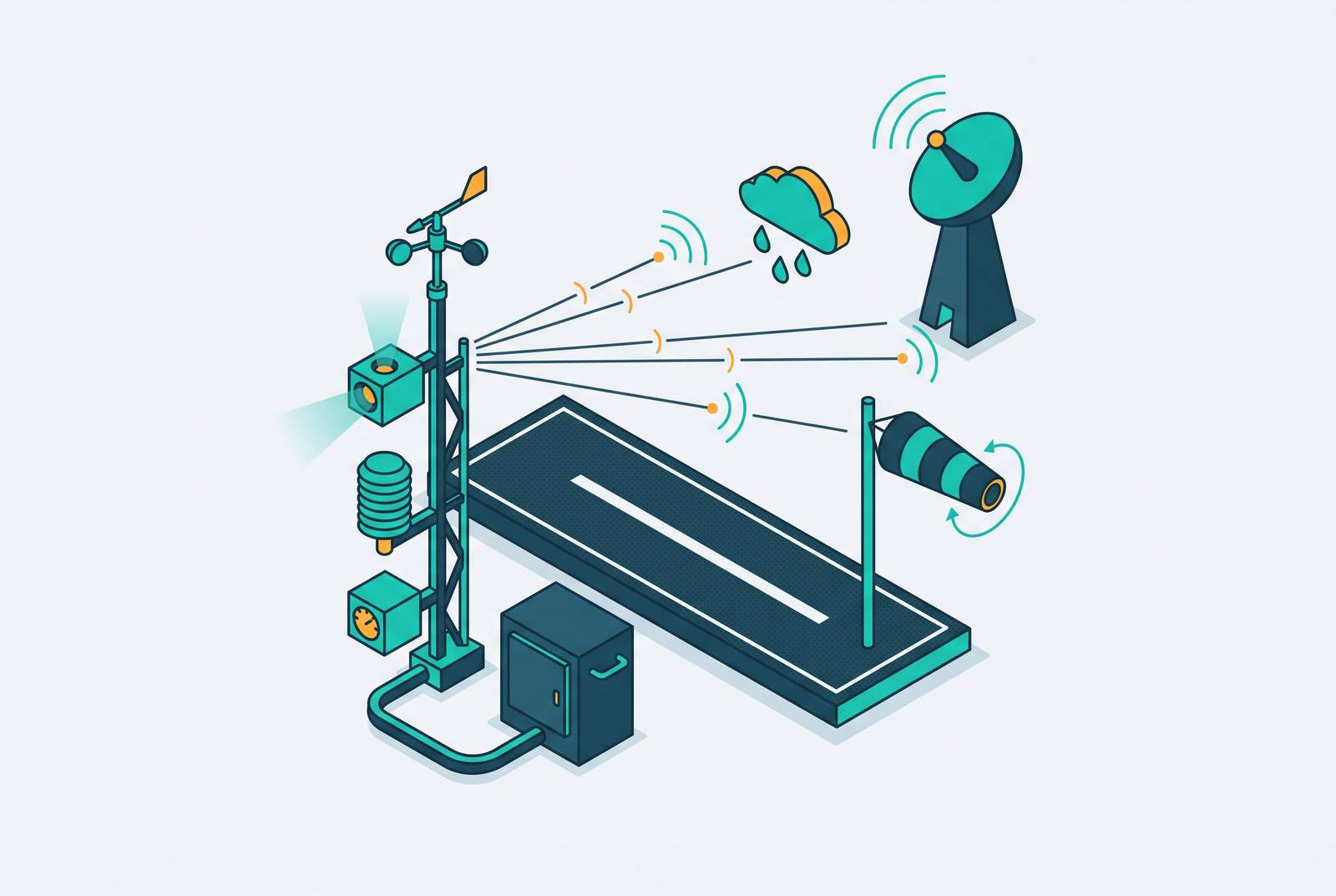
An Automated Weather Observation System takes physical measurements of the atmosphere and turns them into a radio broadcast a pilot can use to decide whether to land, divert, or wait. Depending on the equipment tier installed at a given airport, sensors measure wind speed and direction, altimeter setting, temperature, dew point, visibility, and cloud height. That data gets converted into a computer-generated voice broadcast on a dedicated radio frequency, updated at least once a minute, so a pilot inbound to an uncontrolled field can tune in and hear current conditions without anyone on the ground relaying them.
Most of these systems, at non-federal airports, are operated, maintained, and controlled by state or local governments and other non-federal entities, certified through the FAA's non-federal AWOS Program. That ownership structure matters for everything that follows in this piece, because it means the quality and reliability of weather data at a given uncontrolled airport depends heavily on the resources and attentiveness of whatever local authority runs it.
Not all AWOS units are built the same. The FAA's tiering system, running from AWOS-1 through AWOS-3P and beyond, determines which sensors are physically present at a given site. An AWOS-3 installation that lacks a thunderstorm sensor cannot detect a nearby lightning cell, because that sensor was never part of the configuration purchased and installed there. Data from these systems also reaches people beyond the cockpit: it's accessible by telephone and, at many sites, through online aviation weather services. Pilots can check conditions before they ever start an engine, not just while flying an approach.
Where AWOS coverage breaks down
The three features described above, point-source sensing, a one-minute update cycle, and tier-dependent sensor gaps, are not occasional defects. They are how the technology is built to work, and at uncontrolled airports there is no human layer to catch what they miss. AWOS samples conditions at one physical location on the airfield. Fog, rain, wind shear, or a low cloud layer can affect one runway end or an approach path while leaving the sensor itself untouched, so the broadcast can be accurate about where the instrument sits and wrong about the airspace a pilot is actually flying through.
Timing compounds the problem. A one-minute cloud and visibility update cycle sounds fast, but convective weather can change a ceiling by hundreds of feet in less time than that, and the broadcast simply won't reflect the new reality until the next cycle completes. An AWOS-3 without a thunderstorm detector carries this same blind spot in a different form: it will not report a lightning cell building miles away, because the sensor needed to detect it isn't there. A pilot listening to that broadcast has no way to know the gap exists. The silence sounds exactly like safety.
Part-time tower airports absorb a compounding version of this risk. During staffed hours, a controller provides the judgment layer that fills in what AWOS can't see. Outside those hours, AWOS becomes the only source of weather information at the field, but the airport's baseline investment in weather infrastructure was typically sized for a staffed operation, not for carrying the full weight of coverage alone. Palo Alto Airport in California found exactly this gap in 2025: outside tower hours, real-time weather information was limited enough to affect flight safety and operational decisions, so it moved to install a new AWOS system. The case is useful because it shows the gap is one an airport operator recognized in its own operations and acted to close.
The maintenance and certification gap that takes AWOS offline without warning
A properly designed AWOS can still fail quietly, and the mechanism behind that failure has nothing to do with sensor placement or update speed. It has to do with keeping the equipment maintained and certified once it's installed. If required elements, altimeter setting, wind, visibility, are missing from a broadcast, an instrument approach procedure at that airport may not be legally usable by an IFR pilot. A degraded AWOS doesn't just provide worse information. It can take an entire approach procedure off the table.
Non-federal AWOS units place the financial burden of sensor upkeep, calibration, and hardware replacement on local airport authorities, which are often the most resource-constrained operators in the entire system. Alaska offers the sharpest documented picture of what that burden produces in practice: stakeholders there have noted directly that the AWOS certification process needs revisiting, because a technician visits only every four months for basic cleaning and visual inspection, with full calibration and performance verification required only once a year. An outage discovered shortly after a routine visit can go undetected and uncorrected for close to that full interval. Operators have also pointed out that AWOS is expensive to maintain, and that commercial systems exist which may outperform current FAA-certified configurations, but FAA certification requirements constrain what operators can legally deploy regardless of what the market offers.
The failure mode produces no warning. A pilot checking AWOS before departure or on approach has no reliable signal that the data came from a degraded or partially failed system. The broadcast sounds the same whether the sensor behind it was calibrated last week or hasn't been checked in months.
Alaska as the stress test: what AWOS integration looks like at the extreme edge
Alaska pushes every weakness described above to its limit. Remote communities there depend entirely on air transportation, weather changes faster than in almost any other part of the country, and the margin for a weather system that fails quietly is close to zero. AWOS and Visual Weather Observing Systems are critical for Alaska aviation precisely because they provide real-time weather data in remote areas with harsh, rapidly changing conditions, where radar coverage and other infrastructure are limited or absent. Weather cameras add a second layer at many Alaska sites, offering visual confirmation of conditions that compensates for AWOS's point-source limitation: a pilot can see what the cloud deck and visibility actually look like near the field, not just what the sensor at one spot on the airfield measured.
The FAA's Don Young Alaska Aviation Safety Initiative is directly targeting AWOS gaps at remote uncontrolled airports, with prioritized deployment of 50 AWOS systems, 60 Visual Weather Observation Systems, and 64 weather camera systems as required by the Working Families Tax Cuts Act. At Crooked Creek Airport, the initiative funded re-establishing a baseline AWOS after flooding damaged the original installation; the FAA redesigned the system and relocated it to higher ground to reduce future flood risk, with a contract awarded on February 20, 2026, and construction expected by mid-August 2026. In October 2025, the initiative also funded an AWOS Service Dashboard, a central tool for monitoring the operational status of AWOS installations across Alaska, built as a direct response to the maintenance visibility problem of outages going undetected between scheduled technician visits. With centralized monitoring, an outage can surface quickly instead of waiting for the next scheduled technician visit to be discovered.
The NAS-wide ASOS-to-AWOS-C transition
The same resource pressure visible in Alaska shapes decisions at the level of the entire air traffic system. Hundreds of ASOS sites across the country are being transitioned to AWOS-C rather than upgraded to a modernized ASOS standard, and that decision was explicitly budgetary. It was not a determination that AWOS-C is the superior technology for those locations. The transition reaches sites across the NAS, so the capability floor for automated weather observation nationwide is being set by what the budget allows, not by what safety conditions at those specific airports actually require.
That trade-off matters most for the uncontrolled airports these sites serve, because those are the airports with no staffed backup to compensate for whatever capability the transition gives up. Anyone evaluating AWOS coverage at a specific airport needs this context: the baseline level of federal investment in weather observation infrastructure is contracting in capability terms at the same time the airports relying on it remain uncontrolled and understaffed.
What structured oversight adds at contract tower airports
The Contract Tower Program offers a useful comparison because it shows what even a minimal staffed presence adds on top of AWOS data. Contract towers make up roughly half of all federal air traffic control towers in the United States, and they manage a substantial share of tower aircraft operations while consuming a small fraction of the FAA's overall tower operations budget. Even with that cost efficiency, airports still have to fund capital expenses, including construction and maintenance of the towers themselves, and the Airport Improvement Program and the FAA Contract Tower Competitive Grant Program only cover part of that. Those costs put the program out of reach for most small airports without a staffed tower.
Airports without a contract tower receive no equivalent staffed service. AWOS data reaches pilots there just as it does anywhere else, but no human integrates that data with NOTAM information, local knowledge, or real-time judgment about whether conditions are deteriorating. That integration, not the raw data, is what a controller adds and what AWOS by itself cannot replicate: the system broadcasts, but it does not judge. The FAA has signaled some recognition of this gap. Airport Infrastructure Grant funds for the Contract Tower Competitive Grant Program, announced under the Bipartisan Infrastructure Law, list the construction of remote towers certified by the FAA among the eligible uses, so the agency sees the staffed-coverage shortfall and is starting to fund alternatives to the traditional tower.
What digital remote tower technology adds
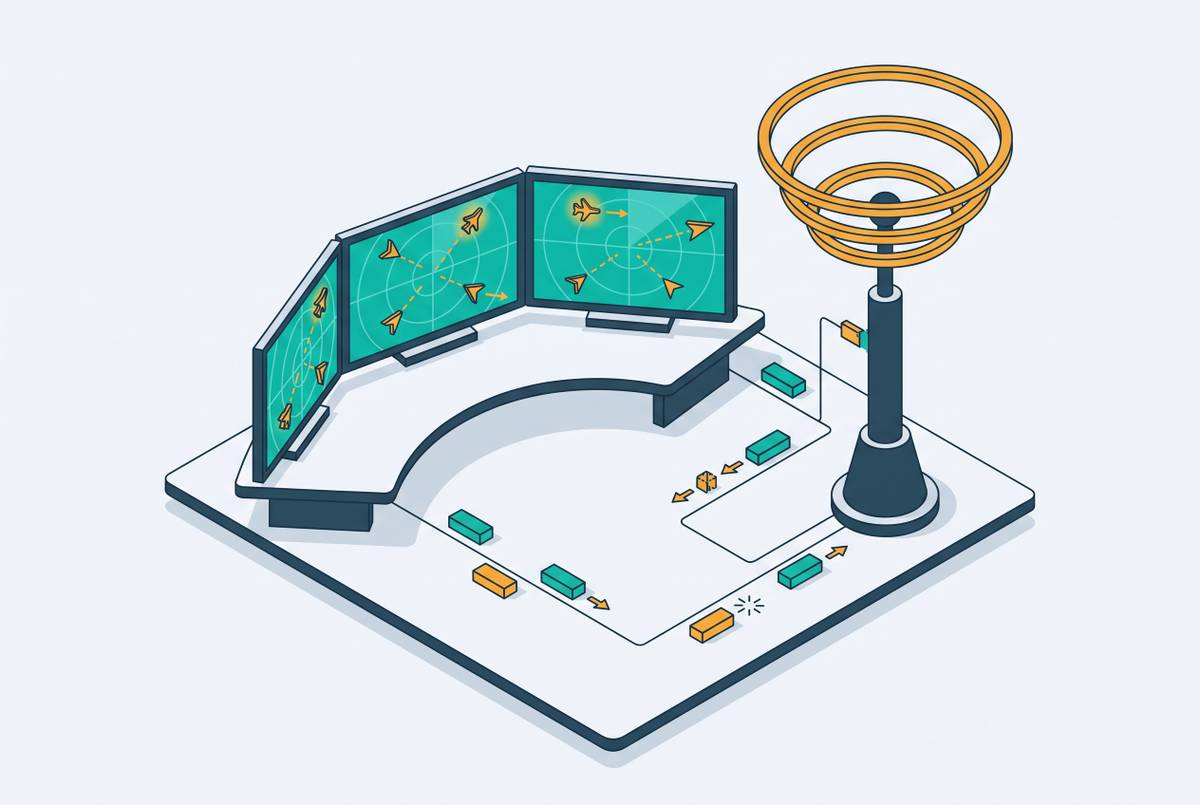
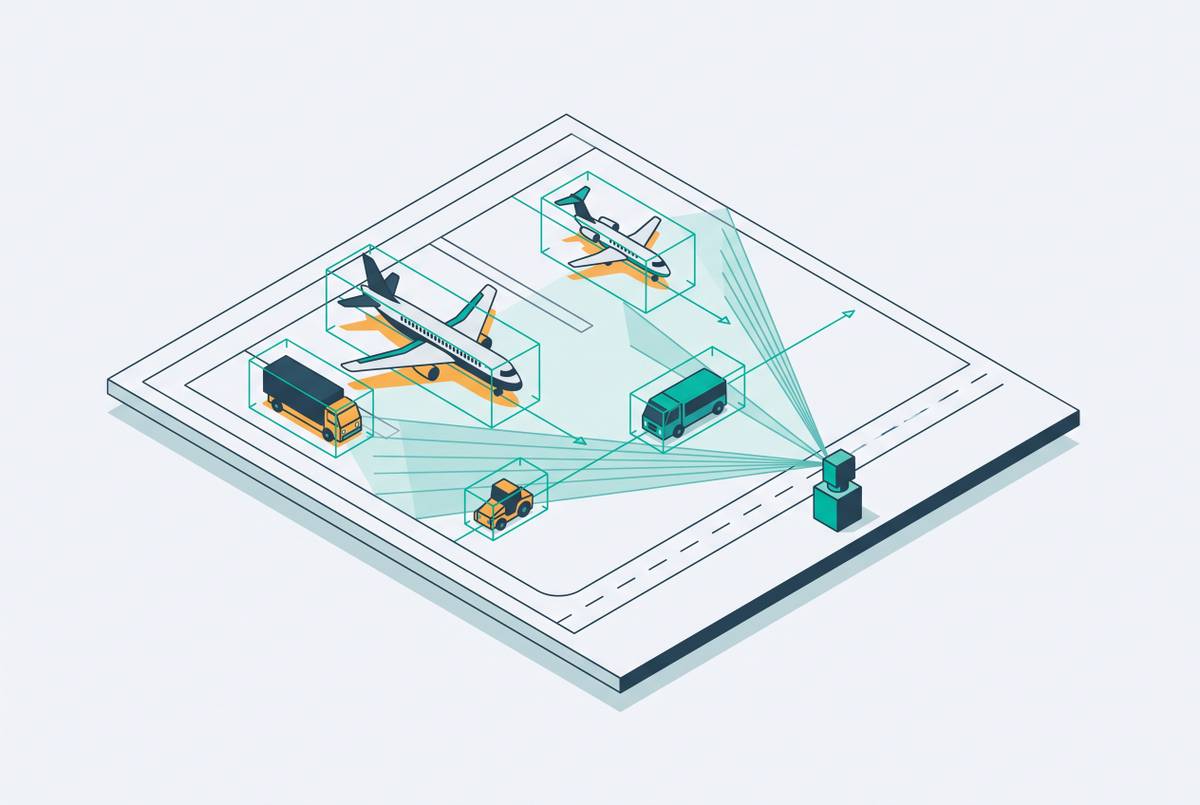
Digital remote tower systems are built to supply the judgment layer that AWOS cannot provide on its own, not to replace the sensor data AWOS already collects. These systems combine camera arrays and sensors, enhanced by artificial intelligence, to give air traffic controllers situational awareness of aircraft and vehicle movement on runways, taxiways, aprons, and the surrounding airspace, without requiring that controller to be physically present at the airport. A controller working a remote tower can take AWOS data, visual observation, and pilot communications and integrate all three in real time, the same judgment function a tower controller performs at a staffed field and the one function AWOS alone cannot perform no matter how many sensors it carries.
The federal government is already moving toward this model. In April 2026, the FAA issued a request for proposals for remote air traffic control tower systems covering a multi-year procurement, as part of a broader shift toward digital ATC technology at smaller airports, where building a conventional tower is hard to justify financially. The Colorado Remote Tower Project is the first of its kind to combine both satellite and ground-based technologies, built to raise the level of safety, operational efficiency, and economic activity at airports operating in uncontrolled airspace. Remote tower technology removes the need for an airport to build, maintain, and staff a physical structure, and it gives airports with seasonal traffic patterns the flexibility to provide ATC service only during the months they actually need it. This approach is already in wide use across Europe and expanding quickly into Asia, Canada, and the Middle East, which places the U.S. procurement effort inside a trend that other aviation systems have already tested at scale.
Put together, AWOS supplies the data layer and digital remote tower technology supplies the judgment layer. An uncontrolled airport with AWOS alone has data without interpretation. One with both has something closer to a complete safety system, available at a cost structure that doesn't require the capital investment a conventional staffed tower demands.
AWOS integration for airport operators and pilots
Closing the weather awareness gap at an uncontrolled airport starts with understanding what AWOS actually covers, where it goes silent, and what the emerging oversight layer looks like. That starting point looks different for the two groups who depend on it most.
For airport operators, the installed AWOS tier is the first thing to know in detail: the tier determines what the broadcast can and cannot tell pilots about conditions at that airport, so an operator who doesn't know whether a thunderstorm sensor is present can't know what blind spot their pilots are flying into. Maintenance visibility deserves the same attention. The AWOS Service Dashboard model built under DYAASI centralizes status monitoring so outages surface without waiting on a scheduled technician visit, and it shows where the field is heading, so local operators should check whether their own maintenance contracts come close to that same detection speed. The FAA Contract Tower Competitive Grant Program, funded under the Bipartisan Infrastructure Law, now explicitly lists remote tower construction and equipment as an eligible use, opening a funding path toward the oversight layer that AWOS cannot supply by itself. Digital ATC systems built for airports without a conventional tower cost fundamentally less than staffed tower construction, so operators evaluating next steps should treat that technology as a complement to the AWOS they already have, not something that requires a start from zero.
For pilots, AWOS is a starting point for a weather picture, not a complete one. Understanding its update cycle, knowing whether the airport's tier includes sensors relevant to the conditions being flown, and never assuming that silence on a given parameter means clear conditions all matter more at an uncontrolled field than almost anywhere else in the system. At part-time tower airports, the shift to AWOS-only coverage outside tower hours is a real change in the quality of available information, not simply a staffing change, and preflight planning should account for that difference directly. Weather cameras, where they exist, as they do at many remote Alaska sites, add a visual layer that fills in what AWOS's point-source limitation leaves out, and checking them before a flight costs nothing.
The technology needed to close the gap between AWOS's raw data and the judgment a pilot actually needs already exists, and it is entering the U.S. market now, through programs like the FAA's 2026 remote tower procurement. What remains is whether airport operators and policymakers treat AWOS without an oversight layer as the incomplete safety system it is, and build toward the combination of sensor data and human judgment that uncontrolled airports have gone without for decades.