AI Assisted Runway Incursion Detection in Digital Towers
AI-assisted detection gives digital towers the data to prevent collisions at uncontrolled airports.
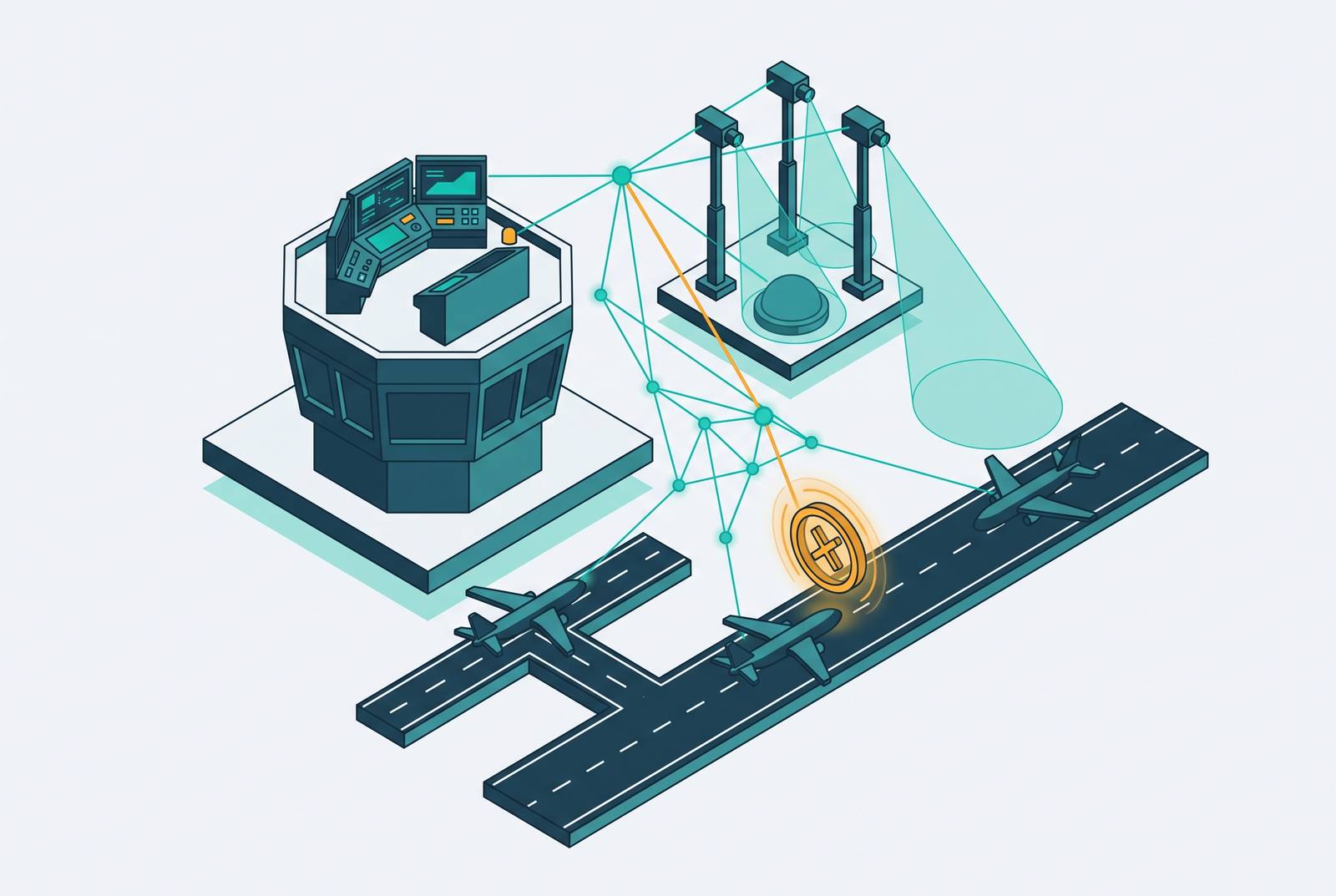
Fatal runway incursions in the United States concentrate overwhelmingly at airports without a control tower. Until 2026, every fatal runway incursion accident in recent memory had occurred at a non-Part 139 airport with no tower on the field. That pattern broke in March 2026, when Air Canada Flight 8646 collided with a vehicle at LaGuardia, a towered, Part 139 airport. One event at a major commercial field does not erase a longer record concentrated at small, uncontrolled airports, and that concentration is what any serious safety response has to address.
The official numbers make the problem harder to see, not easier. The FAA only tracks runway incursions if an airport has an operational air traffic control tower. A count that excludes the riskiest part of the system is measuring only the part of the system that already has a safety net.
Why uncontrolled airports produce incursions at a structural level
The concentration of fatal incursions at non-towered airports is not a coincidence, and it isn't a statement about pilot skill at small airports. At a towered airport, a controller sequences traffic, issues hold-short instructions, and catches a deviation before two aircraft, or an aircraft and a vehicle, occupy the same runway at the same time. At a non-towered airport, none of that exists, and the absence changes what kind of accident is even possible.
The DOT OIG attributes nearly 62 percent of all U.S. runway incursions to pilot deviations. What remains is pilot deviation, which becomes close to the only failure mode left standing, simply because it's the only one the environment still permits.
The data on near-collisions backs this up directly. Near-collisions happen twice as often when a pilot had no prior radio warning of other traffic in the area, and most near-collision reports pilots file involve operations within ten nautical miles of a non-controlled aerodrome. Self-announcing on a Common Traffic Advisory Frequency is the tool pilots have in place of a controller, and it's voluntary, inconsistently used, and gives no one a real picture of what else is moving on or near the runway. It functions as a courtesy among pilots who choose to use it, not as a system anyone can depend on.
Trace the chain and the logic holds together cleanly: no controller means no one with the authority to sequence aircraft, no sequencing authority means pilots have to separate themselves using radio calls and visual scanning alone, and separating aircraft on incomplete information in shared airspace produces exactly the kind of conflict the data shows. This structural gap requires something that can perform the coordinating function a controller performs, even where no controller is present.
Why traditional and contract towers have not filled this gap
The thousands of airports operating without a tower are uncontrolled because staffing and building a conventional tower has always cost more than these airports can justify, and nothing about that math has changed in decades.
The FAA set up the Federal Contract Tower Program in 1982 because it needed to push ATC coverage out to lower-activity airports at a lower cost than a standard FAA-staffed tower. It worked, to a point: contract towers now make up roughly half of all federal ATC towers in the country while drawing only a small share of the FAA's total tower operations budget, saving the agency an estimated large sum each year. An airport has to clear a benefit-cost ratio of at least 1.0 to even become eligible, and the airports with the least traffic and the thinnest infrastructure never get there. They sit below the line the program itself was designed to draw.
Airports that can't clear that threshold stay uncontrolled because no existing coverage model reaches them. That's where the economics of a digital tower start to matter: estimated capital costs for a digital tower facility run meaningfully below those of a recent conventional contract tower, opening up a tier of airports for which real coverage was never previously affordable.
Cost is only half the constraint. The FAA is also working against a significant deficit in certified controllers relative to its own operational targets, a shortfall the agency does not expect to close before 2028 at the earliest. The controller shortage is the condition that makes a technology-based approach necessary, not simply convenient.
The Digital Tower
A digital tower is a full sensor and data environment built to replace the function of a physical control cab, and in some conditions, to do that job better than a human controller working from glass and binoculars ever could.
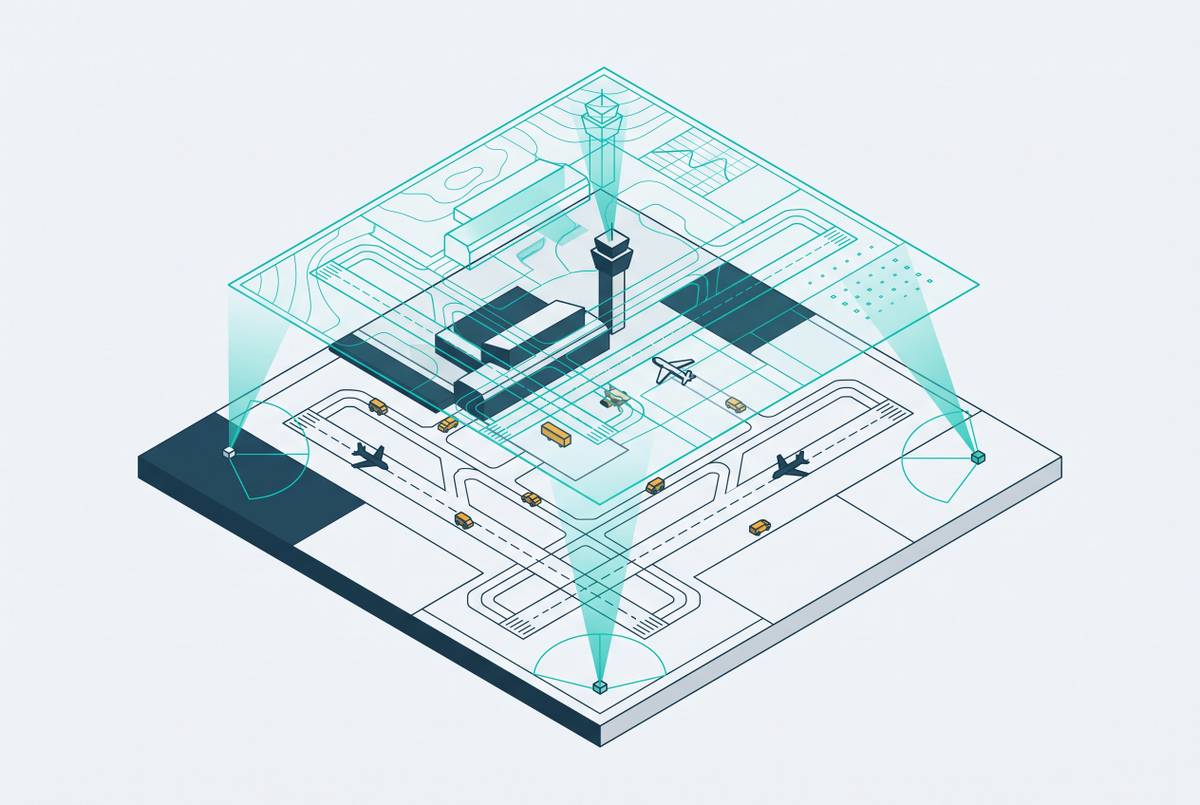
The system swaps the traditional tower cab for high-definition cameras, infrared sensors, microphones, and digital displays that together build a 360-degree, real-time view of the airfield. The FAA itself updated its own terminology for this technology, moving from "Remote Tower" to "Digital Tower," to reflect that what defines the system is its digital architecture, not where the controller happens to be sitting. A digital tower can sit on the airport it serves.
The capability goes beyond matching what a human in a cab can already do. In low-visibility and nighttime conditions, which is exactly when incursion risk tends to rise, a digital tower isn't a lesser substitute for a human in a cab. It gives the controller sensory reach a physical tower cannot provide. That shift in observational capability is also what makes the next layer possible: a digital tower generates a continuous, structured stream of sensor data rich enough for machine learning systems to work on, which is the raw material artificial intelligence needs to start catching conflicts before a controller does.
How AI-assisted incursion detection works inside a digital tower
AI detection inside a digital tower doesn't replace a controller's judgment. It handles a volume and variety of real-time data no person, no matter how experienced or attentive, could track by eye alone, and it turns that processing into alerts fast enough to matter before a conflict turns into a collision.
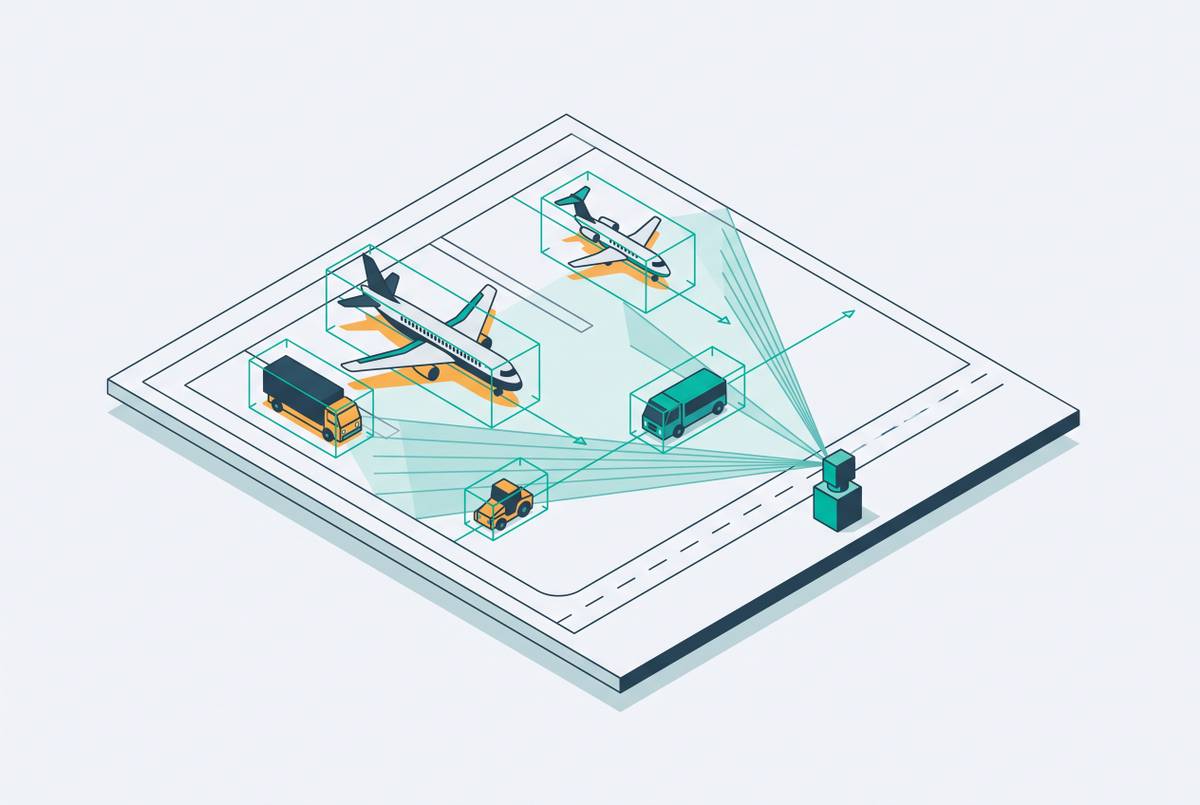
Most automated detection systems today work by projecting where an aircraft will be next, based on its current speed and heading pulled from surveillance data. The March 2026 LaGuardia crash made that blind spot concrete. A camera-and-AI system doesn't have that limitation, because it identifies a vehicle by recognizing what it is in the video feed, not by reading a signal it broadcasts. A fire truck with no transponder is still a fire truck on a runway, and a camera can see it regardless of whether it's transmitting anything.
Research already underway shows what this looks like in practice. TensorRT optimization lets the system run this analysis in real time on GPU hardware as a continuous process. In testing, INSy-RS improved conflict precision by 56.94 percent and cut incursion alert time compared to earlier state-of-the-art models, so controllers get a usable warning sooner.
A separate research effort out of another robotics research lab shows where this technology is headed next. The goal isn't only to catch a conflict as it's forming, but to predict a collision before it happens, giving a controller extra seconds, or in some cases minutes, to act. Combined, World2Rules can produce output that is interpretable and grounded in rules a human can check. Michael McCormick of Embry-Riddle Aeronautical University has pointed out that a camera-and-AI system tracking objects regardless of transponder status could have given the LaGuardia controller more information before the collision occurred, and he frames AI monitoring as an early step toward building that same awareness into the cockpit itself.
Why AI detection's value is highest where no controller currently works
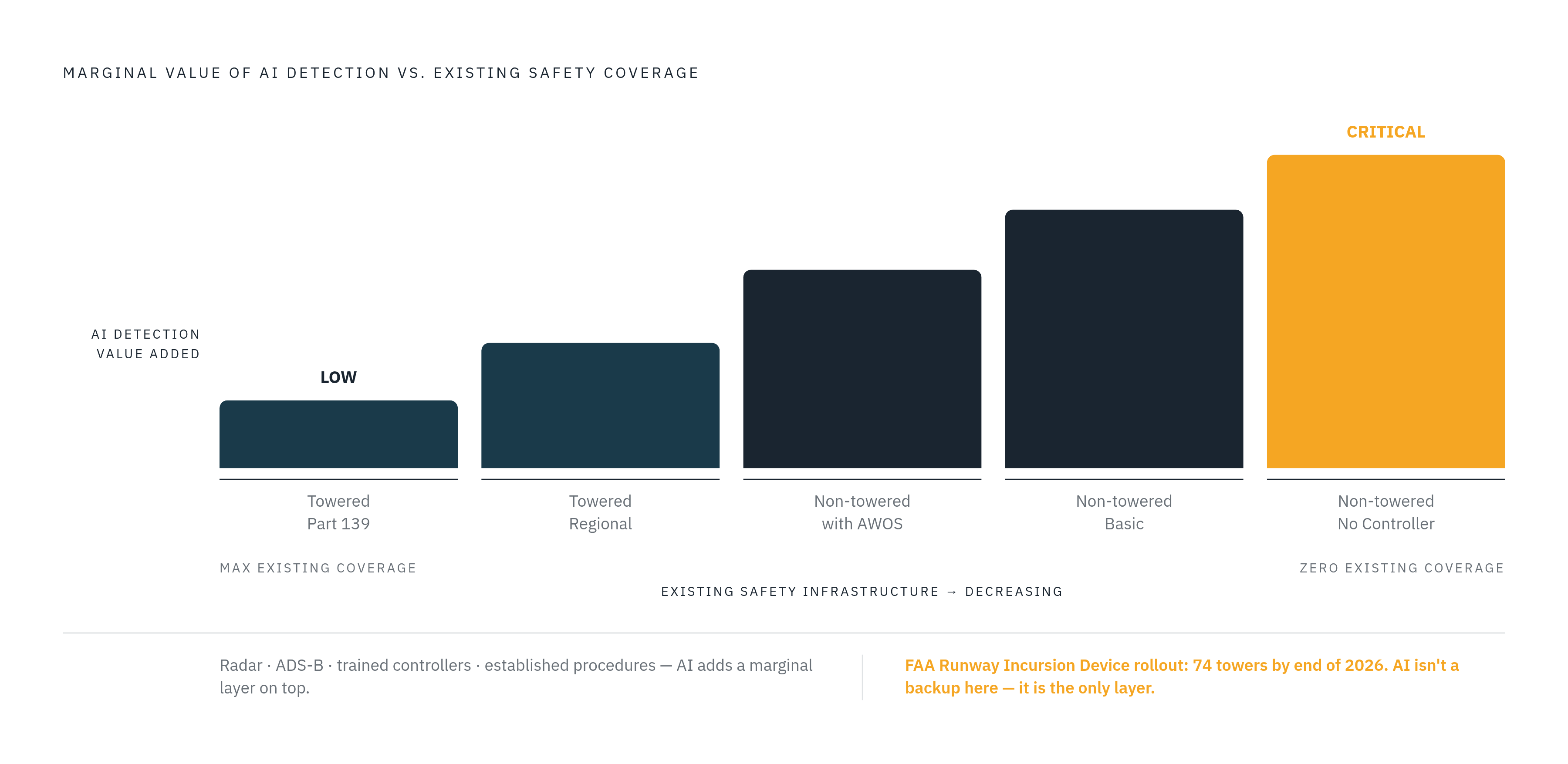
The value of this technology is not evenly spread across the airport system. At a towered airport, AI detection adds a layer on top of safety infrastructure that already exists: a trained controller, established procedures, radar coverage, and in many cases, ADS-B surveillance. At a non-towered airport, that same technology adds no layer. It's filling a vacuum where nothing was watching before. The marginal value of AI-assisted detection runs in the opposite direction of existing safety infrastructure: the less coverage an airport already has, the more a given unit of this technology changes what's possible there.
The FAA's current Runway Incursion Device rollout makes the point by contrast. The program will reach 74 towers by the end of 2026, with Centennial Airport in Colorado, Austin-Bergstrom International Airport in Texas, Charles B. Wheeler Downtown Airport in Missouri, and Portland International Airport in Oregon already operating it. That's real progress, and it's also, by design, a tower-only deployment. The vast majority of airports in the National Airspace System get nothing from it, because the program assumes a controller is already there to use the device. The Surface Awareness Initiative follows the same pattern: it expands across a number of towered airports but depends on ADS-B, and that technology is structurally limited at non-towered fields, where ground vehicles and other hazards often carry no transponder.
At a non-towered airport, a digital tower equipped with AI detection isn't a backup to a controller's judgment, because there's no controller there to back up. It becomes the only layer of real-time awareness operating on that field. A pilot flying the pattern at one of these airports today gets no sequencing guidance, no automated conflict alert, and no warning that a vehicle has moved onto the runway, unless a system like this is watching. Digital towers also have use beyond airports with no coverage at all: they can supplement existing Class D towers during the hours those towers close for the night, extending real-time monitoring into overnight periods that currently go completely unwatched.
The FAA's own Runway Incursion Mitigation program backs up the underlying logic here, showing that targeted intervention at specific high-risk locations meaningfully cuts incursions. A digital tower paired with AI detection is a version of that same intervention logic that doesn't depend on building physical infrastructure at each site. It can reach locations the RIM program's current approach cannot touch. The stakes get higher as drone traffic grows: as unmanned aircraft operations expand into the national airspace, non-towered airports will be the primary point where that traffic enters the system, turning runway safety at these fields from a local concern into a system-wide one.
What stands between the capability and widespread deployment at small airports
None of this is held back by the technology. The main obstacle to deploying AI-assisted digital towers at non-towered airports is the absence of a clear FAA regulatory pathway, and the institutional friction that fills the space where that pathway should exist.
The FAA Reauthorization Act of 2024 directed the FAA to build a formal program and publish milestones for approving the system design and operation of remote tower systems. An ad hoc approach to system design review creates uncertainty, and it hits small airports hardest, since they typically have the least administrative capacity and the fewest resources to navigate a process that doesn't yet have fixed rules.
There are real technical hurdles too. Assurance frameworks like the one built under Project Bluebird exist so someone can work through that risk systematically.
Weigh all of this honestly and the core obstacle is institutional. A capable, affordably priced system doesn't deploy itself: without a regulatory framework that gives airport sponsors a clear and predictable path to approval, adoption will stall no matter how good the cost or the performance numbers look.
The case for treating small airport runway safety as a national airspace problem
A national airspace system in which most airports run with no real-time runway safety coverage at all modernized its busiest, highest-visibility nodes while leaving its most numerous, and in some respects its most dangerous, gaps untouched.
The controller staffing shortage that has already drawn urgent national attention and calls for major congressional investment makes the case for technology-driven coverage on its own: airports that will never be staffed under any realistic scenario still need some form of real-time safety coverage, and digital towers with AI detection are the only approach that scales to reach all of them. This is the only model built to work at this scale and at this cost. The same logic applies to drone integration: as unmanned aircraft operations expand into the national airspace, they'll rely on runway safety infrastructure at the small airports that will serve as their primary operating environment, which makes AI-assisted digital towers a necessary enabler of that integration rather than a separate, optional initiative running alongside it.
Countries that have gone furthest with digital tower deployment, Sweden, Norway, and Belgium among them, treated the technology from the start as national airspace infrastructure, not as a local experiment to be tried out at one airport and reconsidered later. To close the gap, the FAA needs regulatory clarity, a realistic cost model built around what digital towers actually cost to deploy, and a shift in how the issue gets framed politically, from a niche concern affecting a handful of small airports to a basic condition of a genuinely modern national airspace system. The technology needed to close this gap already exists, is actively being refined through programs like INSy-RS and World2Rules, and is now deployable at a cost that changes the economics of small airport safety for the first time.