ADS-B Integration in Remote Tower Surveillance Displays
ADS-B technology now offers affordable surveillance for 91 contract towers that have operated blind.
The surveillance gap at small and mid-size airports is not a smaller version of the problem major hubs solve with radar. It concentrates risk in rare, severe events that national accident statistics tend to flatten out. At the thousands of U.S. airports with no operating control tower, pilots depend on the see-and-avoid principle and on radio calls over a common traffic advisory frequency, calls that remain voluntary rather than required by law, and that reliance on pilots spotting one another visually and choosing to announce their position means the system's safety margin rests on human habit, not on any ground-based check.
The gap does not disappear once a tower is added. Of the 265 airports in the FAA's Federal Contract Tower program, 91 have no radar or any other modern surveillance technology. Controllers at those facilities have to sequence arriving and departing aircraft with binoculars and radio reports, tools a tower controller already had decades ago. The absence of surveillance at these airports is not a byproduct of neglect so much as a stalled approval process: for years, contract tower controllers asked for better tools, and the FAA had not authorized commercial off-the-shelf surveillance products for use in those facilities. The technology existed. What did not exist was permission to use it. That distinction matters, because it means the risk these controllers managed for years was never a matter of unsolvable engineering. It was a matter of regulatory timing, and the people absorbing the consequences in the meantime were the pilots and passengers moving through airspace that nobody could fully see.
What ADS-B Does
ADS-B answers this problem because its design matches the exact constraints that make radar impractical at smaller airports. The name itself is an acronym, and each word in it describes a real engineering choice. It is automatic: no pilot action or outside interrogation triggers it. It is dependent on the aircraft's own navigation system, typically GPS, rather than on a ground radar antenna sweeping the sky and waiting for a return signal.
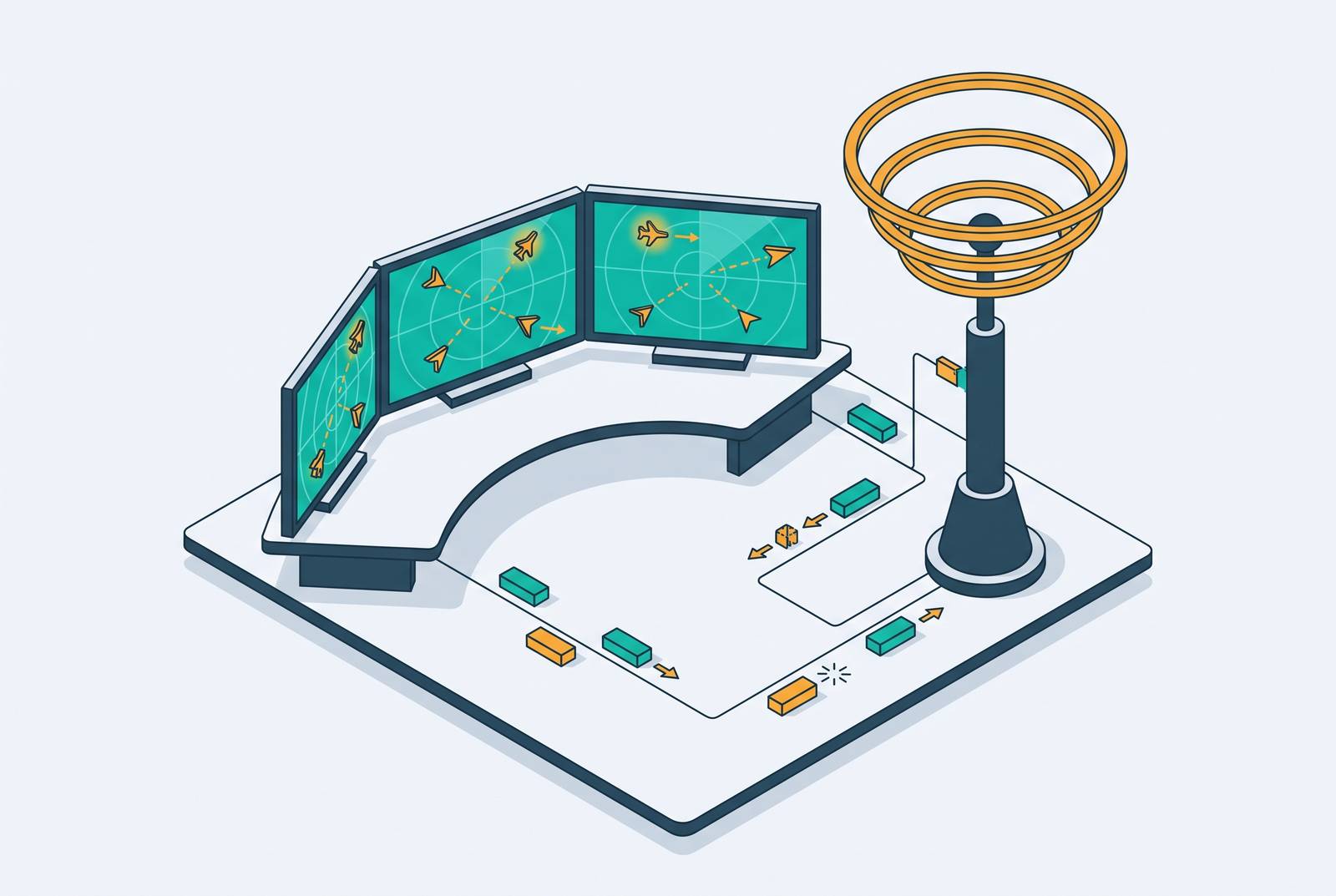
That difference splits into two halves that matter for anyone trying to understand what a ground display actually receives. ADS-B Out is the aircraft broadcasting its own position, derived from GPS, and in most cases that position is more accurate than what radar can measure, letting controllers manage and separate aircraft with tighter precision. ADS-B In is the receiving half: nearby aircraft and ground stations can pick up those broadcasts directly, supporting both traffic awareness in the cockpit and the kind of ground display that a remote tower depends on. Because ADS-B needs no interrogation equipment on the ground, a receiver and a display are enough to build a surveillance picture, at a fraction of the cost traditional radar demands.
The FAA's own ADS-B Airport Surface Surveillance Capability program treats ADS-B as one input among several, fusing it with surface movement radar, multilateration, and airport surveillance radar to track aircraft on runways, taxiways, and in the surrounding airspace. A federal mandate that took effect in January 2020 requires ADS-B Out on aircraft flying in Class A, B, and C airspace, and in Class E airspace at or above 10,000 feet MSL. That mandate built a large and steadily growing base of equipped aircraft whose broadcasts a ground receiver can pick up without any new hardware on the airplane. Canada reached this conclusion earlier: it has used ADS-B for surveillance in remote regions beyond radar coverage since January 15, 2009. The lesson from that program is direct. ADS-B delivers the most value where ground infrastructure is thinnest, and that is precisely the condition at most U.S. contract towers today.
Turning ADS-B Broadcasts into a Workable Traffic Picture
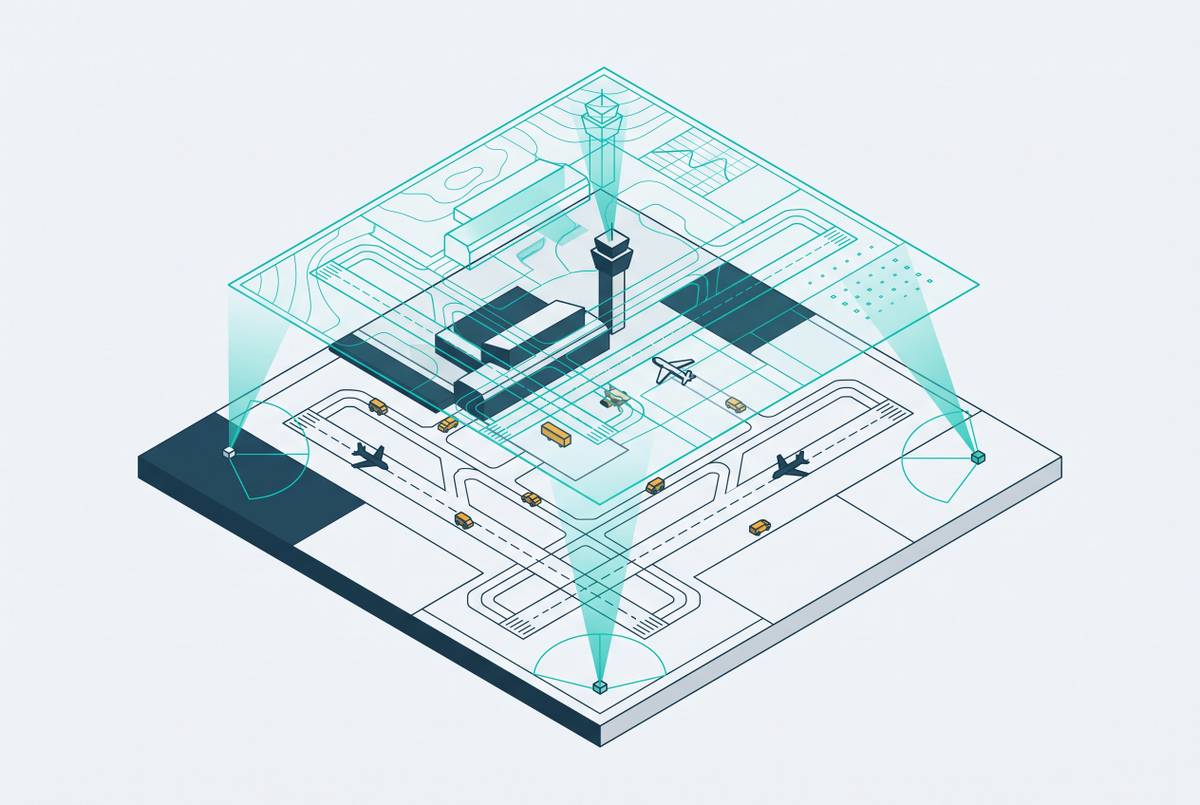
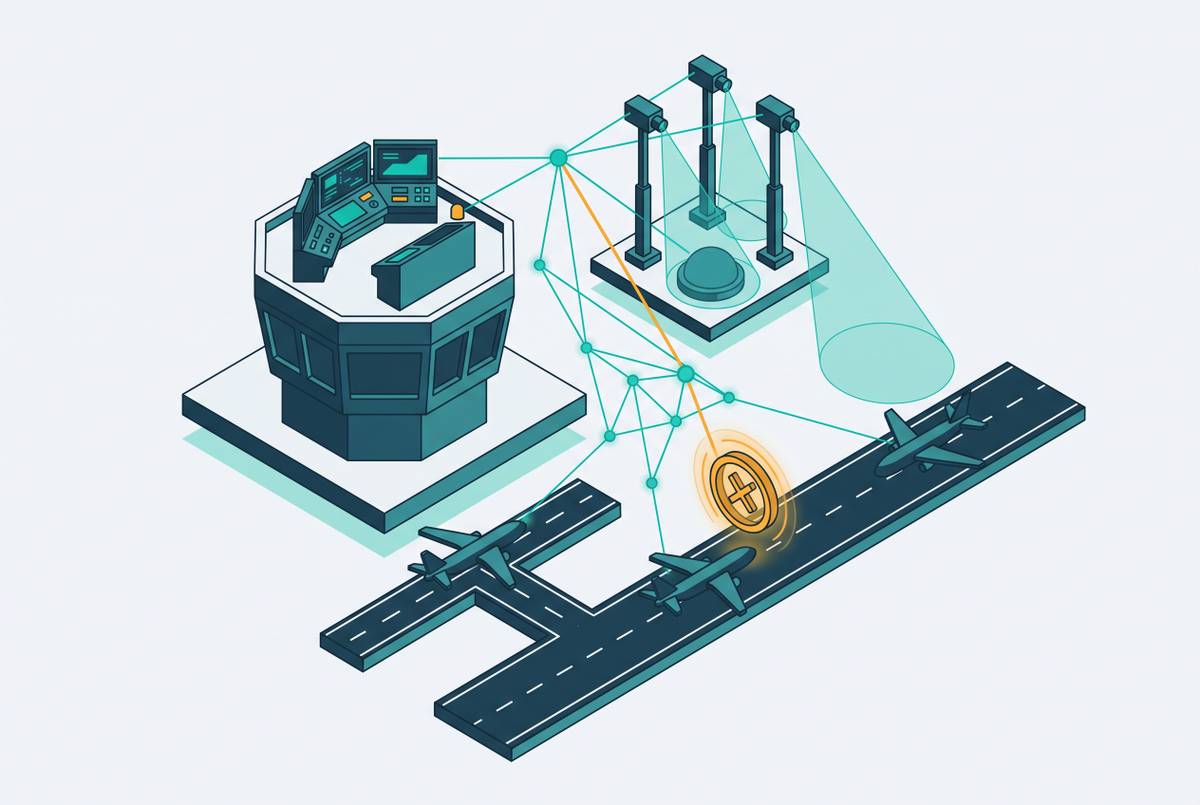
You need more than dots on a map to put ADS-B into a remote tower display. It means fusing a continuous stream of broadcast position data with a separate visual and audio sensor system to build one coherent picture a controller can actually work from. A remote tower replaces the physical glass cab with high-definition cameras, sensors, microphones, and digital screens that recreate a 360-degree view of the airfield in real time, piped to a remote operations center with latency held to one second or less even in the worst case.
ADS-B adds a layer on top of that camera feed that behaves independently of what the cameras can see. Every broadcasting aircraft shows up as a labeled, positioned target on the surface and airspace map whether or not it is visible on screen at that moment. That independence is what makes the system valuable in the conditions where visual observation breaks down: terrain blocking sightlines, low visibility, nighttime operations. A camera can lose an aircraft behind a ridge or in fog. An ADS-B target keeps broadcasting its position regardless of what the lens can resolve. Remote tower systems compound that advantage by layering in infrared cameras, automated object tracking, zoom, and augmented reality overlays, all of which can be cued directly to an ADS-B target's position rather than relying on a controller scanning a wide field of view for something small and far away.
The resulting picture covers more than the sky. It covers ground movement too, the taxiing and holding and crossing that happens on runways and ramps. A large share of incursions start there. If you deliver this as a managed cloud service rather than dedicated hardware bolted to every tower, you make the whole model affordable at airports that could never have justified a traditional radar installation. The system can detect ADS-B spoofing, meaning false position broadcasts, by using multilateration to confirm that a transmission's claimed origin matches the geometry of where it actually came from. A display that only showed broadcast positions without that cross-check would have no way to catch a falsified signal. Fusing the two data sources closes that hole.
The FAA approval that made ADS-B displays usable in contract towers
All of this was technically achievable well before contract towers could use it. The obstacle was regulatory, and it held until the FAA granted the first System Design Approval for a commercial Airborne Position Reference Tool. uAvionix received that approval, known as an SDA, for its FlightLine APRT product in August 2025. That made uAvionix the first and, so far, the only provider of a modern situational awareness display cleared for use in both Federal and Non-Federal Contract Towers.
FlightLine APRT delivers real-time aircraft position data from ADS-B through a web-based display, built for the 91 contract towers that have no surveillance capability. Its first installation went into Glacier Park International Airport, where difficult terrain and frequent low-visibility weather make you feel the absence of surveillance most acutely. That choice of site was not incidental. It placed the technology where the consequences of the old binoculars-and-radio method were most exposed.
The underlying architecture was not unproven when the approval arrived. The same FlightLine Surface Awareness System already runs in 14 FAA towers, so regulators had live operations to draw on before they cleared it for the contract tower environment. A dozen additional airports had already committed to installing it by the time the SDA was announced, a detail that says something important about where the real bottleneck had been. Demand for better surveillance tools was not waiting on anyone to build the technology. It was waiting on someone to approve it.
The legislative push to extend ADS-B surveillance across all contract towers without it
A single approved product at a handful of airports is a meaningful milestone, but the policy response that followed shows this is understood as a systemic fix, not an isolated product story. The Air Traffic Situational Awareness Enhancement Act, introduced February 26, 2026 by Senators Tim Sheehy (R-MT), Jeff Merkley (D-OR), Steve Daines (R-MT), and Ron Wyden (D-OR), would authorize installation of APRT systems at more than 90 federal contract towers that currently operate with no surveillance technology.
Support for the bill arrived from across the industry rather than from a narrow interest group: AOPA, the National Business Aviation Association, Airlines for America, the Regional Airline Association, and the U.S. Contract Tower Association all backed it, with Horizon Air adding its own statement of support. That range of backing, spanning pilots, business aviation operators, airlines, regional carriers, and the contract tower workforce itself, reflects how broadly the surveillance gap had already been recognized as a problem needing a fix, not a debate needing more study.
The underlying economics make the case for urgency. The Federal Contract Tower program handles 29 percent of all U.S. tower operations, but it consumes only a small fraction of the FAA's combined tower budget. The program is already a highly cost-efficient way to staff towers nationwide, and extending ADS-B surveillance into it builds on that efficiency rather than requiring the kind of expensive new infrastructure that would undercut it. None of this solves the separate issue of controller staffing levels at these facilities. What it does is make sure that the controllers who are on duty have a meaningfully better picture of what is happening around them, which keeps the operating margin intact when staffing is thin and traffic gets compressed into narrower operating windows.
How coverage gaps in ADS-B affect display reliability
ADS-B surveillance is only as complete as the population of aircraft actually broadcasting a position. The FAA's 2020 mandate brought most of the IFR fleet and nearly all commercially operated aircraft into compliance. Aircraft that fly exclusively in uncontrolled airspace below the mandate's altitude and airspace thresholds, however, can still legally operate without ADS-B Out. Those aircraft simply do not appear as broadcast targets.
In a remote tower display, if an aircraft is unequipped, it stays invisible to the ADS-B layer. The controller falls back on the camera and audio feeds for that aircraft, the same way a controller in a traditional tower would rely on looking out the window and listening to the radio. The display adds a data layer on top of visual observation, and the controller still relies on that visual observation directly. A controller working one of these systems is not handed a false sense that the picture is complete. The system is built, and used, with the understanding that it is not.
Spoofing, the broadcast of a false position, is a separate and well-documented integrity concern in ADS-B research. The accepted countermeasure is multilateration-based validation, where a network of ground receivers checks the geometry of an incoming signal against its claimed position and flags a mismatch. The practical way the field handles both problems, incomplete coverage and the risk of falsified signals, is layering: ADS-B targets, camera and sensor feeds, pilot radio calls, and standard air traffic procedures together make up the situational awareness picture, with no single layer treated as sufficient by itself. As more aircraft carry ADS-B and receiver networks expand, including multi-signal arrays that also pick up Remote ID and other broadcast types, the gaps in that first layer will keep narrowing, and the tower display needs no redesign for that to happen.
ADS-B Integration and UAS Traffic at Remote Towers
The same ADS-B infrastructure built to give a remote tower controller awareness of manned aircraft turns out to be the foundation for managing drone traffic in the same airspace, which makes the investment pay off twice. ADS-B receiver arrays built for ground-based monitoring are increasingly designed to pick up more than transponder signals from manned aircraft. Many now capture UAS Remote ID broadcasts, FLARM signals, UAT, and other transmission types using the same hardware that already serves manned traffic.
That matters directly for beyond-visual-line-of-sight drone operations, because no one can see the drone and the manned traffic in the same glance, so these operations need positive awareness of manned aircraft operating nearby. A ground display capable of receiving those broadcasts at the local airport is the infrastructure that makes that coordination possible. A remote tower with ADS-B integration can give UAS operators and drone traffic management systems the traffic awareness they need to coordinate safely with manned aircraft, and it can do that without a fully staffed, physical control tower at every site where drones operate.
Norway's NINOX program offers a working example of where this leads. The route from an ADS-B surveillance display to a fuller airspace management role is already being built, tested, and operated.
What ADS-B integration means for airports that have never had surveillance
The path proven at contract towers, ADS-B data delivered as a managed cloud service to a web-based display, is the same path that makes digital air traffic control possible at airports that have never had any control tower, staffed or otherwise. It is a solution designed from the start for a tier of airports that traditional infrastructure was never going to reach.
For an airport that cannot clear the FAA's benefit-cost threshold required to justify a conventional tower, digital ATC with ADS-B integration is the first realistic path to any surveillance, at a cost those airports can actually plan around. The hardware required is modest by comparison to a radar installation: a receiver array, a camera system, and a managed data connection, not new concrete, new towers, or new maintenance contracts stretching decades into the future.
The safety argument lands hardest at exactly these facilities. Every fatal runway incursion accident in recent years at a non-Part 139, uncontrolled airport fits the pattern this piece opened with: a low-frequency, high-consequence event that even partial surveillance is built to catch before it happens. A digital tower with ADS-B integration can also step in as backup or after-hours coverage at airports that already have a staffed Class D tower, providing a situational awareness picture when that tower is closed for the night, without the cost of building and staffing a second facility.
The national airspace system cannot claim to be modern, or fully safe, if its surveillance stops at the boundary of airports large enough to afford the old way of doing things. ADS-B integration into remote tower displays is what extends real, working situational awareness to the rest of the system, to the contract towers still waiting for a legislative fix, and to the thousands of airports that have never had a surveillance tool of any kind.