Non-Cooperative Target Detection at Non-Towered Airports
Radar and cameras can spot aircraft that hide their location or stay silent.
If an aircraft carries no working transponder, or its pilot never keys the mic, it stays invisible at most U.S. airports that have no control tower. This piece explains why that detection gap exists, what it costs, and which technologies can actually close it.
Why non-towered airports have a structural detection blind spot
At most U.S. airports, no one and nothing is watching the whole picture. There is no controller with a radar scope cross-checking every aircraft in the pattern, no electronic authority sequencing arrivals and departures, no backstop if something goes wrong. A towered airport gives pilots an external check: a human being, looking at returns on a screen, who can tell two aircraft they are converging before either pilot sees the other. Without the tower, that check no longer exists.
What fills the space instead is a voluntary system. Pilots announce their position and intentions over the shared radio frequency used at the airport, scan visually for other airplanes, and follow a shared set of procedures that everyone is supposed to know and follow. It works only when every pilot in the area chooses to participate, every time. Insufficient communication between pilots in the same area is the most common cause of safety incidents near non-controlled aerodromes, and near-collisions occur twice as often when a pilot had no prior warning of other traffic, whether that warning would have come by radio or by a traffic alerting system such as TCAS. The entire model rests on an assumption of universal, voluntary cooperation, and that assumption breaks the moment one aircraft doesn't hold up its end: no radio, no transponder, or simply a pilot who skips the call. If that happens, nobody else in the pattern can tell the self-separation model has already failed.
A report filed with a federal aviation safety reporting system shows what that failure looks like in practice. Only afterward did the airport manager tell them that another aircraft, inbound on final, had never made a CTAF call. That aircraft was at roughly 500 feet on final before the crew in question had any idea it was there, and the only reason anyone caught it was that the airport manager happened to see it and say something. No controller caught it. It is as clean an example as exists of an aircraft that was simply not there, as far as the detection environment was concerned, until it was nearly on top of them.
How surveillance technology's taxonomy defines the detection gap
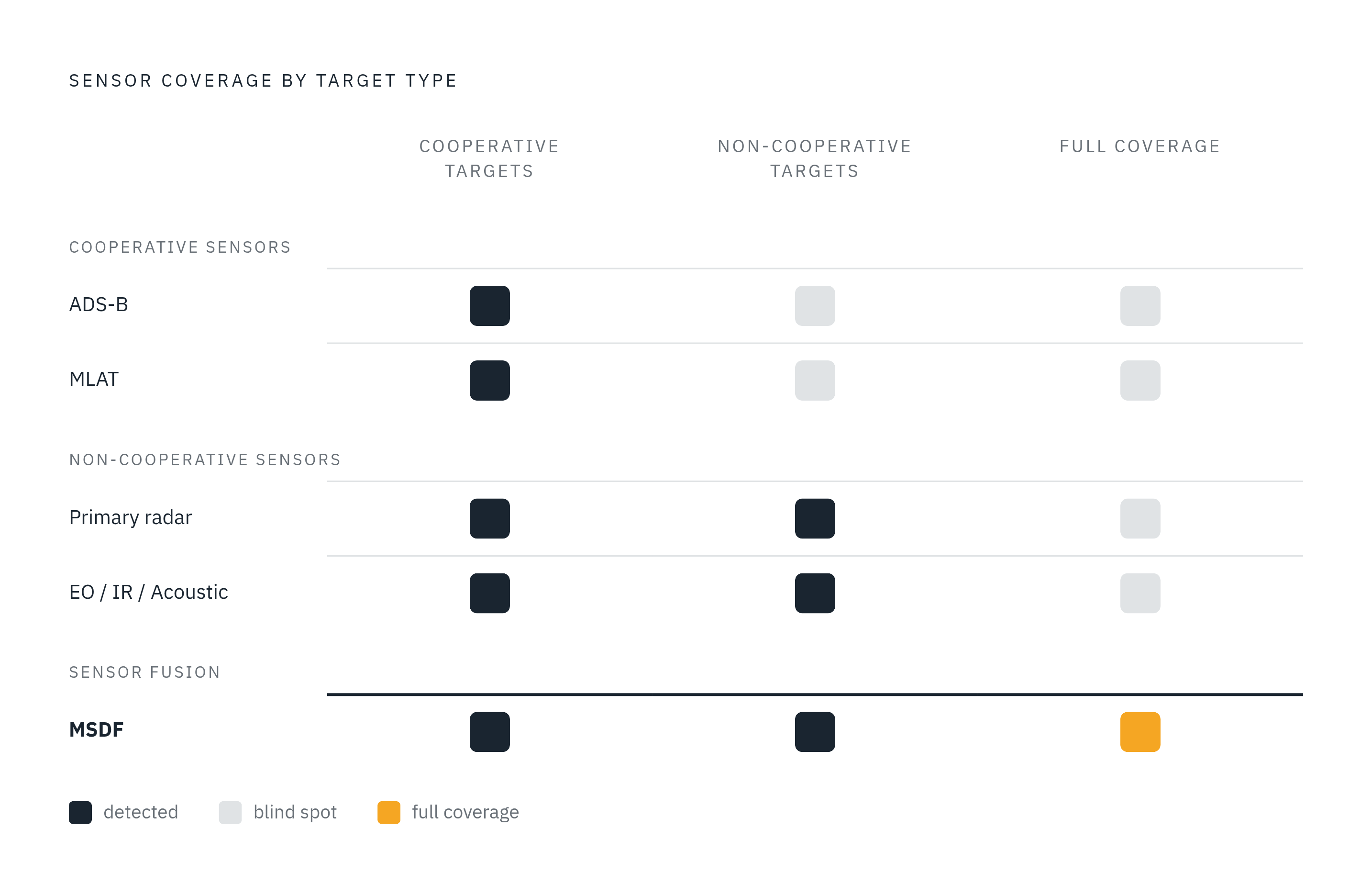
Surveillance technology used in aviation falls into one of two categories, cooperative or non-cooperative, and whether a system can see a target that refuses to cooperate depends on which one it belongs to. Cooperative systems, chiefly ADS-B and multilateration (MLAT), work by having the aircraft report its own position outward. The system does not search for the airplane; it listens for the airplane to announce itself. That means any aircraft without an active, functioning transponder does not fail to register as some kind of glitch. It was never going to register in the first place, because the entire method depends on a signal that aircraft simply isn't sending.
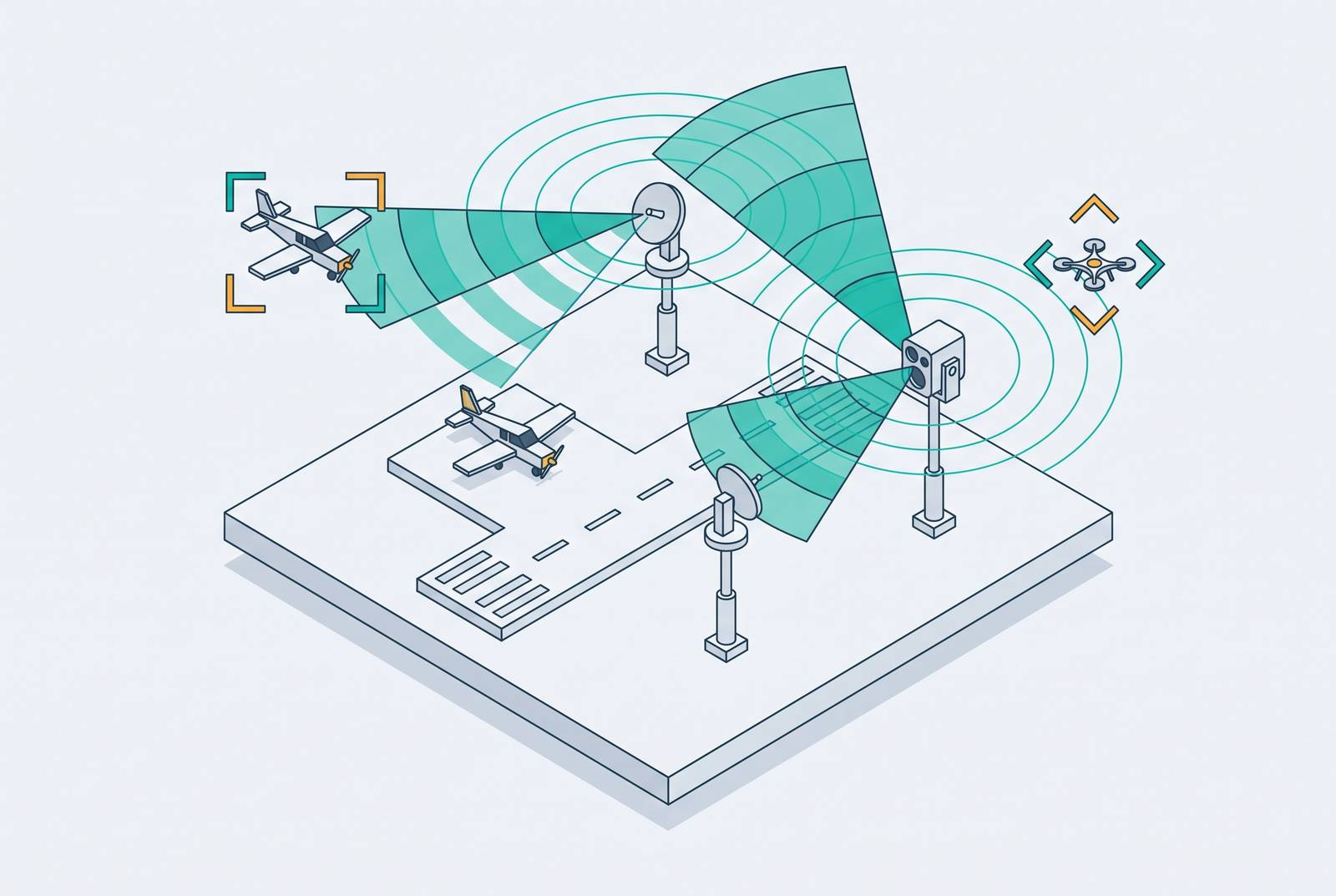
Non-cooperative systems work the opposite way. Primary surveillance radar (PSR), electro-optical and infrared (EO/IR) sensors, acoustic sensors, and video-based systems detect a target on their own terms, regardless of what equipment that target carries or whether its pilot has any interest in being seen. RF-based approaches, including ADS-B and various proprietary systems, work well for cooperative surveillance, but they fail outright against non-cooperative or autonomous unmanned aircraft, and they run into coverage gaps at low altitude regardless.
This distinction matters most at exactly the airports where it is least likely to be addressed. ADS-B does a reasonable job counting operations at non-towered airports, but it isn't reliable as the sole method, because it will always miss non-cooperative traffic by definition: any target without an active transponder will not be detected or tracked by an MLAT system, full stop. The gap is built into the population of aircraft these airports actually serve, not a rare edge case.
The incident record on non-cooperative risk at uncontrolled fields
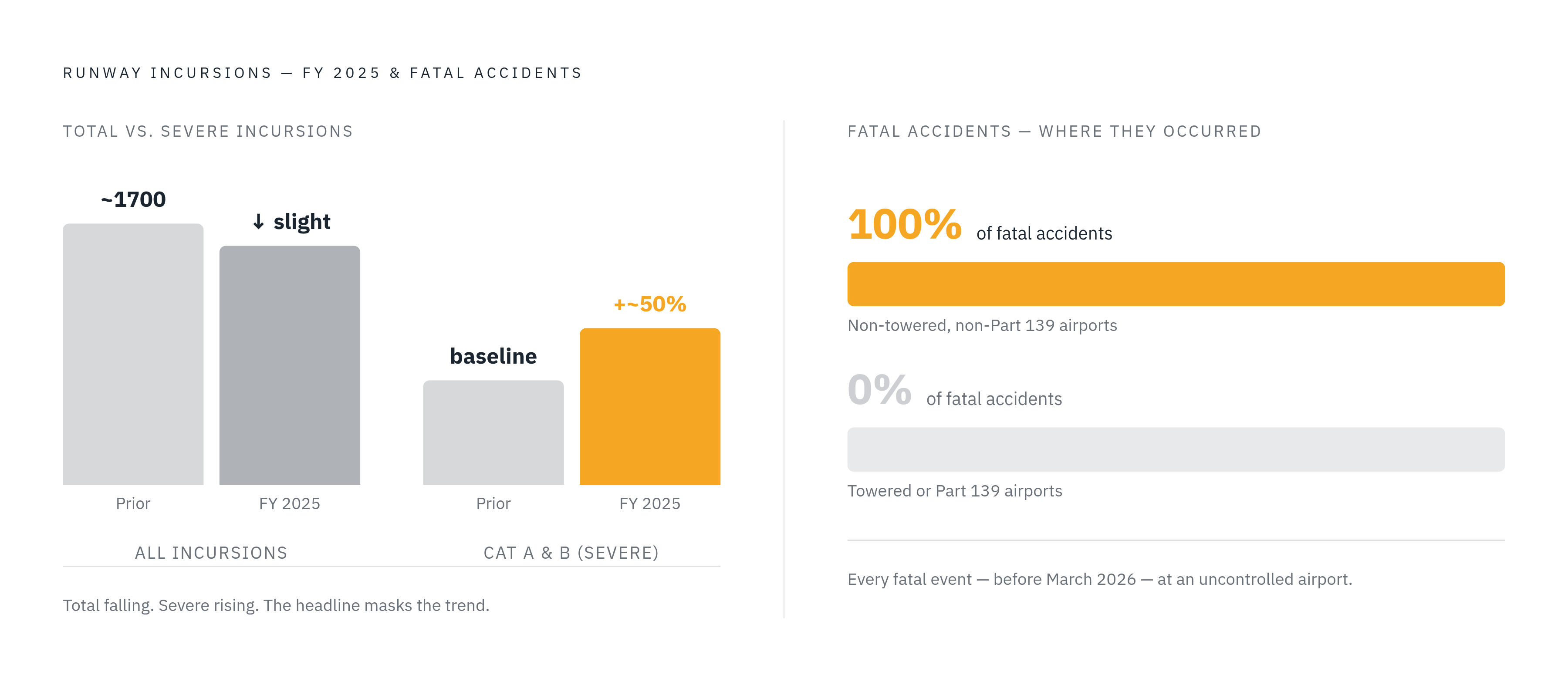
The aggregate numbers on U.S. runway safety look stable at first glance, and that stability is misleading. The more important finding sits inside that total, not in the headline number. Severe incursions, Category A and Category B events, rose by nearly half in fiscal year 2025 even as total events fell slightly. There were fewer events overall, but more of them came close to killing someone.
Before 2026, every fatal runway incursion accident in recent years happened at a non-Part 139 airport, a smaller field that has no control tower. The March 2026 fatal collision at LaGuardia broke that pattern for the first time, but the broader history still points the same direction: a small number of fatal events, concentrated almost entirely at uncontrolled facilities. Pilots file three-quarters of near-collision reports about operations within ten nautical miles of a non-controlled aerodrome.
The Flight Safety Foundation's 2024 Safety Report named runway incursions and excursions as persistent safety issues across the industry, and pointed to communication breakdowns and noncompliance with standard operating procedures as contributing causes. That finding reinforces a point this piece has already made from the ground up: harm concentrates on the ground, in the pattern and on the runway, not only in the air. And the aircraft doing the most damage to this picture is the one that leaves no trace beforehand. It never made a CTAF call, never squawked a code, and never announced itself to anyone. The detection gap is invisible in safety statistics until the event it caused occurs, and only then does it register as a casualty.
Primary radar and multi-sensor fusion as the only complete answers
Closing the non-cooperative detection gap requires sensors that work without any help from the target, and research in this field has converged on combining several of them. Primary surveillance radar remains the foundational tool for this job. It sends out its own energy and reads whatever bounces back, asking nothing of the aircraft in return, and that independence is what gives it a layer of protection no cooperative system can match on its own.
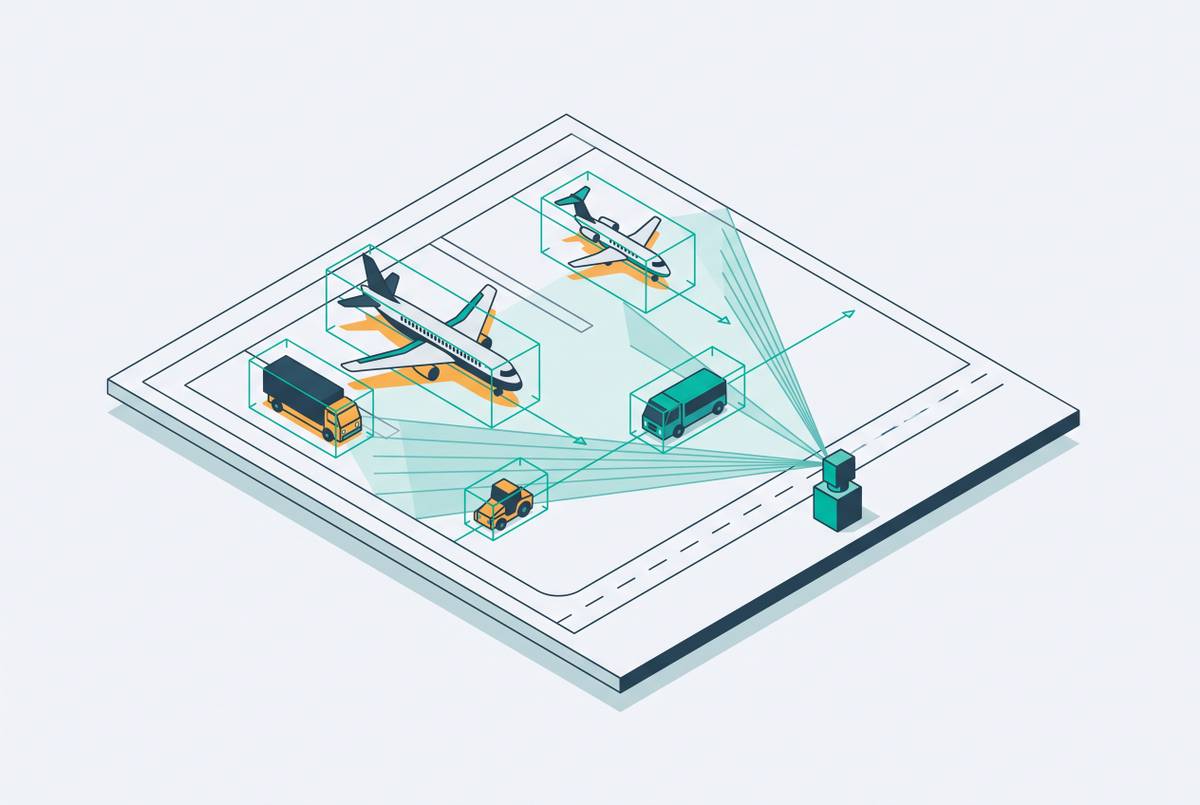
Radar alone has limits, particularly at low altitude and close to the ground, and that's where EO/IR cameras, acoustic sensors, and video-based tracking extend coverage. These systems can track cooperative and non-cooperative aircraft alike, so they fill in the gaps radar struggles with. Multi-Sensor Data Fusion (MSDF) goes a step further: it combines cooperative data from ADS-B with the returns from non-cooperative sensors, so you get one unified picture of the traffic in an area. Some of the most recent work applies deep learning, including recurrent neural networks, to the problem of Non-Cooperative Target Recognition, extracting features directly from raw radar signals to classify targets automatically, without any transponder data.
The practical dividing line runs straight through the sensor list. ADS-B and remote ID can track only the cooperative half. If full non-cooperative coverage is the goal, the sensor set has to go beyond ADS-B, there's no way around it. The same logic applies to drones: RF monitoring tools built for cooperative UAS identification, including proprietary systems like DJI's now-discontinued AeroScope, worked fine for aircraft that wanted to be seen, but failed against non-cooperative or autonomous drones. The fusion approach that closes the manned-aircraft gap closes the drone gap at the same time, using the same architecture. None of this is unproven technology waiting on a breakthrough. What stands between the research and the runway is cost.
The economics that make unassisted sensor deployment nearly impossible at non-towered airports
The reason most small airports have no tower is money, and the same constraint makes installing non-cooperative sensors on their own almost as hard. Non-cooperative sensor installations, primary radar especially, carry their own heavy capital and infrastructure costs, costs that most non-towered airports simply cannot absorb on their own balance sheet.
Academic modeling of this problem lands on a direct conclusion: if an airport only needs to track cooperative aircraft, ADS-B and remote ID are the cheapest and most practical sensors available. Covering non-cooperative traffic fully costs substantially more, a serious constraint for small airports running on thin margins. Most airports dealing with chronic funding shortfalls and limited revenue streams are the ones with the greatest need for non-cooperative detection, yet they have the least ability to buy it on their own.
The trap compounds on itself. So it keeps operating with a coverage gap that the self-separation model, by its nature, cannot reliably fill. Grant structures built around runway pavement and approach lighting weren't designed with sensor fusion platforms in mind, and that mismatch leaves airport operators stuck choosing between an infrastructure category that doesn't fit their need and a budget line that doesn't exist.
Digital tower technology's integration of non-cooperative detection within an affordable architecture
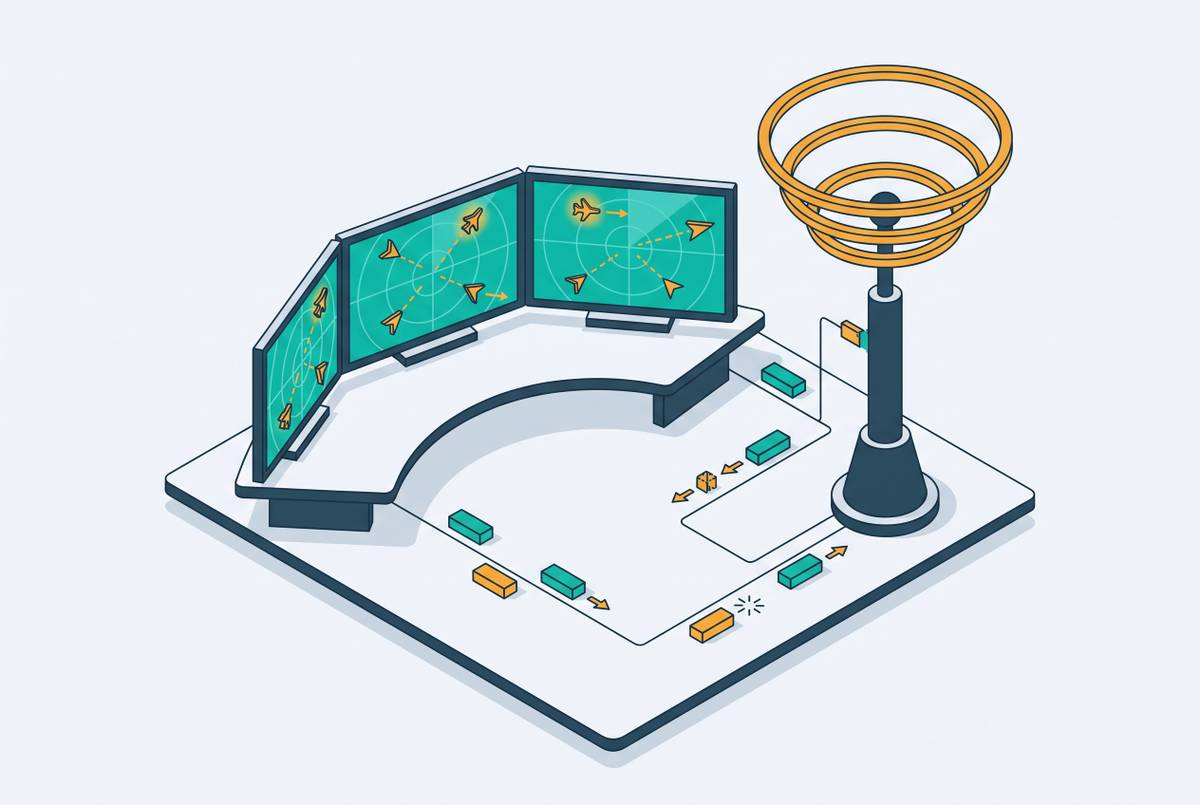
The way out of that trap is a different kind of platform, not a cheaper version of the same one. Digital tower systems give Air Traffic Control Specialists the visual information they need to deliver tower services through dedicated digital displays instead of a physical glass cab, so you cut the biggest infrastructure cost of a traditional tower but keep the control authority intact. The FAA has shifted its own terminology from "Remote Tower" to "Digital Tower" specifically to reflect that the technology doesn't have to sit off-site, which opens up far more flexibility in how and where it gets deployed.
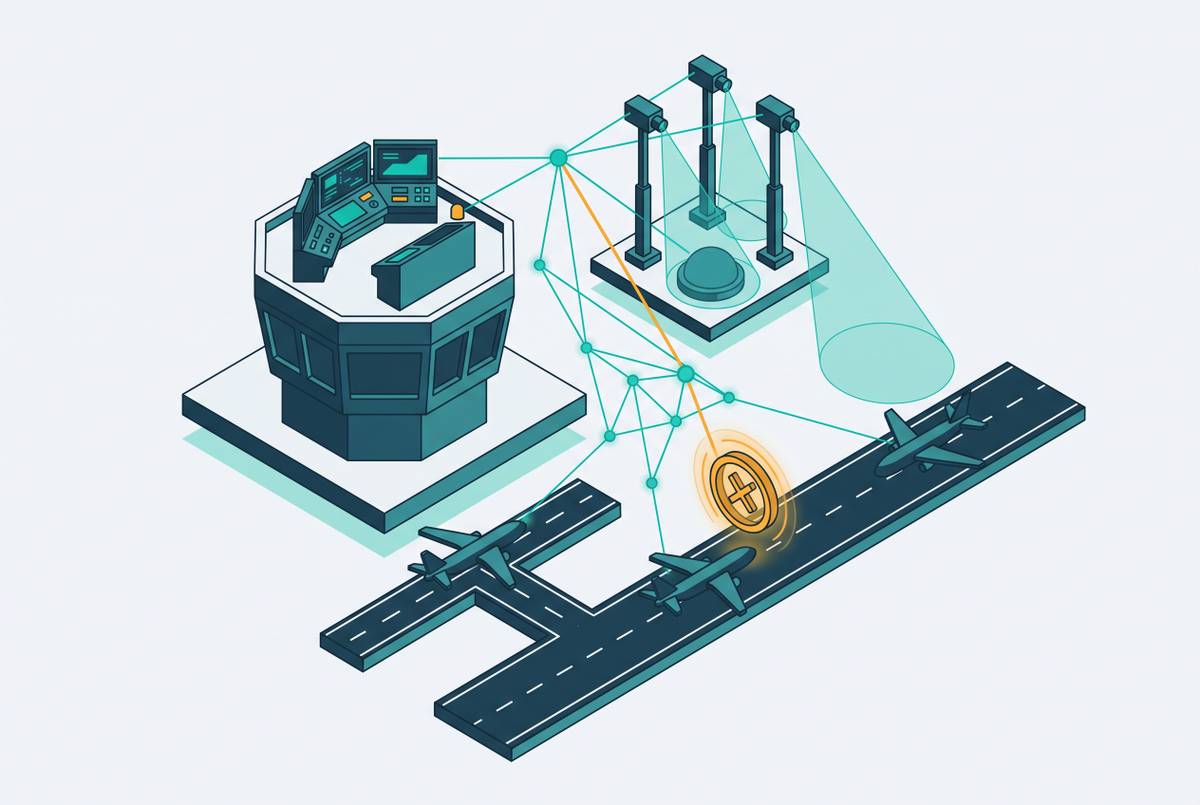
That flexibility reaches airports that have never had any tower service. Digital Tower systems can be installed at airports currently in Class E or Class G airspace that want to move up to Class D, bringing full tower services, and the surveillance authority that comes with them, to fields that have operated without either for their entire history. The AI layer in these systems supports fusion of optical and radar data, flags potentially hazardous situations automatically, and identifies abnormal patterns and possible runway conflicts early, applying the multi-sensor fusion approach described above as part of the tower service.
The architecture is moving from prototype toward daily operation. Atrak's MAESTRO Digital Remote Tower, unveiled at Airspace World in Lisbon in May 2026, pairs advanced camera systems with AI-enhanced sensors, and it has been under development and testing at Václav Havel Airport Prague for more than 18 months, linked to real-time operational data, communications, and surveillance infrastructure the whole time. Germany's DFS already runs a remote tower center that manages both Saarbrücken and Erfurt-Weimar airports from Leipzig, so one digital facility can control multiple airports at once in daily operation, not just on paper.
The same workforce flexibility that lets one facility run two airports also solves the staffing cost that has kept tower service out of reach for small fields for decades. These platforms carry their non-cooperative detection straight over to drone traffic, because the same methods that catch a manned aircraft flying without a transponder can also catch an uncooperative or autonomous UAS. And digital towers don't need to replace an existing tower to add value: they can run alongside a Class D tower, covering nighttime hours when the physical tower would otherwise be closed, or stepping in as backup during an outage, which makes the architecture useful across airports of every size and every current service level.
What airport operators and policymakers must accept about detection
Airport operators have long treated surveillance as something that comes bundled with a full control tower, a feature they get if they can afford the tower and go without if they can't. Digital tower architecture breaks that bundle apart. Surveillance, including non-cooperative detection, is now something an airport can acquire on its own terms, without first clearing the far higher bar of building and staffing a traditional tower.
The incident record makes clear that this isn't a cosmetic distinction. Fatal events concentrate at uncontrolled facilities, severe incursions are climbing even as total events hold flat, and the non-cooperative aircraft stays invisible in every dataset until it has already caused the thing the data is trying to measure. A non-towered airport does not carry the same risk profile as a towered one, and choosing to operate without surveillance is an active choice with consequences, not a neutral default. The self-separation model has a hard ceiling built into it: it only works as well as the least cooperative aircraft using the field on a given day, and no amount of refining procedures or reminding pilots to make their calls will ever let that model detect a target that simply doesn't announce itself.
Policymakers have their own adjustment to make. Grant structures built for pavement and lighting upgrades were never calibrated for surveillance technology, and that mismatch is now starting to get attention: the One Big Beautiful Bill set aside $50 million specifically for digital and remote towers, a sign that a recalibration is underway. You cannot call the airspace system modern when most of its airports sit entirely outside any surveillance architecture, but affordable digital tower platforms, with real non-cooperative detection capability, can let modernization reach the airports that need it most.
The practical move for an airport operator starts with a basic inventory: know which aircraft actually use the field, work out what share of that traffic is non-cooperative, and then evaluate a digital tower platform, sensor suite included, as a fundable alternative to the current gap rather than as a scaled-down substitute for something still out of reach.