Digital Tower Product Matrix for Airports With No Control Tower Budget
Three digital options let airports without tower budgets choose their level of ATC service.

Airports that cannot afford a control tower have three digital options: passive awareness infrastructure, a single-airport digital tower, and a shared multi-airport hub. The lowest-cost tier helps pilots see more but provides no ATC service, while the shared hub does the most to spread the costs of controllers and infrastructure across airports. This digital tower product matrix maps those choices against the funding, certification, and staffing an airport can realistically sustain.
Why the severity of runway incidents at non-towered airports is getting worse, not better
Severe Category A and B runway incursions rose by nearly half in fiscal year 2025, while total incursions fell about one percent. The aggregate count therefore offers limited reassurance. Fewer events do not establish that the most dangerous encounters are becoming less likely. The DOT Inspector General’s March 2025 audit found that the FAA lacks an integrated approach to analyzing runway incursion data and identifying risks. That gap limits confidence in explanations of what is driving the severity increase.
The same agency attributes close to 62 percent of all U.S. runway incursions to pilot deviations. At a non-towered airport, the operational-incident category disappears because there is no controller to generate one. Risk remains in the other two categories, without an external authority present to intervene. A lower count in one category cannot compensate for the absence of active control.
The Australian Transport Safety Bureau reports that three-quarters of the near-collision reports it gets from pilots concern flights within ten nautical miles of a non-controlled aerodrome. It also reports that near-collisions occur twice as often when a pilot had no prior warning of other traffic through radio or a traffic alerting system like TCAS. Advance awareness is therefore a relevant distinction between technology tiers. It is not, however, equivalent to ATC service, and the matrix must keep those functions separate.
Why the airports most exposed to this risk have no realistic path to a traditional tower
FAA approval records estimate that a traditional tower would cost between $10 million and $24 million to build at each of Johnston Regional Airport and Raleigh Executive Jetport. Those figures establish the scale of the capital obstacle. AIP Non-Primary Entitlement grants for GA airports do not approach even the lower estimate, including when funds are carried over for up to three years across four fiscal years total. Banking an entitlement does not bridge that gap. The conventional option is constrained before an airport selects a design.
The ASCE 2025 Infrastructure Report Card identified aviation infrastructure needs that vastly exceed projected funding from all sources over the current decade. The shortage is broader than any one airport. Non-commercial fuel taxes brought in less than one percent of the Airport and Airway Trust Fund’s excise tax revenue in 2024, while GA airports got roughly a third of total AIP funding. Those shares show why an airport can receive support and still lack the resources for a tower.
Attracting and retaining controllers at small, remote fields is a documented difficulty, independent of the capital budget. A less expensive building would not resolve that problem. Digital alternatives therefore need evaluation on two axes, namely the infrastructure they replace and the staffing model they make possible.
What digital tower technology actually does and why the FAA renamed it
A Digital Tower Center gives the controller camera and sensor feeds on dedicated digital displays in place of a direct view through tower windows. Software can overlay flight data, meteorological updates, radar tracks, and aircraft callsigns onto video. This reduces the time spent looking away from the active runway environment. The technology changes how visual information reaches the controller, who must still interpret it.
Infrared and high-definition cameras let controllers see at night and in low-visibility conditions. Enhanced zoom can reveal hazards such as wildlife that would be invisible to the naked eye at distance. These functions can improve on unaided observation under some conditions. They also explain why camera infrastructure has potential value below the level of a full ATC facility. Its operational role nevertheless depends on whether a controller is providing service through it.
The FAA changed its terminology from “Remote Tower” to “Digital Tower” to describe the technology without implying that the facility must be off-airport. Location is a deployment choice, so an on-site display facility and a remote center can belong to the same technical category. Controller situational awareness in this virtualized environment remains an active research concern, so enhanced imagery does not remove the human factors challenge.
The economic lever that changes the per-airport cost calculation through multi-airport control from a single hub
The Single Remote Tower model assigns one controller to one airport, while the Multiple Remote Tower model allows one controller to manage several. That distinction changes the operating-cost equation. A shared Remote Tower Center can also distribute its infrastructure, certification, and maintenance overhead across participating airports. A digital installation serving only one airport cannot capture the full benefit of shared staffing.
Norway’s Bodø model provides an operational example of a center serving multiple airports and approved for further expansion. Sweden’s Sundsvall Centre has demonstrated the approach at a smaller national scale since 2015. These examples establish the shared-center model beyond a single-airport demonstration. They do not make every form of simultaneous control interchangeable. Serving several airports from one center and assigning several airports to one controller are distinct operating arrangements.
Avinor received Norwegian Civil Aviation Authority approval in 2026 to trial multiple operations for four selected airport pairs, including Rørvik–Namsos, Mehamn–Hasvik, Vardø–Berlevåg, and Røst–Svolvær. The trial runs until the end of September 2026. It represents the leading edge of simultaneous multi-airport operation. An airport director involved in digital tower deployment estimated that a digital remote tower costs roughly half the price of a traditional ATC tower. Shared operation offers a mechanism to reduce the per-airport burden further, but that estimate is not a project quotation.
The policy shift that moved digital towers from experiment to funded program in the U.S.
The FAA Reauthorization Act of 2024 included explicit remote tower language in Section 621. That established a congressional directive toward a deployment pathway beyond limited experimentation. The “One Big Beautiful Bill,” signed in July 2025, then allocated billions for NAS overhaul under the FAA’s Brand New Air Traffic Control System, or BNATCS. It included $50 million specifically for advancing digital remote towers.
FAA Flight Plan 2026 named deployment of digital remote tower technology at the first key site as a stated goal. Federal procurement 693KA8-26-T-00016 provides a further program context for airports considering deployment. Policy direction, appropriation, and procurement now exist together. They do not establish that every airport can obtain an award or put a system into operation immediately. Airports still need both access to funding and technical approval.
The FAA System Design Approval process, or SDA, remains the principal certification bottleneck for an ATC system entering the NAS. It is expensive, lengthy, and required before operation. For an airport without substantial reserves, that burden influences which tier is accessible and which partnership structure is viable. Joining through a provider or shared program changes who has to do the work of getting certification. The distinction is central to comparing a standalone installation with a regional hub.
What digital tower options exist for airports that cannot afford a traditional tower
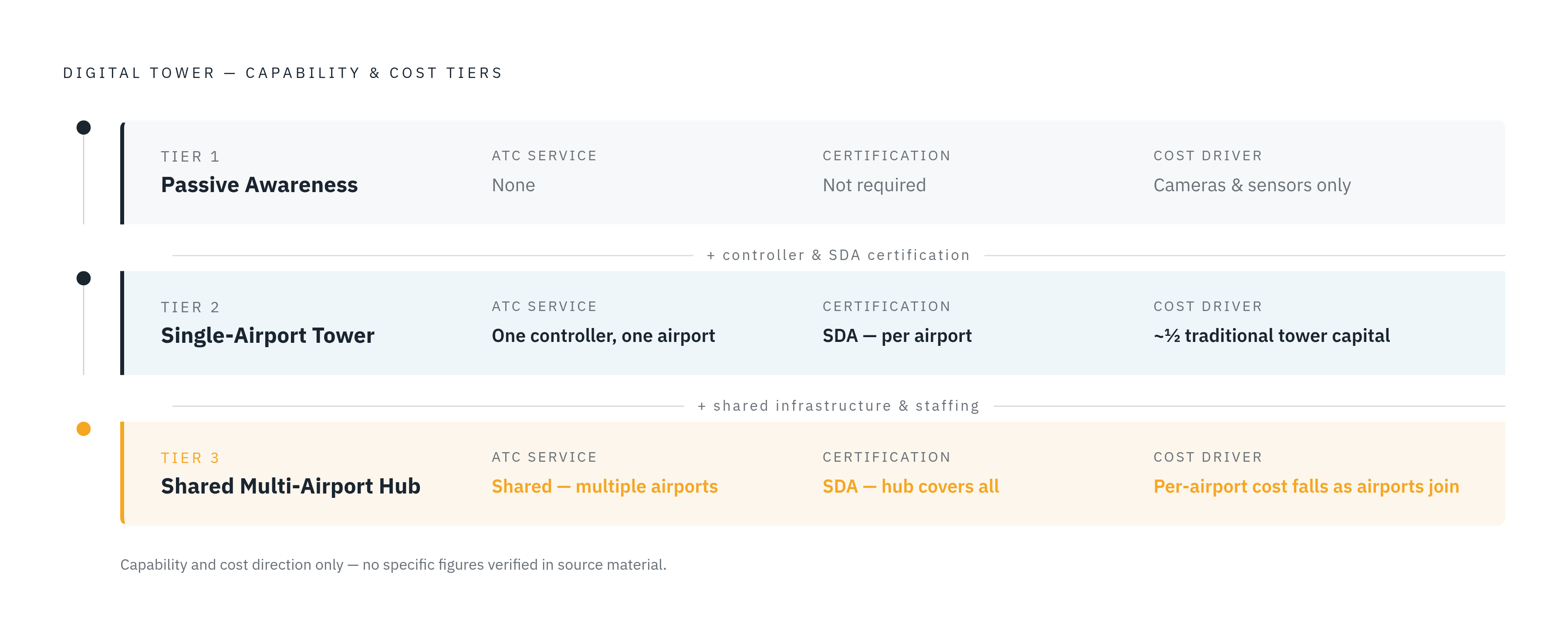
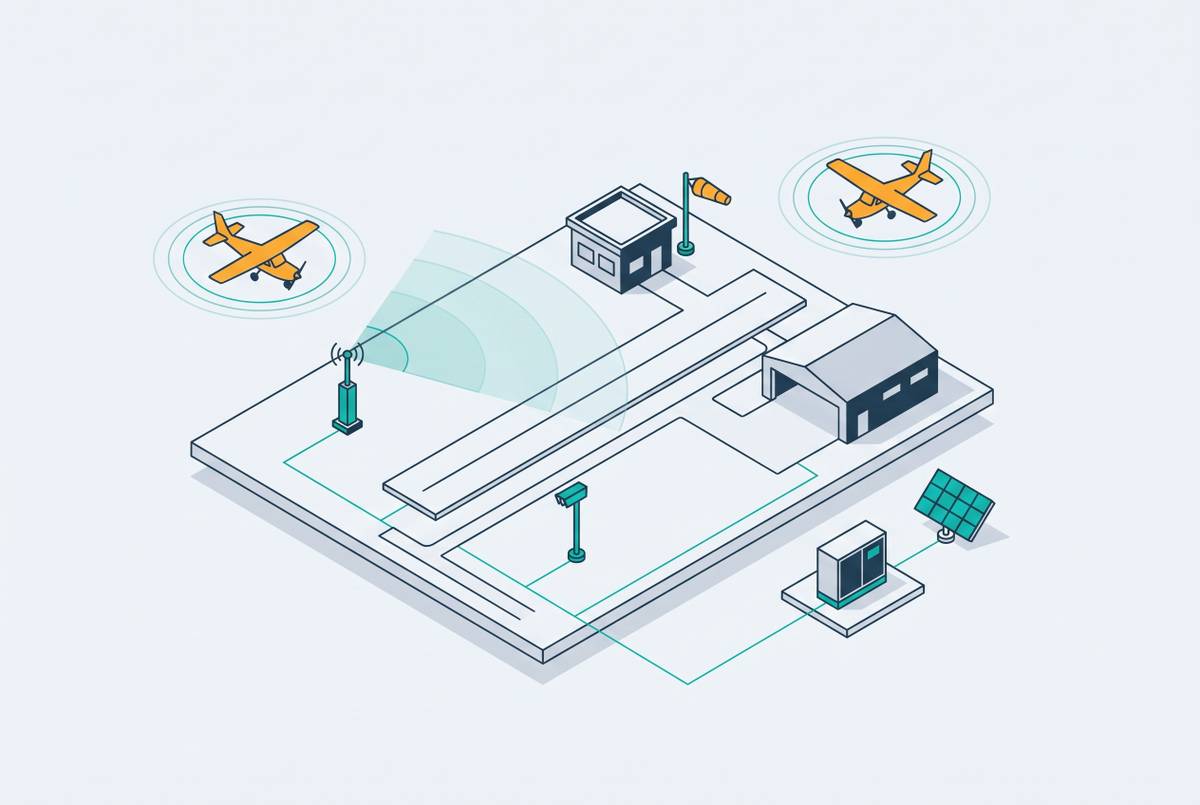
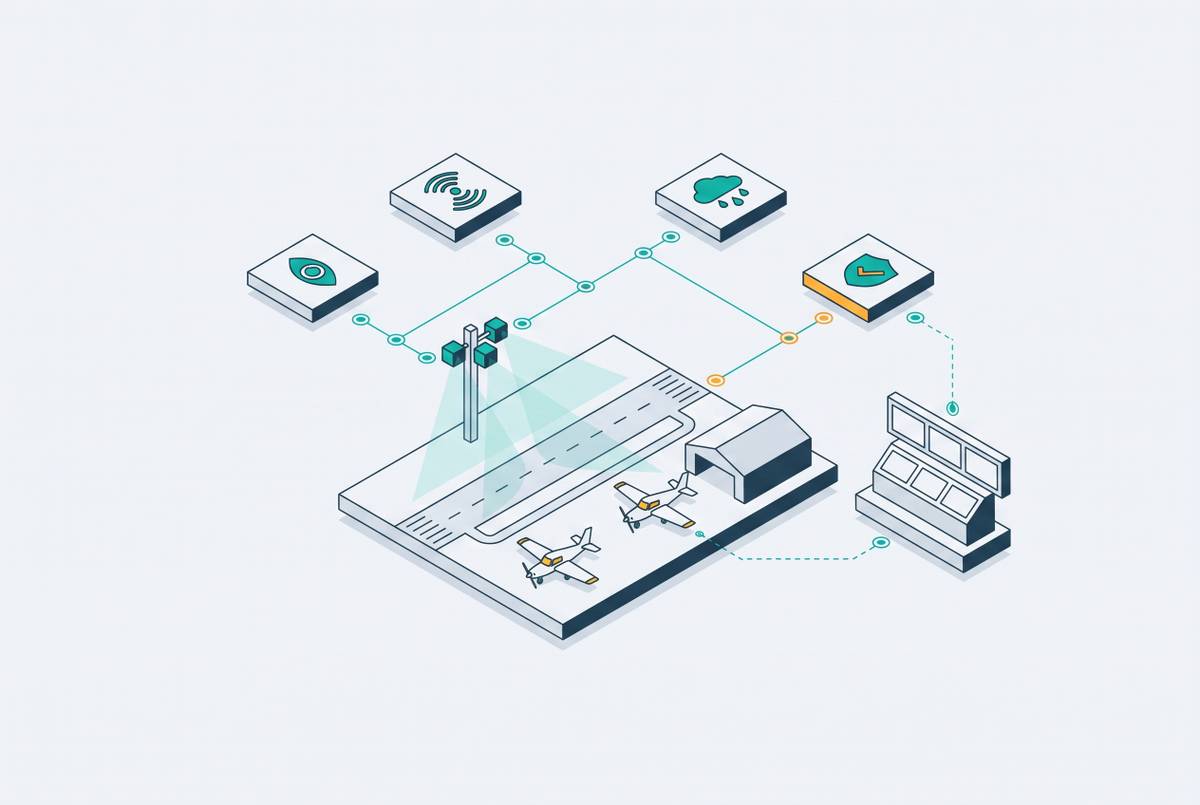
Tier 1 provides passive situational awareness without ATC service. Airport cameras and sensors feed a monitoring interface, but no dedicated controller provides active control. This tier has the lowest capital outlay and avoids controller staffing costs. Because it provides no ATC service, it does not require FAA SDA certification for an ATC function. It helps with hazards caused by poor visibility and lack of airport familiarity without the need for a staffed control facility.
That limited scope is also its principal trade-off. Pilots still operate without an external authority, so passive awareness does not close the self-separation gap. For a lower-activity airport, the infrastructure can be a possible first investment and form a stepping stone toward higher tiers if funding and certification milestones are reached. No supported dollar range is available for this tier, so its cost comparison is relative.
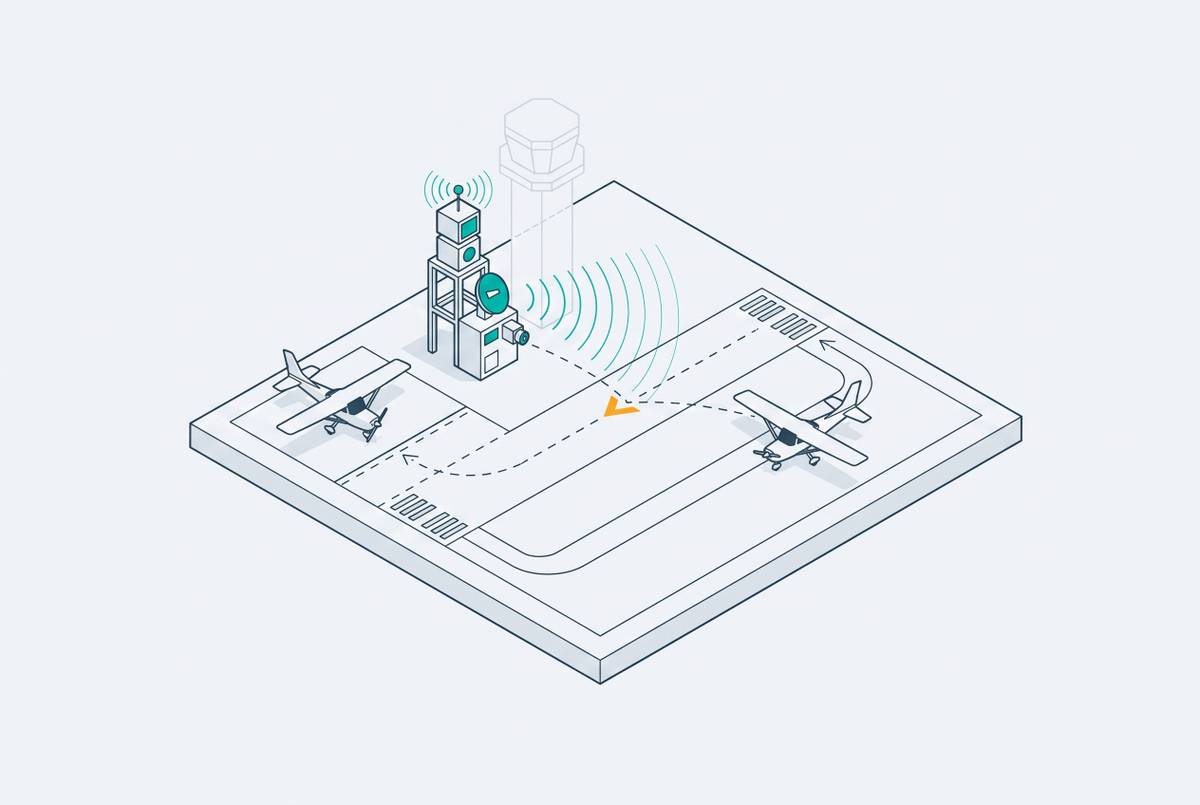
Tier 2 provides a single-airport digital tower. One controller works one airport through digital displays at an on-site or near-site facility. It is the closest functional counterpart to a traditional tower, but staffing remains the primary ongoing burden. It also requires SDA certification, making access to an approved system provider or participation in federal procurement particularly relevant.
This tier fits airports with moderate traffic, no viable hub partners within range, and access to AIP discretionary funding or BNATCS support. It can save on capital by replacing conventional tower infrastructure, while airports still have to pay for controllers. Tier 2 also has a distinct augmentation use case at airports with an existing part-time Class D tower. Digital operation can provide nighttime coverage or backup during outages. That complements an existing service and should not be confused with establishing standalone ATC at an uncontrolled airport.
Tier 3 distributes ATC costs through a shared multi-airport center. Several airports share the hub’s capital and operating burden, with the potential for substantial annual per-airport savings relative to traditional towers, principally through reduced staffing requirements. The savings become proportionally larger as more airports share the hub. No supported annual dollar range is available here either. The defensible comparison is the cost structure.
At this tier, SDA certification at hub level covers connected airports, distributing the approval burden rather than leaving each participant to navigate it independently. That works for groups of airports in the same region that can form a joint sponsor arrangement and seek funding together. Flight-training-dense regions have a particularly strong safety case because their incursion risk is documented as highest. An airport needs suitable partners to get those savings even if it chooses hub-capable technology.
Across the tiers, the main trade-off is upfront capital against recurring staffing and certification obligations. A single remote tower module still has a significant price tag, with additional network infrastructure and cybersecurity costs. BNATCS support and AIP discretionary grants address the capital gap, but competitive awards and match requirements can remain obstacles. International deployments have also shown that multi-airport digital work can appeal to younger controller recruits, while awareness tools can reduce workload and stress. Those workforce benefits do not remove the continuing design challenge of controller situational awareness in a virtualized environment.
How an airport operator with no tower budget should read this matrix and take a first step
For an operator applying this matrix, traffic volume and mix should be the first sorting criteria. Flight-training-intensive airports have the strongest documented incursion-risk case for ATC service. Airports with less traffic may be better served by Tier 1 infrastructure as they work toward a shared hub. This separates the immediate visibility need from the longer-term control requirement. It also avoids treating every airport as a smaller version of the same project.
Regional clustering should come before a commitment to standalone Tier 2 costs. Operators should check whether airports close enough to work with could form a joint sponsor arrangement. That is the prerequisite for Tier 3 economics. Where a cluster is not viable, the single-airport option must stand on its own funding and staffing case. Where it is viable, collective access to infrastructure and certification can change the feasible service level.
The next step is a funding-pathway audit before technology selection. The BNATCS allocation, AIP Non-Primary Entitlement banking, and AIP discretionary grants have different eligibility criteria, match requirements, and timelines. Those conditions help determine which tier an airport can afford and qualify for. Participation in a federal procurement or partnership with a provider that has navigated SDA can reduce the airport-specific certification burden. Neither route removes the need for approval.
UAS integration adds an emerging secondary reason to consider digital infrastructure. At non-towered airports, it can support integration into the NAS and inform longer-term operational and revenue planning. It remains secondary to the immediate traffic and safety case. The practical first investment is therefore the tier the airport can fund, approve, and sustain, with any path to shared ATC grounded in actual regional partners.