Autonomous Traffic Alerting Systems as Staffed Tower Substitutes at Untowered General Aviation Airports
Autonomous alerting can close CTAF's gaps, but only as advice.
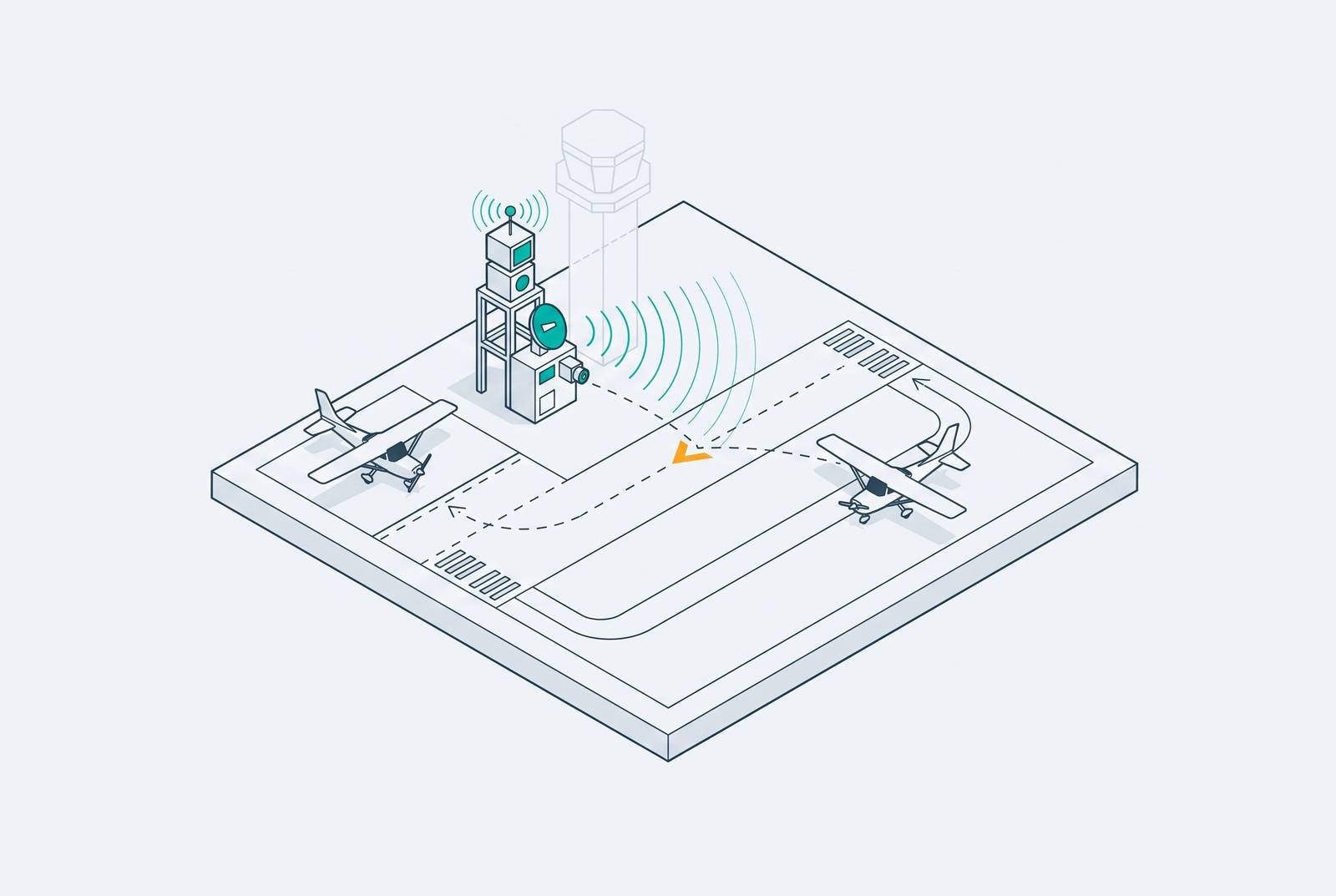
Autonomous traffic alerting offers untowered GA airports a credible way to add independent traffic awareness without building and staffing a conventional tower. Digital remote towers cost less to build, while autonomous alerting could reach airports that cannot afford even a shared controller. These systems can address specific failures of pilot self-announcement, but their present role is advisory rather than a replacement for a staffed tower’s legal authority.
Why untowered airports are structurally different from airports that have had accidents reduced
GA fatal accident rates have trended downward in recent years, and year-to-date accident counts in 2025 were below those in 2024. Those aggregate gains do not distinguish airports with active traffic management from the vast majority of U.S. airports without a staffed tower. At untowered airports, pilots self-announce on the Common Traffic Advisory Frequency, or CTAF, without an independent party monitoring, sequencing, or warning traffic. CTAF communication is not legally required, so a pilot flying under visual flight rules can approach and depart without transmitting, even with working radios.
The specific failure modes that CTAF-only environments produce
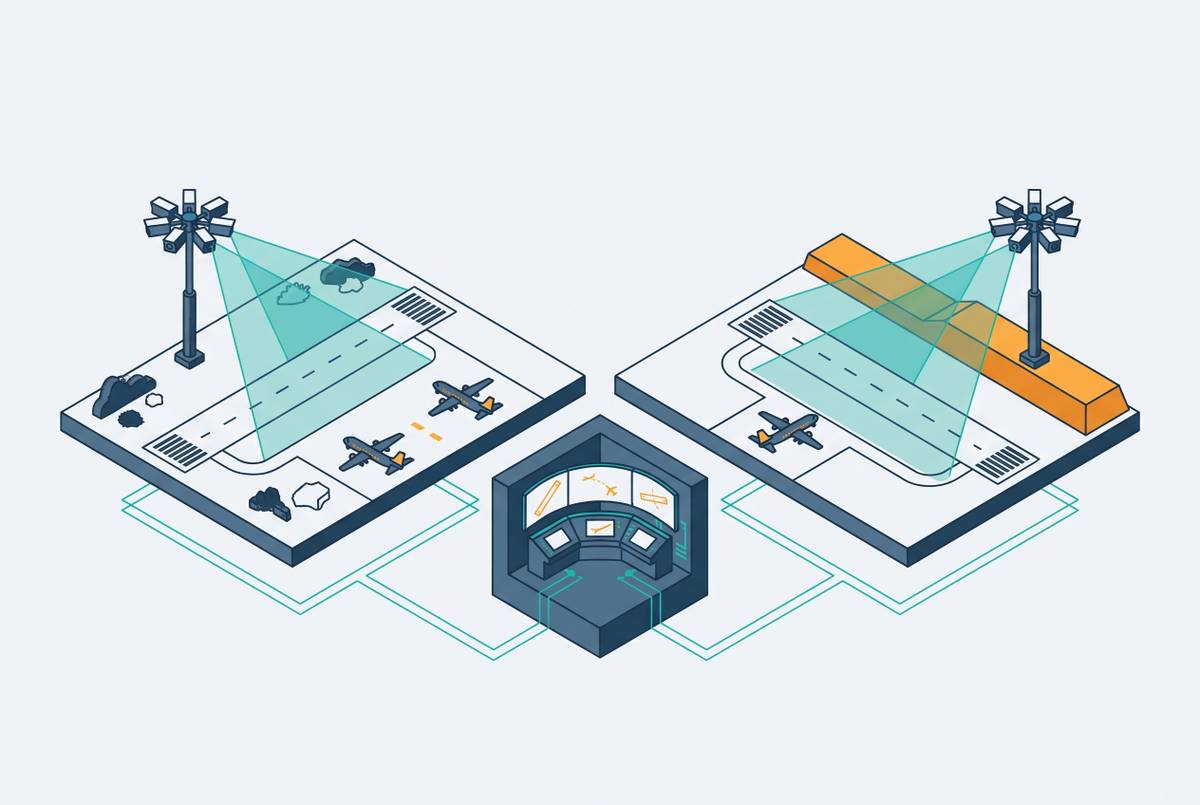
Silence is the first failure mode. An aircraft whose pilot does not announce produces no position report for other pilots to interpret, and CTAF provides no mandatory check on that omission. An aircraft flying an instrument approach through clouds can come out near a VFR aircraft using the same runway environment before either pilot has seen the other aircraft. Both pilots may be making the right announcements yet fail to spot the conflict until the aircraft are dangerously close.
The third failure is saturation of the advisory frequency. At busier untowered airports, a pilot who hears the announcements may still be unsure where each aircraft is in the pattern. The NTSB record identifies failure to see and avoid other aircraft as the most probable cause of mid-air collisions and documents recurring near mid-air collisions at non-towered airports. These failures show that the protocol leaves a surveillance gap when clouds, sun angle, or blind spots keep pilots from seeing other aircraft.
What a staffed tower actually does that CTAF cannot replicate
A staffed tower supplies independent surveillance, authoritative sequencing, and mandatory acknowledgment. A substitute must account for all three functions. A controller watches traffic rather than depending entirely on pilots to volunteer position reports, then uses that traffic picture to issue instructions on sequence, spacing, and go-arounds. Those instructions have legal weight that a CTAF announcement lacks. A landing-clearance readback closes the communication loop by requiring the pilot to acknowledge the clearance.
CTAF allows pilots to broadcast intentions, but it does not establish an authority that resolves conflicting intentions and requires acknowledgment. When a tower closes, surveillance, authority, and the closed loop disappear together, leaving pilots to self-announce. Autonomous alerting therefore has to be evaluated separately for what it can detect, what it can communicate, and what it can legally require.
Why building more staffed towers is not the answer for most untowered airports
Conventional towers need a large amount of money to build and permanent staff to run them. Untowered airports often lack both the money and the staff. The FAA’s federal contract tower program was well short of its targeted controller headcount as of April 2025, with attrition and stagnant wages contributing to the shortage. Adding towers supplied by the same controller pipeline would deepen that constraint. The case involving Johnston Regional Airport and another domestic airport places this conventional-tower question in a domestic setting, but the broader obstacle is the model’s dependence on scarce staff.
Airport finances compound the difficulty of securing enough controllers. Non-hub airports represent a small share of total enplanements but a large share of capital need. Most nonhub airports without Essential Air Service support saw their average daily departures per route fall from 2018 to 2024. Those financial limits put a model with high capital costs, permanent staffing, and a tower for each airport out of reach for many airports. A clear safety need does not itself make that model affordable.
What digital tower options exist for airports that cannot afford traditional ATC infrastructure?
Digital and remote towers separate traffic observation from a conventional tower building. In 2021, London City Airport became the world’s first major international airport to have all its traffic controlled by a remote digital tower. Johnston Regional’s director estimated that a digital remote tower costs roughly half the price of a conventional tower. This is a useful comparison, but it is not a price range for autonomous alerting or proof that every airport would achieve the same saving.
Digital ATC towers are operational at airports in Florida and Alaska, while the remote tower at another regional airport has been described as “less than optimal. Operational does not mean perfected. The 2024 FAA Reauthorization Act directed the agency to define clear standards, and vendor testing began at its Atlantic City International Airport facility in early 2025. As of May 2025, vendors still had to test there rather than at their intended operating airports, slowing field deployment.
What autonomous traffic alerting systems add beyond basic remote tower capability
A remote tower sends surveillance information to a human controller. Autonomous alerting adds a decision layer that does not wait for human review before producing a safety classification and advisory. It uses ADS-B trajectories, radio communications, weather, and chart data together to work out how aircraft relate to one another. The distinction is operational as well as technical. An airport too small to justify even a shared remote controller could still have a system watching for conflicts at all times.
A 2026 research proof of concept at Half Moon Bay Airport, KHAF, showed how this architecture works using data from the past. Whisper Large-v3 transcribed pilot radio communications, which went to Gemini 2.5 Pro together with METAR weather, ADS-B trajectories, and a VFR sectional chart. The model produced a structured safety classification and a free-text explanation, correctly identifying a right-of-way violation that produced a near mid-air collision. This was not a certified deployed product. The work still shows how a system could give plain-language advisories in a CTAF-style format without pilots needing new cockpit hardware or a different way to communicate.
How well autonomous alerting addresses each of the three CTAF failure modes
An equipped aircraft remains visible through its transmitted trajectory even when its pilot says nothing on CTAF. An autonomous system can therefore generate an alert without a position announcement. The limitation is equally direct. For aircraft without ADS-B out, this surveillance layer remains incomplete, and the system cannot warn about traffic it cannot see.
For IFR/VFR break-out conflicts, combining trajectories with METAR weather gives the system information that isolated radio calls do not provide. It can spot an instrument approach while a VFR aircraft is in the pattern, which could allow a warning before the pilots see each other. The KHAF right-of-way detection is an analog. For CTAF saturation, a prioritized machine-generated warning adds a conflict signal to the stream of pilot announcements, but does not eliminate frequency congestion. Whether pilots reliably act on that warning remains an empirical question, so the strongest case is direct coverage of equipped silent traffic and approach conflicts, with partial coverage of saturation.
The certification and authority gap that keeps autonomous alerting in advisory-only territory
The FAA has not certified any remote tower in the United States, let alone an autonomous one. An advisory system cannot issue binding sequencing instructions or require the acknowledgment that makes a tower clearance a closed loop. That is an institutional boundary. It also leaves performance validation necessary before broader authority could be justified.
NATCA was excluded from the FAA’s decision to modify its staffing model and has publicly called the rationale flawed. Concern about transferring a safety function away from certified controllers deserves consideration, although the staffing shortage also limits the human-controller model’s reach at untowered airports. Funding does not automatically bridge that gap. Congress appropriated $9 billion in July 2025 for the Brand New Air Traffic Control System, or BNATCS, but that modernization funding targets staffed infrastructure rather than autonomous alerting at untowered airports.
The automation-complacency risk and what the European experience does and does not resolve
An alerting system can change the behavior it protects. Pilots who believe a machine is watching may reduce their own vigilance, creating false confidence precisely where surveillance remains incomplete. The concern is that reliance on the system could weaken the visual scanning needed when an aircraft has no ADS-B out. The KHAF historical-data demonstration cannot measure how pilots behave when they know monitoring is active.
London City, Avinor’s Bodø center, and Sundsvall use certified human controllers viewing remote video feeds, rather than autonomous decision-making without a human in the loop. Avinor’s official digital towers page reports 14 airports in operational service at its center, which opened in May 2022. That supports the viability of remote digital monitoring at scale. Active pilot acknowledgment offers a design route away from passive receipt of warnings, but how to implement it in a CTAF environment remains open.
What a credible deployment path for autonomous alerting at untowered airports looks like
The credible near-term path is advisory-only deployment supported by testing. The FAA’s Atlantic City facility is the designated place to begin testing remote tower technology. Passing those tests could give the technology a foothold with regulators before certification standards are final. ADS-B out mandates across much of the NAS also provide an existing surveillance foundation, although they do not cover every aircraft.
The multi-airport remote-center model shows how a system can be set up to cover more than one airport. A few autonomous alerting hubs could serve many untowered airports at a small added cost for each airport, with humans checking in from time to time as a possible step along the way. That deployment proposition still requires demonstration at autonomous scale. Costs depend on the infrastructure, the controller staffing needed over time, the surveillance coverage, and how much human oversight is needed. The BNATCS modernization effort creates a more receptive policy setting for that proposition, but does not establish an autonomous-alerting funding commitment.
Why the advisory-only posture is a starting point, not a permanent ceiling
Operational evidence can support a broader authority claim over time. Advisory deployments would provide evidence from live use that the KHAF proof of concept cannot supply, while remote-tower activations and Atlantic City testing establish related infrastructure and validation pathways. The FAA’s 2026 Workforce Plan identifies a full staffing target of 12,563 Certified Professional Controllers with a persistent gap. That shortage creates pressure to consider alternatives that do not draw entirely from the same constrained workforce.
For untowered airports, CTAF remains the relevant near-term baseline. A system that reliably detects equipped non-communicating aircraft and warns of IFR/VFR approach conflicts would add independent protection that self-announcement does not provide. Such performance would not confer clearance authority or remove the need to see and avoid. It would, however, establish a functional role grounded in documented failures.