Radio Procedures and Self-Separation Technology Filling the Control Tower Void
Radio calls and cockpit traffic tools help, but they can't replace a controller's authority.
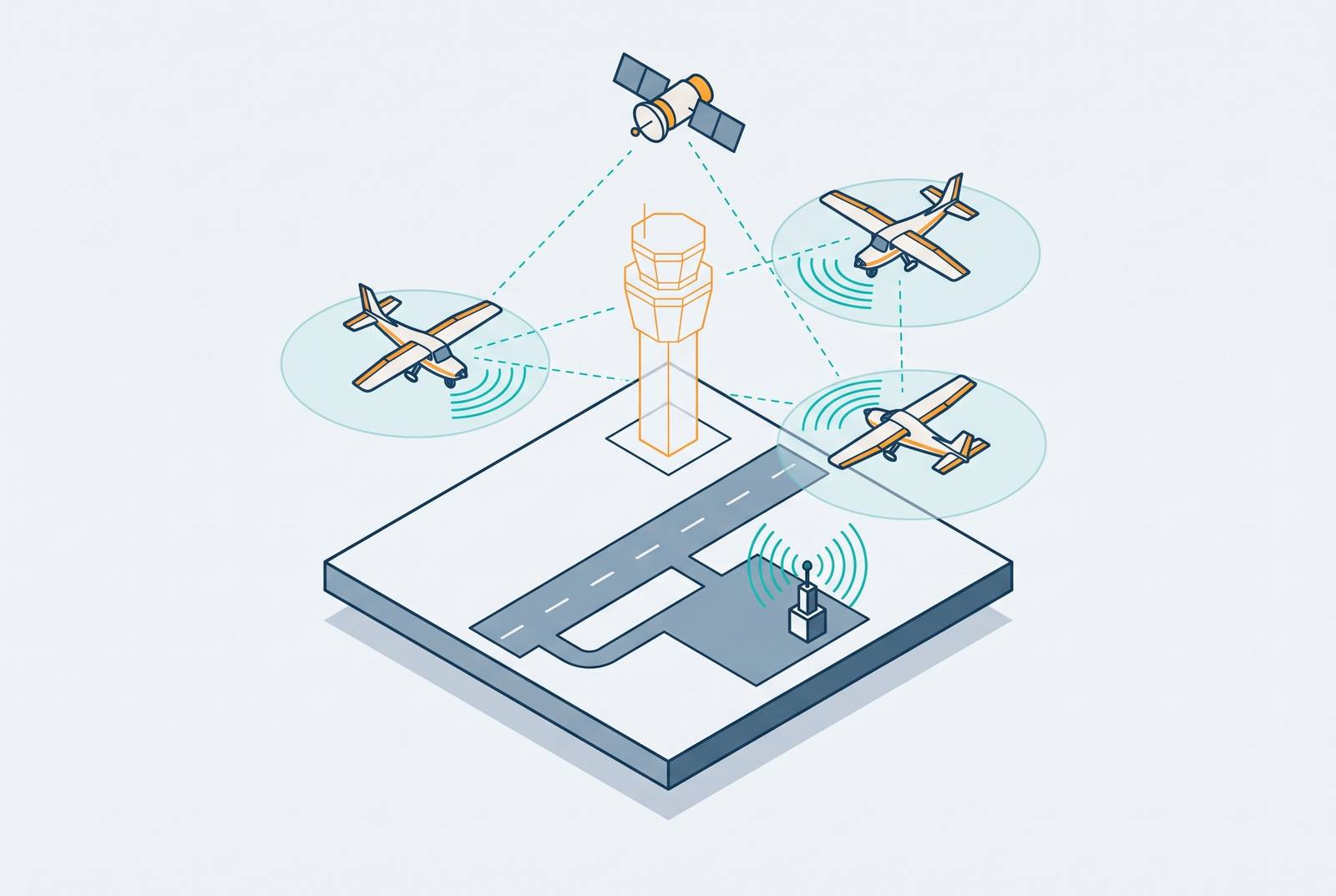
Roughly 90% of U.S. public-use airports have no control tower, so pilots must keep clear of one another through radio calls, visual awareness, and optional traffic technology. Those tools help, but they cannot check where every aircraft is or give instructions that pilots must follow when traffic conflicts. The safety gap at uncontrolled airports is therefore a gap in oversight and authority, which digital remote towers can close only if funding, staffing, and approvals support wider deployment.
Why roughly 90% of U.S. airports operate without a control tower
A conventional tower needs infrastructure and trained controllers, while some airports do not earn enough to cover their existing operating costs. The airport in Bethel, Maine, spent more on operations in 2025 than it earned. That leaves little room for a new service. Across thousands of non-towered airports, the cost of control must be weighed against resources that are already limited.
The rules accommodate that operating reality rather than requiring every airport to provide control. Under 14 CFR 91.126 and 91.127, the two-way radio requirements for airports in Class G and Class E airspace apply at airports with an operational control tower. The FAA’s Advisory Circular AC 90-66C states that airports without operating control towers generally do not require two-way radios. Some aircraft have no radio, while some pilots make no calls, leaving other users without an announced position or intention.
The FAA Contract Tower Program gives airports a way to have controller services without each having to support a conventional federal tower. Its reach is limited, however, and it was running well short of its controller headcount target as of April 2025. Infrastructure is only part of the constraint. Any expansion also needs people qualified to deliver the service.
What CTAF procedures actually do — and what they cannot do
The Common Traffic Advisory Frequency, or CTAF, gives pilots a shared channel for airport advisory practices when no tower is operating. Depending on the airport, it may be a UNICOM, MULTICOM, FSS, or tower frequency. Its logic is straightforward and practical. Pilots broadcast their positions and intentions so that others can form a mental picture of traffic and manage their own separation.
When two aircraft approach the runway at the same time, that exchange helps their pilots recognize the conflict and coordinate their actions. No controller assigns the sequence through CTAF. Each pilot must make sense of the information at hand and act without an outside authority deciding what to do when pilots’ plans conflict.
That distinction creates three linked limits. An aircraft that makes no call is absent from the radio picture, an incorrect call has no authoritative verification, and a call from another pilot is not a binding ATC instruction. Transient and student pilots compound the challenge when they are unfamiliar with local patterns, terrain, and traffic flow. The ATSB’s Safety around non-controlled aerodromes report says that pilots not communicating enough with one another is the most common cause of safety incidents near non-controlled aerodromes.
The FAA’s circular likewise emphasizes the importance of air-to-air communication, noting that failures to follow communication protocol have contributed to near midair collisions and could constitute careless and reckless operation. CTAF is still a reasonable choice when resources are limited, but it works only as well as the pilots who make calls and get them right, which the channel itself cannot ensure.
How the severity picture at non-towered airports differs from the aggregate incursion count
The total count of runway incursions can hide changes in how dangerous each encounter is. The total for fiscal year 2024 was roughly the same as for fiscal year 2019. The FAA Safety Team reported that Category A and B incursions rose by nearly half in fiscal year 2025, even as total events fell slightly. Those categories concern collisions barely avoided or events requiring evasive action.
Those national figures do not, by themselves, quantify the share of severe events at non-towered airports. The reporting structure adds another limitation. The FAA classifies incursions as pilot deviations, vehicle/pedestrian deviations, or operational incidents, but the last category requires a controller. At a non-towered airport, that category is absent, as is a controller who could observe and record an unfolding event.
Pilot deviations make up close to two-thirds of runway incursions nationally. At non-towered airports, those errors occur without controller intervention, while the lack of external observation makes the full risk harder to characterize. The DOT Inspector General’s March 2025 audit found that the FAA lacks an integrated approach to analyzing runway incursion data and identifying risk. The resulting uncertainty is consequential. Aggregate counts cannot substitute for a clear account of severity, operating conditions, and the gaps in observation at uncontrolled fields.
The self-separation technology layer pilots and airports have added on top of CTAF
ADS-B In extends a pilot’s traffic picture beyond what can be inferred from radio calls. Receiving traffic data in the cockpit can supplement the mental model built through CTAF, but receiving capability is not mandated. ADS-B Out alone does not provide that view. A pilot may broadcast information useful to others without seeing the conflict picture that those broadcasts help create.
Georgia Tech researchers have developed a different supplement, allowing autonomous aircraft to interpret CTAF calls and use them to improve predictions of nearby aircraft trajectories. Their findings show a reduction in average trajectory prediction error of more than 50 percent compared with position-data-only models. Spoken intentions add information that position alone lacks. The same approach could help flag potential conflicts before they become hazardous, although improved prediction is not equivalent to demonstrated conflict resolution.
These tools address real weaknesses in situational awareness. Their value does not remove adoption gaps, coverage limits, or the dependency on information being available in the first place. Nor do they issue clearances or establish an authoritative traffic sequence. The pilot still has to resolve the encounter. Technology makes self-separation better informed, but it does not turn it into air traffic control.
Why the gap between self-separation tools and actual control is widening, not narrowing
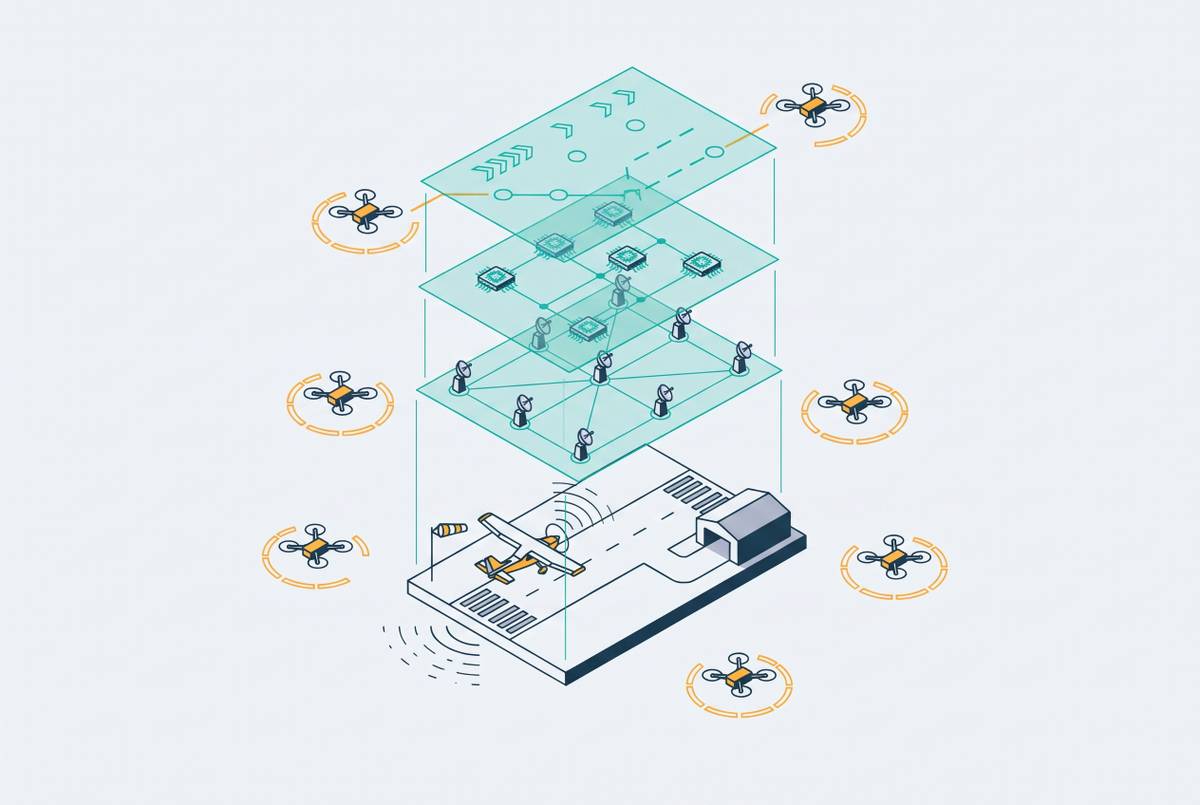
Procedures developed mainly around light piston aircraft flown by trained pilots now have to accommodate drones, autonomous cargo aircraft, and other entrants with different operating characteristics. Low-altitude activity concentrates some of that pressure around small, rural airports. These are also places where no controller provides a common coordination point.
Autonomous cargo operators are starting to base their aircraft at non-towered airports. Their aircraft may not make CTAF calls in the conventional sense, and their traffic patterns may differ from those expected by pilots of manned aircraft. Better displays do not automatically resolve that mismatch. Detecting another aircraft, understanding its intentions, and coordinating a response across different kinds of operations are all necessary.
The Flight Safety Foundation’s 2025 Safety Report says that as airspace grows more complex, it puts pressure on safety margins across the system. Airlines, business aviation, helicopters, and uncrewed systems bring more traffic of more kinds into airspace that has only so much room. The Reagan National collision on January 29, 2025, illustrates the system-level consequences of mixed-use airspace and inadequate coordination. Small airports face their own version of the coordination problem without the external authority already present at a controlled airport.
What digital remote towers actually add that CTAF and self-separation tools cannot
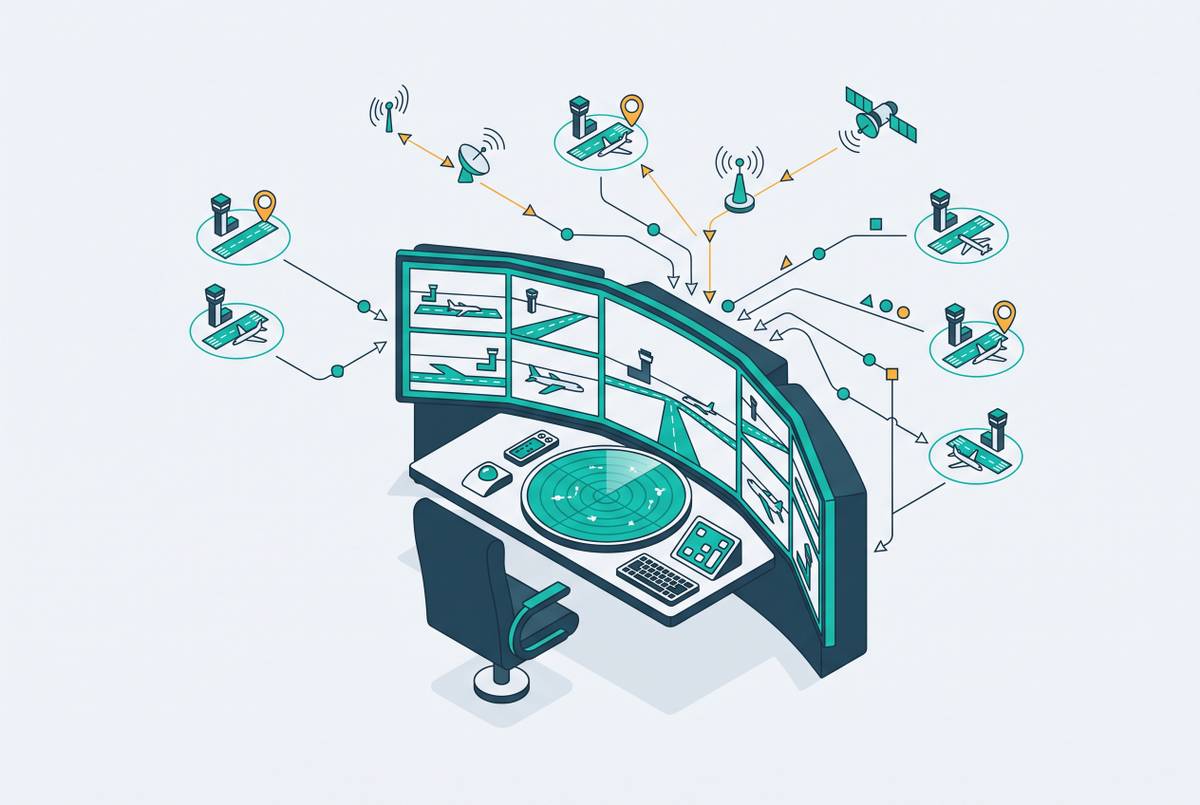
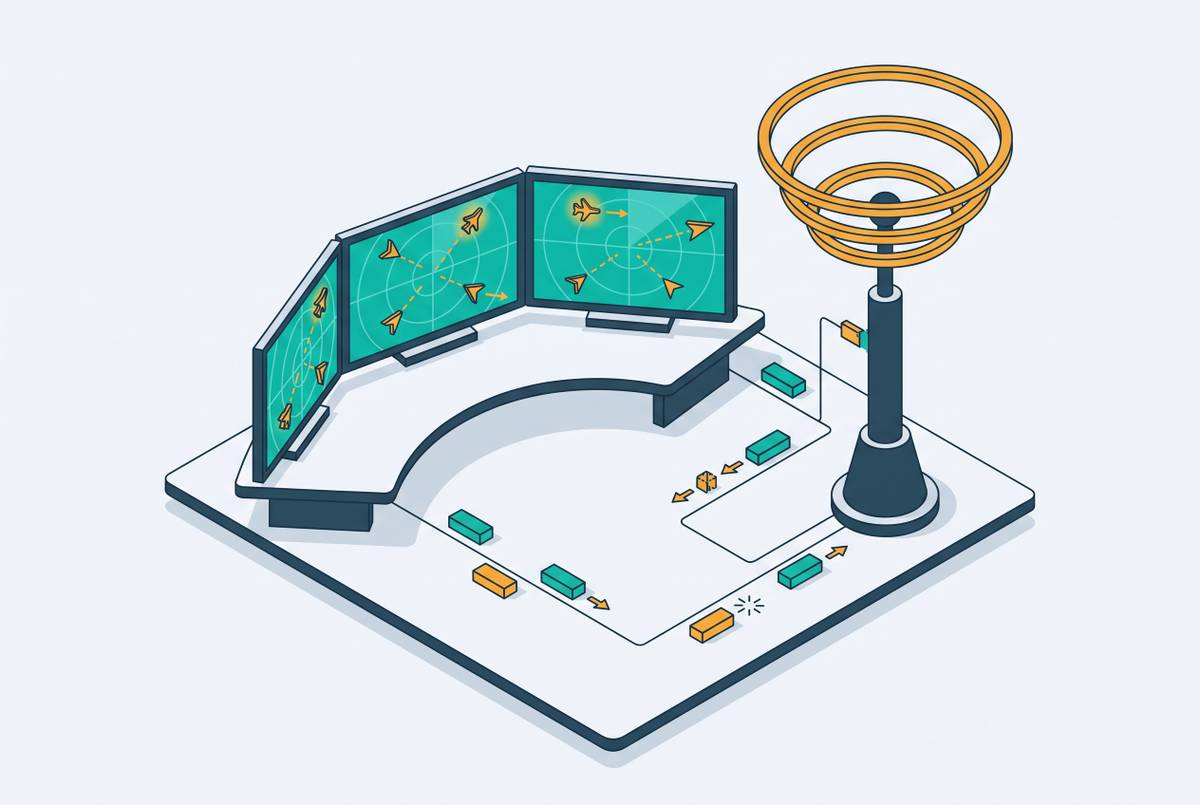
Digital remote towers bring back a trained controller who has the legal authority to sequence traffic, maintain separation, and issue clearances. Cameras, sensors, and data feeds transmit a real-time operational picture from the airport to a remote operations center. The controller works from that picture.
That authority changes how a conflict is handled. A controller can identify traffic a pilot cannot see, correct deviations the pilot has not recognized, and issue binding instructions to resolve competing intentions. Digital towers also keep a surveillance and data record where there was none before, so incidents can be studied afterward and risks that recur can be found.
Remote operation can also change the economics of providing that service. Sweden’s Sundsvall Remote Tower Centre manages several airports from one facility. Avinor’s Remote Tower Centre in Norway connects to up to fifteen airports in its first phase, with individual controllers able to manage up to three airports simultaneously. These arrangements share infrastructure across airports. They do not eliminate the need for trained controllers.
Atrak unveiled its MAESTRO Digital Remote Tower platform at Airspace World in Lisbon in May 2026, combining advanced cameras and AI after well over a year of development and testing at Václav Havel Airport Prague. For mixed manned and unmanned operations, a remote center provides the external situational awareness and coordination capability that CTAF alone cannot supply.
Where digital tower deployment stands in the U.S. and what the pipeline looks like
Digital ATC towers began operating in the U.S. in September 2026, and the FAA announced this publicly in November 2026. The first two airports were Bartow Executive Airport (BOW) in central Florida and Kenai Municipal Airport (ENA), southwest of Anchorage, Alaska. They are among the first of seven airports that controllers will manage from remote operations centers.
The five airports next in line are Winter Haven Regional Airport (FL), Venice Municipal Airport (FL), Montgomery County Airpark (MD), Johnston Regional Airport (NC), and Durango-La Plata County Airport (CO). These pipeline airports do not have towers today. Their deployments would introduce controller coverage. That makes the pipeline directly relevant to airports operating under the self-separation model.
The 2025 One Big Beautiful Bill Act provides the funding mechanism. In September 2026, the FAA awarded an indefinite-delivery/indefinite-quantity contract valued at up to $200 million for a remote tower program focused on rural and small community airports. The FAA’s Flight Plan for 2026 explicitly includes deploying digital remote tower technology at the first key site within its modernization agenda. Federal procurement now supports the operating concept. Even so, the first seven airports are a small group compared with the thousands that have no towers.
The Digital Tower Technology Coalition has brought stakeholders together to push the FAA to move faster on approval, deployment, and funding. Its work covers the steps needed to turn technology that is available into a service that is up and running. That distinction governs the pace of expansion. A procurement vehicle can support deployment, but it does not by itself establish affordable, staffed service at every airport that could benefit.
What still has to change for digital towers to close the gap rather than nibble at its edges
Airport affordability remains the binding constraint. Digital towers require installation funding, but they also need sustainable support for remote operations centers and the controllers staffing them. AOPA has noted that digital towers can reduce FAA costs and extend controller services to more airports only if those airports can afford to operate them. Federal deployment cost and local operating cost are different questions. The current funding model does not fully resolve that distinction.
Staffing imposes a separate limit on expansion. The FAA’s 2026 workforce plan targets roughly 12,563 certified professional controllers and sets hiring goals of thousands of new controllers across fiscal years 2026, 2027, and 2028. Its updated staffing model still identifies a shortage estimated in the thousands of certified professional controllers. Remote operation does not manufacture qualified staff. A well-funded digital tower program competes for the same scarce workforce as conventional towers.
Regulatory progress must accompany funding and recruitment. Remote tower systems require FAA approval frameworks that are relatively new in U.S. airspace, and historically slow approvals are part of the reason the coalition exists. Faster approval is a prerequisite for broader deployment. Meanwhile, mixed-use traffic and autonomous operations keep adding demands to airports whose safety model still depends on pilots detecting, interpreting, and resolving conflicts themselves.
The policy task is to make affordable digital ATC coverage part of infrastructure planning rather than treat each installation as an isolated technology project. The first U.S. services, an active procurement mechanism, and an identified pipeline provide a basis for expansion. Sustainable operating funding, controller training, and workable approvals will determine its reach. The distance between those first deployments and meaningful national coverage is a policy and resourcing problem.