Automation Layers Replacing Procedural Self-Announce at Non-Towered Airports Under Rising Drone Pressure
Digital towers move from optional to essential as drones overwhelm voluntary radio protocols.
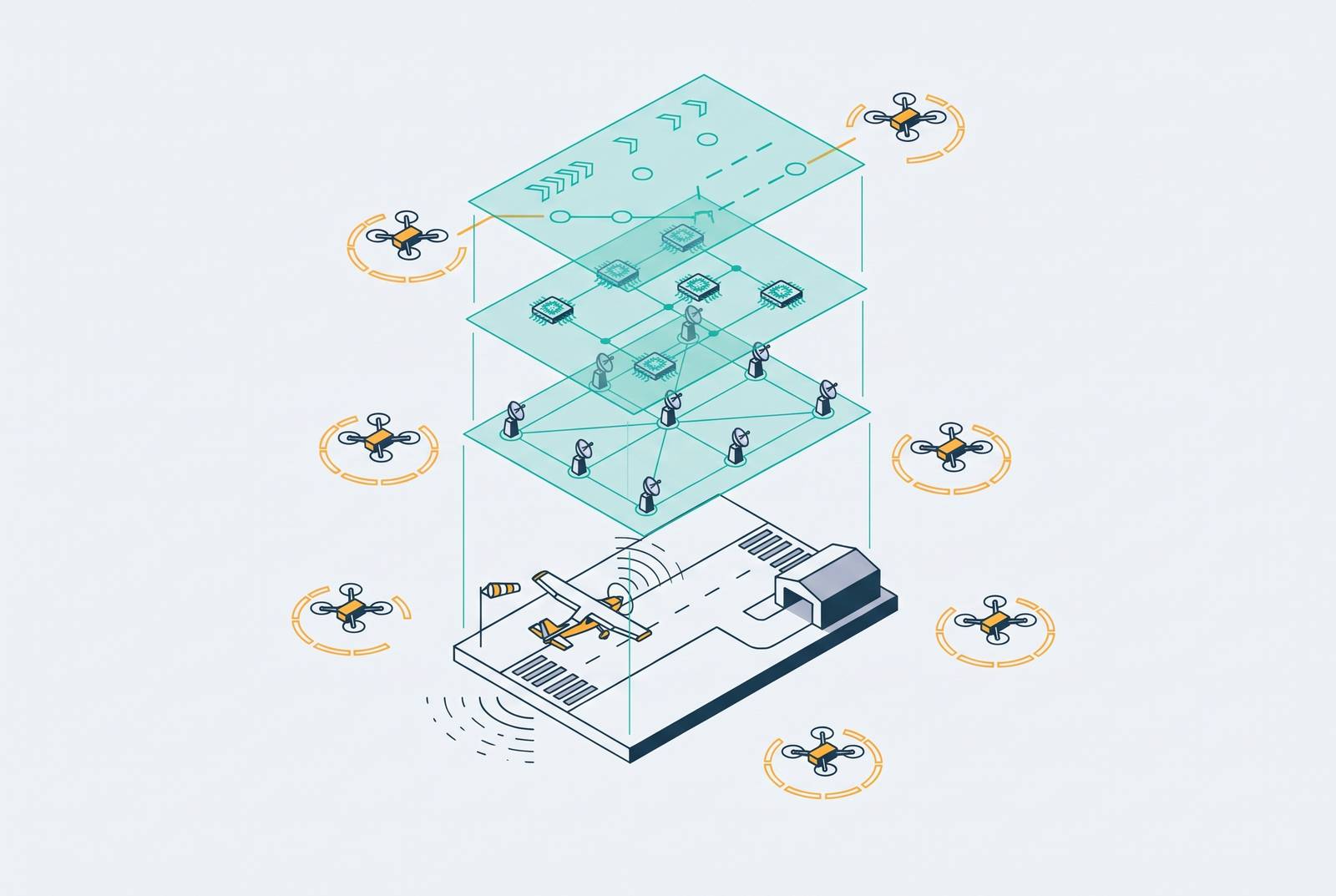
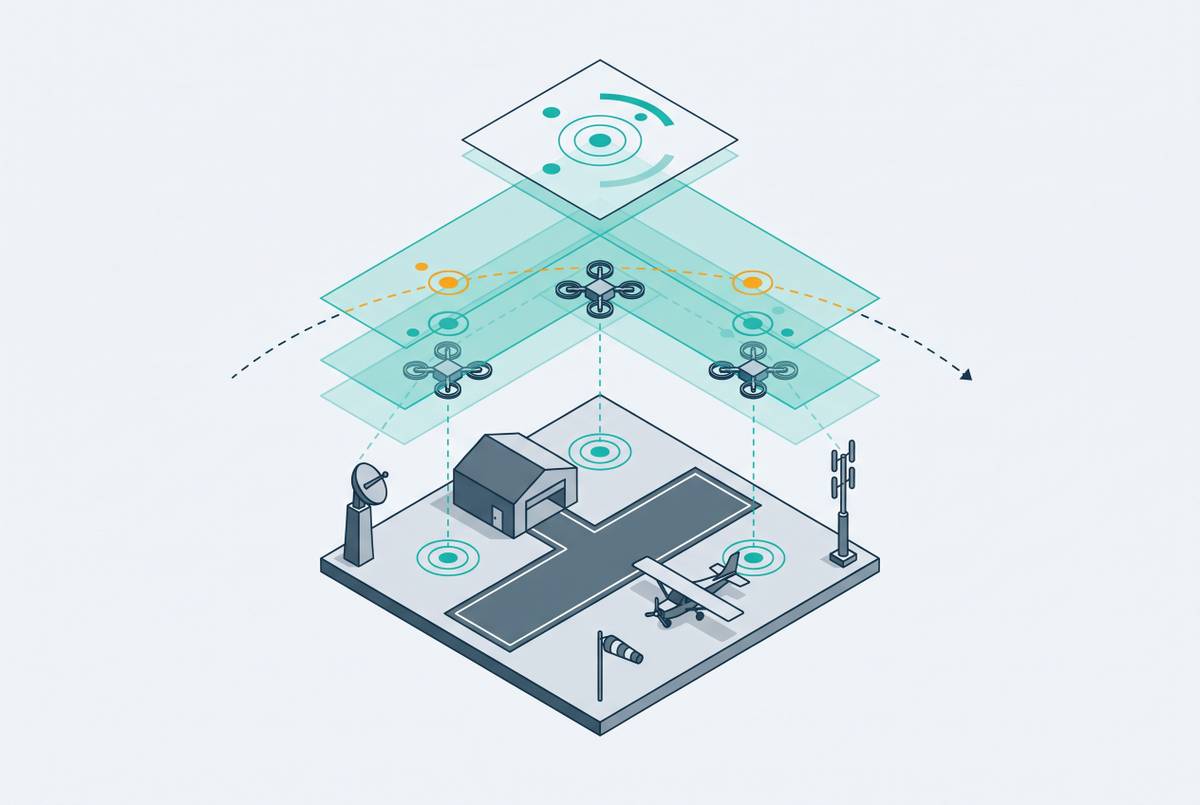
Digital ATC infrastructure enables UAS and drone integration at non-towered airports by combining continuous surveillance, fused traffic data, and active sequencing independently of voluntary radio calls. Affordable digital towers linked to remote tower centers offer the scalable architecture for that work. Their purpose is not simply to move a controller’s view off site, but to close the awareness and coordination gaps that drone growth exposes.
Why self-announce at non-towered airports was always a workaround, not a system
CTAF self-announce depends on pilots voluntarily broadcasting their position and intentions so that other participants can build a picture of nearby traffic. The procedure is used primarily at airports without an FSS on the airport, and radio use is not required at non-towered airports. Cooperation is therefore the foundation of the arrangement. An aircraft that does not broadcast creates a blind spot that the protocol itself cannot close.
NASA’s ASRS Callback report from September 2025 documented that failure mode in a near-miss involving a departing crew. An airport manager notified the crew that an aircraft on final had made no CTAF call. The inbound aircraft was at approximately 500 feet. The incident illustrates the critical distinction between a procedure that shares information participants supply and a surveillance system that detects traffic independently.
The scale of the uncontrolled airport population makes the flaw systemic
The overwhelming majority of the tens of thousands of U.S. airports are non-towered, with self-announce serving as the primary coordination mechanism. The same dependence on cooperation therefore extends across a geographically dispersed airport population. This dependence on cooperation is a common design premise embedded throughout much of the National Airspace System, including airports without an active traffic-management service to compensate when radio participation fails.
The Contract Tower Program provides substantial operational coverage relative to its budget footprint, but that coverage does not extend to airports with no tower. Both House and Senate FY2026 proposals include a substantial increase for the program since FY2022. A program built around individual staffed towers cannot reach the non-towered majority at current unit economics merely by growing incrementally. The capacity of existing towers and the absence of surveillance and sequencing at airports outside their reach are both problems.
Drone traffic does not add stress to self-announce — it breaks the assumption it rests on
The FAA identifies drones as the fastest-growing segment of U.S. aviation and forecasts substantial commercial fleet growth through 2029. For non-towered airports, that growth changes more than traffic volume. UAS operations must deal with non-cooperative VFR traffic that may not share its intentions through radio calls or electronic broadcasts. More participants do not necessarily produce more usable information. The underlying protocol provides no complete mechanism for coordinating drones with that traffic.
Underutilized airports in uncontrolled airspace are attractive to cargo and delivery operations, yet they are also among the airports with the least surveillance infrastructure. Their available capacity does not establish their readiness for mixed traffic. Without active coordination, uncertainty about traffic intent persists in the pattern and terminal airspace even when the drone operator has access to better surveillance information.
The peer-reviewed MDPI study identifies a limit that information alone cannot overcome. Beyond a certain traffic density, a UAS cannot be safely integrated into the holding stack without active sequencing. That finding changes the nature of the requirement. A fully informed drone operator still cannot compensate for a protocol that provides no sequencing authority.
Why the controller shortage cannot be answered by hiring more controllers
Adding conventional towers would put more pressure on a staffing model that is already under strain. Attracting and retaining controllers for towers far from population centers is a recognized difficulty both domestically and internationally. Recruitment alone cannot resolve that geographic constraint. Where existing contract towers are understaffed, building and staffing thousands of additional towers is not a credible route to comprehensive coverage.
Construction funding would not remove the personnel requirement. Each expansion of the conventional model would create another obligation to supply qualified staff, including at locations where retention is difficult and activity is modest. The shortage therefore constrains both the maintenance of existing services and the extension of services to new airports. An architecture that assumes abundant local staffing conflicts with the conditions it must address.
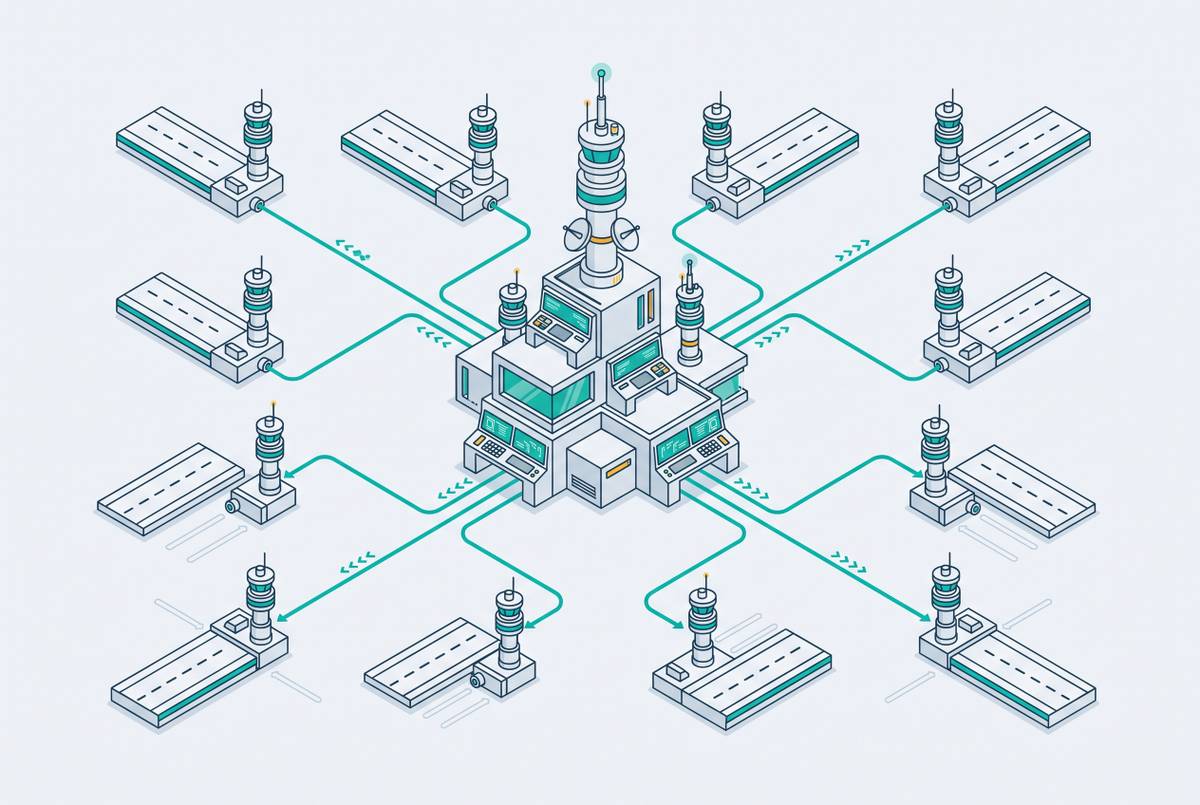
The alternative is to change how coverage is delivered. Remote tower centers allow multiple low-activity airports to share infrastructure and staffing rather than reproducing a complete local arrangement at each site. With the controller’s role preserved, this changes the relationship between an airport’s location and the resources needed to provide its service, making centralized coverage the logical response to a distributed staffing problem.
What technology gives non-towered airports situational awareness during UAS operations?
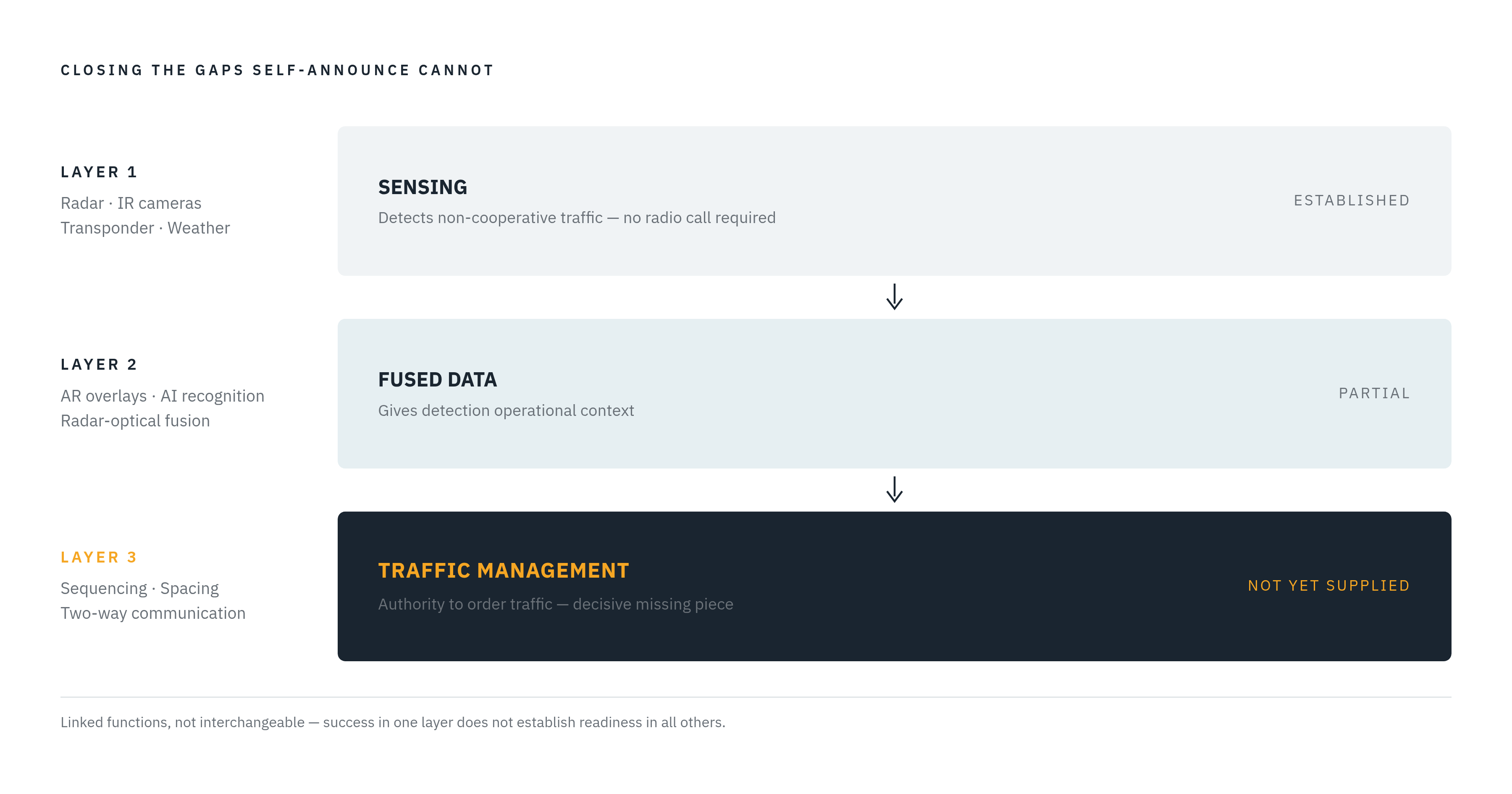
With digital tower technology, continuous, sensor-driven surveillance takes the place of awareness that depends on pilots. Its architecture combines a sensing layer, a fused information layer, and a traffic-management function. Radar, weather, and transponder data feed a single interface so that a controller sees a combined picture. Some platforms add augmented reality overlays with flight paths and aircraft identifiers displayed directly on the visual feed.
That distinction addresses the weakness of self-announce directly. Sensors do not require an aircraft to make a radio call before it becomes visible, allowing the surveillance layer to reveal non-cooperative traffic. The fused display then gives that detection operational context. Rather than asking each participant to reconstruct the situation from voluntary transmissions, the system provides a shared basis for active management.
For UAS integration, the final layer is decisive. A digital tower can provide the sequencing and spacing function that the study identifies as a prerequisite for safe integration at non-towered airports. Surveillance provides the information, and traffic management uses it to put traffic in order. A remote visual display alone does not establish that capability.
Where digital towers are already operating and what the evidence shows
Norway’s Avinor is implementing remote tower services across multiple airports through the NINOX program, managed from a tower center in Bodø. In July 2024, Kongsberg Defence & Aerospace announced an agreement with Avinor to add more digital towers at small airports. It is the world’s largest remote tower program. The program establishes the use of a centralized service model across a dispersed small-airport network.
Italy’s air navigation service provider ENAV announced in April 2025 that control centers at Brindisi and Padua would become remote tower centers managing 16 low-traffic airports. Its plan provides for further expansion by 2033. The low-traffic airport is the deployment unit here. The announced conversion extends the centralized model to a defined group of airports rather than treating remote service as an isolated installation.
Nav Canada uses 360-degree cameras, infrared imaging, and AI-driven tracking at its digital aerodrome tower in Kingston. Controllers in Kingston are planned to oversee flights at Hamilton Airport, approximately 150–300 km away, following a shadow testing period and Transport Canada regulatory approval. That service remains subject to testing and approval.
These programs address airports whose activity can make a conventional staffed tower difficult to justify. They show how airports in different places can share surveillance and control resources. The evidence is limited to remote service delivery. It establishes a practical foundation on which the additional communication and sequencing requirements of UAS integration can be built.
Where the U.S. stands (regulatory momentum and the gap that remains)
The FAA issued a request for proposals outlining deployment of 50 remote air traffic control tower systems at U.S. airports over five years. That is a concrete procurement step toward wider use of remote services. Against the non-towered airport population, the proposed deployment reaches only a small fraction of the locations that rely on self-announce.
Leesburg Executive Airport shows that domestic regulatory movement has not been uniformly toward remote operation. The FAA discontinued its remote tower program there in 2023, after which a temporary mobile tower was put in place. The FY2026 FAA Contract Tower grant award partially funds construction of a new Federal Contract Tower to replace that temporary facility. This was a reversal. It demonstrates the regulatory friction that remains between remote tower technology and sustained domestic service.
The NPIAS 2025–2029 lists tens of billions of dollars of eligible and justified airport development, which shows that there is scope to invest, though no funds are set aside there for digital towers. Funding potential is only part of the equation. The service must also cost little enough to build and run for low-activity airports to afford it. Managing several airports from one remote tower center cuts both costs sharply, giving airports a way to use the opening from regulators to bring service to more places.
What automation at non-towered airports must do that existing programs have not yet required
Drone integration requires more than remote visual surveillance. DOT officials have stated that ADS-B alone is not a reliable detect-and-avoid solution, and two-way communication between drones and other aircraft requires technology that ADS-B cannot provide. The FAA proposed regulations in August 2025 requiring BVLOS drones to detect and avoid other aircraft. However, it has not identified specific technical milestones or clear roles for two-way drone-to-aircraft communication.
The functional requirements follow from those gaps. Surveillance must detect non-cooperative traffic even when it does not broadcast, and the data it gathers must support traffic flow management. Drone operations must be able to communicate with the other aircraft in the same airspace. Sequencing must then organize movements when density makes independent integration unsafe. These are linked functions, but they are not interchangeable.
The study’s holding-stack finding makes sequencing a prerequisite even with a better display. More information for the drone pilot does not supply authority to order traffic. Digital towers are positioned to connect surveillance data with communication and sequencing, but an ordinary remote tower replacement does not by itself demonstrate that full capability.
Platforms that use AI-driven object recognition, radar-optical fusion, and automated conflict detection are moving toward that broader role. Their development shifts the emphasis from reproducing a visual view to extracting information that supports operational decisions. Yet the communication gap still needs explicit treatment. A rigorous deployment approach must connect sensing, data fusion, communication, and sequencing rather than assume that success in one layer establishes readiness in all the others.
Why the airports most exposed to drone growth are the same airports most in need of affordable digital ATC
Underutilized airports in uncontrolled airspace offer drone cargo and delivery operators room to grow, but their limited surveillance makes that growth an infrastructure challenge. With little traffic, a conventional tower is hard to justify, and controller shortages limit the staff available even where there is money to build. These constraints converge at the same locations. The airports with the strongest reason to add active traffic management are often those least able to support its traditional form.
Affordable digital ATC fits that combination by allowing airports to share remote infrastructure and staffing while adding independent surveillance and sequencing. For a national airport network, the appropriate design starts with a system purpose-built for the non-towered airport. There may be no existing tower to retrofit. The design must work for airports with little traffic, far apart, under growing pressure from drones, and in need of active management they can afford.
Deployment must be judged by how well it closes the non-cooperative traffic blind spot, supports two-way communication, and provides sequencing authority through a shared service that airports can keep paying for. Those criteria connect the safety requirement to the economics. They also define what distinguishes affordable digital ATC from a remote camera installation.
The coverage gap is solvable, but it cannot be closed by requiring more attention from participants in a voluntary protocol. Remote tower programs around the world show how to share services, while drone integration sets the further tasks those services must handle. The U.S. task is to join those capabilities in a purpose-built architecture that can reach the airports conventional towers cannot.