Edge Computing Architecture in Remote Tower Systems
Processing data at the airfield keeps remote tower systems safe and fast.

Edge computing architecture is what makes remote tower systems work. By processing video, sensor data, and radio communications at the airfield itself, rather than shipping raw streams to a distant data center, this architecture delivers the real-time situational awareness that air traffic control demands. Understanding how the layers fit together explains why remote towers are already flying in Europe and why the U.S. has not caught up.
Latency as the defining constraint in remote tower architecture
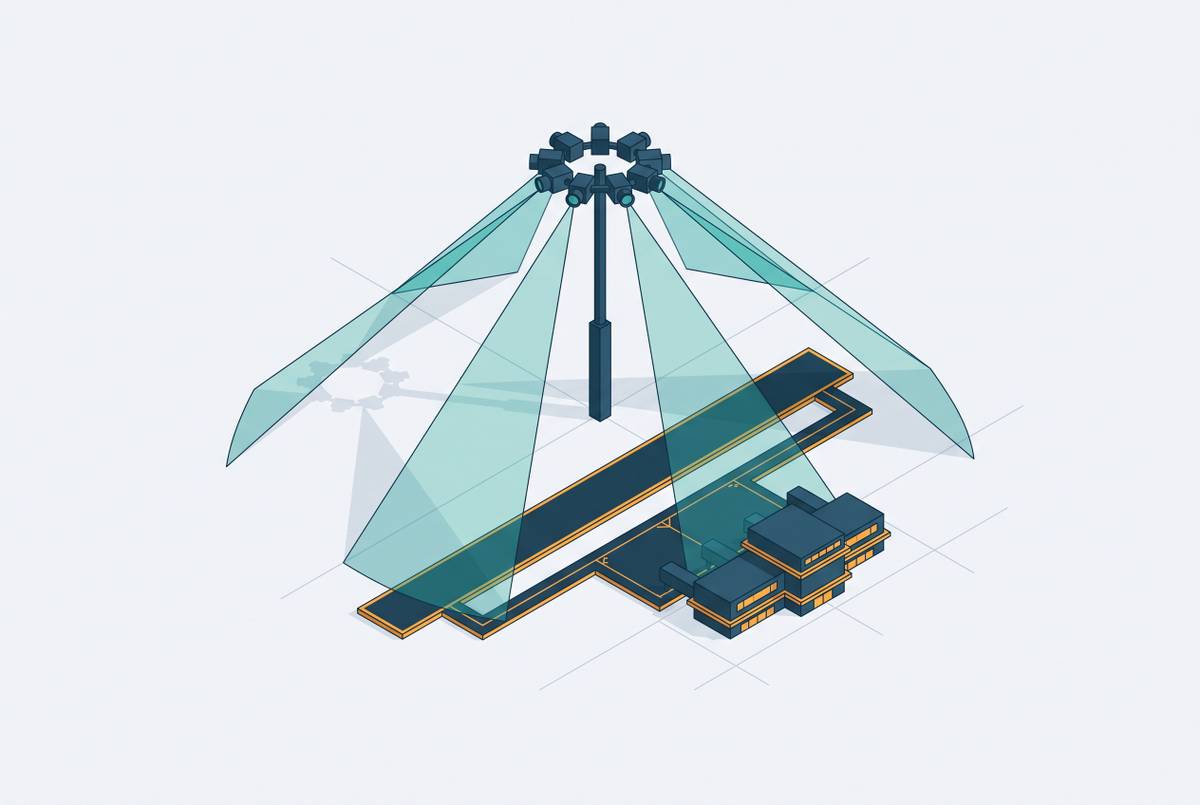
A remote tower system replaces the physical out-the-window view with camera arrays, sensor feeds, and panoramic displays at a workstation that may sit hundreds of miles from the runway. That substitution means the controller's entire picture of the airfield has to travel over a network before it reaches a human being who is responsible for keeping aircraft separated. Any meaningful delay between an event on the airfield and its appearance on the display breaks the premise the whole system depends on: a delayed image of a runway incursion carries none of the value a live one would, because the moment for action has already passed. This is why latency in remote tower design functions as a safety threshold rather than a performance metric to be optimized after the fact.
The obvious answer, routing everything through the cloud, fails on exactly this point. Cloud-centric AI deployment produces high task latency, cannot operate offline in communication-denied environments, and requires centralizing sensitive data, and each of these three problems disqualifies it on its own in an ATC context. Aircraft and remote airports cannot always guarantee a high-bandwidth, low-latency link to a cloud server, and a safety-critical operation built on an architecture that assumes such a link will always be there is building on an unreliable foundation. The constraint pushes designers to rethink where the processing happens.
Edge computing architecture in a remote tower system
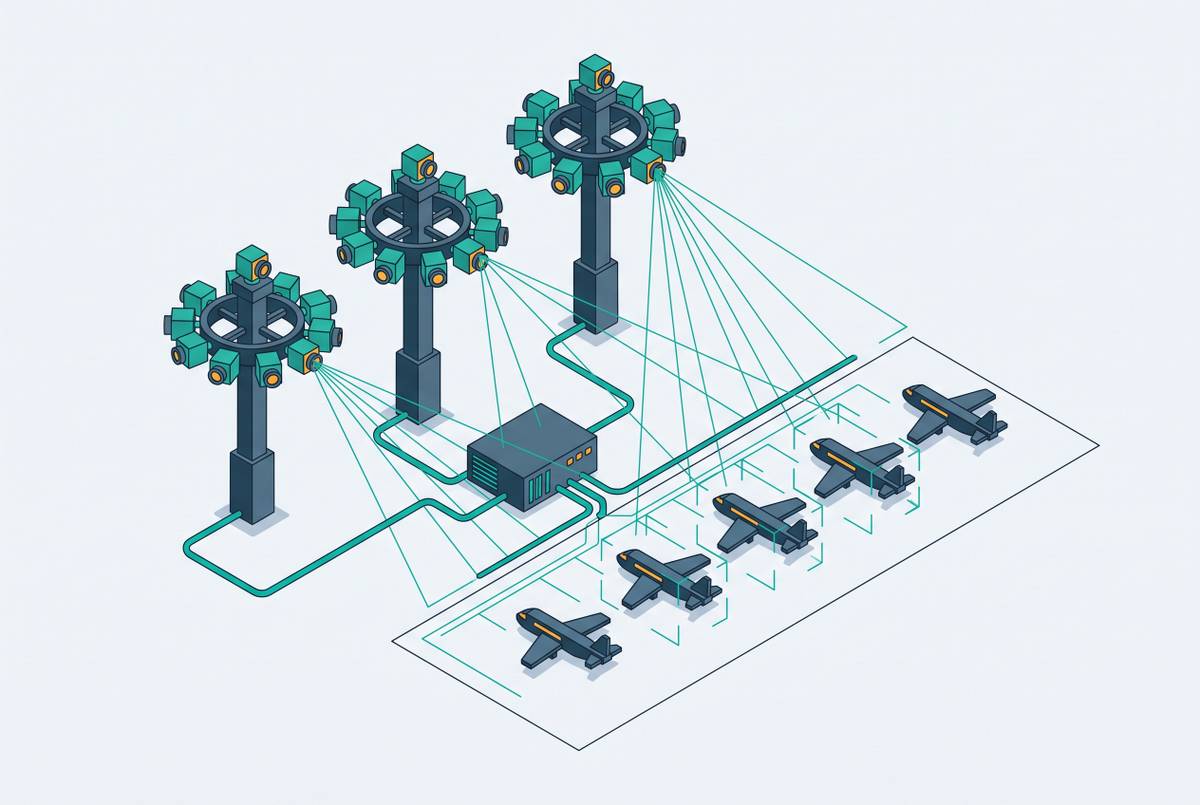
Edge computing moves perception, inference, and video processing to nodes at or near the airfield, so what actually crosses the network has already been interpreted rather than left raw. The architectural principle is straightforward: push computation to where the data originates, at the cameras, sensors, and radios on the airfield, instead of routing everything to a data center that might be a continent away. Physically, "the edge" means end devices, embedded processors, and local edge servers stationed at or near the airport, distinct from the centralized cloud infrastructure that handles other parts of the system.
The data types that demand this local treatment share three traits: they are voluminous, time-sensitive, and unable to tolerate a round trip to a distant server. High-definition panoramic video from camera arrays, infrared feeds, sensor inputs, and VHF radio communications all fall into this category. Radio communications, in particular, illustrate the value of edge placement well. Domain-adapted Automatic Speech Recognition and Natural Language Understanding, run in quantized or adapter-augmented form directly at tower nodes, can flag call-sign confusion and read-back inconsistencies in real time without depending on a wide-area backhaul connection.
None of this eliminates the cloud from the picture. It reassigns its job. Edge nodes handle the real-time inference that safety depends on, while cloud components spend the time between operational shifts refining the language models and analytics that the edge will use next. The two form a loop of local action and background improvement, with the shift from raw to processed data keeping bandwidth manageable and latency tolerable. That loop also gives the system resilience it would otherwise lack: an edge node with local inference capability continues to function through a connectivity disruption, which matters most acutely for the remote and rural airfields where network reliability was never a safe assumption to begin with.
The sensor and display stack that edge processing makes possible
What edge processing buys the controller is a picture of the airfield that is, in measurable ways, richer than what a person standing in a physical tower could see. High-definition panoramic camera arrays with infrared capability and zoom deliver continuous 360-degree coverage of the airfield, a vantage point no controller achieves unaided from a fixed tower cab. In fog or low light, infrared and enhanced imaging let controllers hold visual awareness of the field in conditions that would otherwise degrade or eliminate a physical tower controller's line of sight.
The computer vision running on this video has to happen at the edge, because the volume of raw footage involved is too large and the timing too tight for a cloud round trip to make sense. That local processing is what allows real-time detection of aircraft movement, identification of runway incursions, and flagging of weather hazards as they develop rather than after the fact. Automated object tracking extends this further: AI engines fuse radar and video data to follow aircraft across the field and alert controllers when a runway is clear. London Heathrow's Digital Tower Laboratory tested exactly this capability at scale, deploying 20 ultra-HD cameras integrated with an AI platform called AIMEE, and recovered capacity that had previously been lost to low-visibility conditions.
On top of the video, the display can layer flight data and weather in real time, giving the controller a single interface that merges what the cameras see with what other systems know. Pan-tilt-zoom cameras with integrated light gun capability round out the stack, replicating the functional tools a tower controller already relies on and extending their reach. None of this is speculative. It is the sensor and display configuration that operational deployments have already put in front of working controllers.
Edge, network, and cloud layers in the architecture
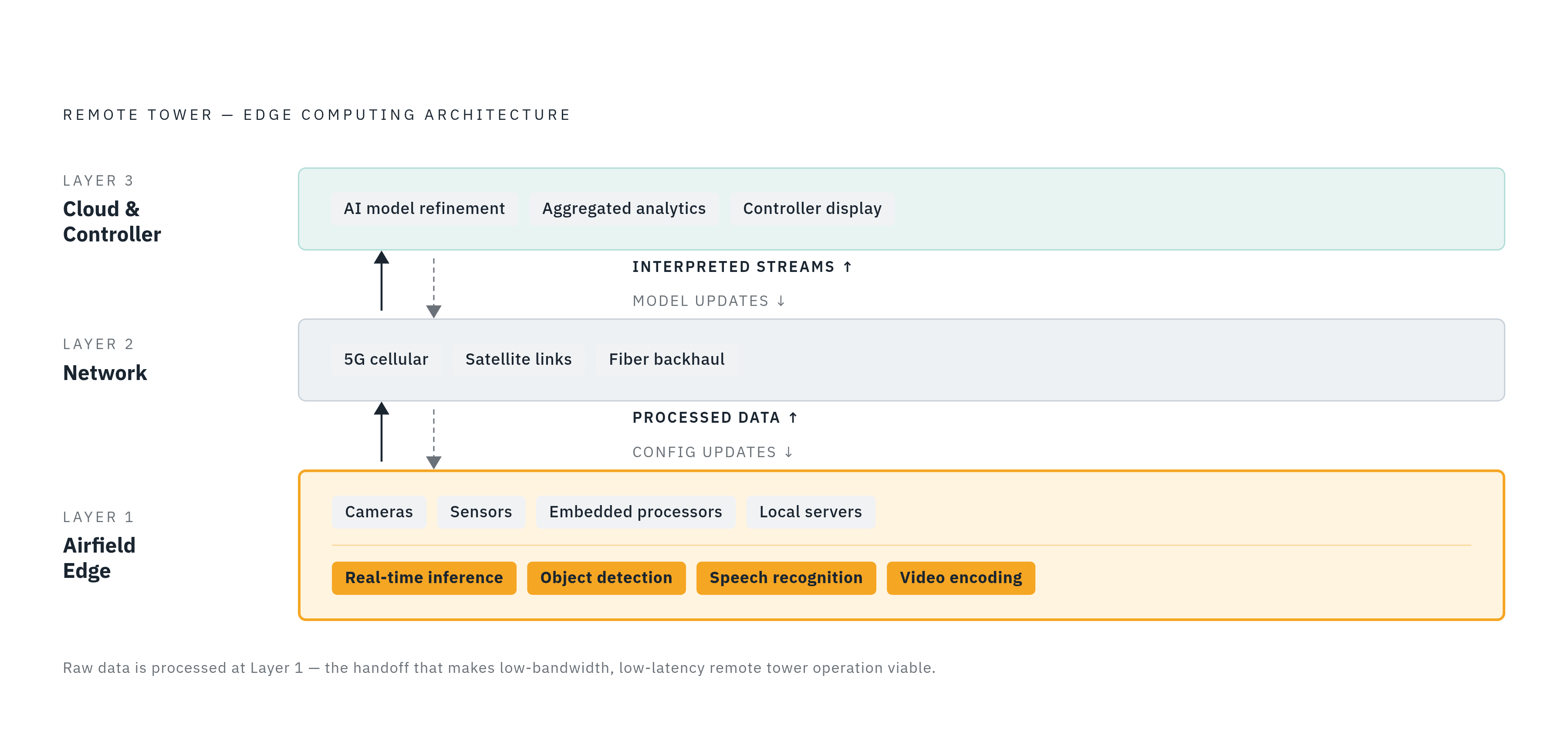
A functioning remote tower system is not one technology but a three-layer architecture, and each layer carries the part of the job it is best suited to handle. The first layer sits at the airfield itself: cameras, sensors, embedded processors, and local servers that carry out real-time inference, video encoding, speech recognition, and object detection. Nothing latency-sensitive is allowed to leave this layer unprocessed.
The second layer is the network connecting the airfield to the remote workstation. Fifth-generation cellular, satellite links, and fiber backhaul carry interpreted data streams rather than raw video, and this shift from raw to processed data is precisely what keeps bandwidth requirements manageable and latency within tolerable bounds. The FAA's ongoing modernization of its telecommunications infrastructure, moving off legacy copper lines and onto fiber, directly enables this network layer to function as designed. Satellite communications extend the same architecture to airfields where terrestrial fiber has never been laid.
The third layer is the cloud and the remote workstation itself. It hosts the ongoing improvement of AI models, aggregated analytics across sites, and the display environment the controller actually works from. A cloud-based microservices architecture of the kind Collins Aerospace describes is built to hold up across environments ranging from major hub airports to remote fields with a fraction of the traffic. Redundancy is built across layers: contingency remote tower capability provides backup air traffic control during outages, and cybersecurity at the digital layer enables real-time detection of cyber threats along with robust remote access controls, capabilities a physical tower does not inherently have.
This layered model also explains why "remote tower" and "digital tower" are not competing concepts but points on the same spectrum. A remote tower typically describes a low-volume operation controlled from another location, while a digital tower describes a larger airport integrating multiple data sources with decision-support tools, and both configurations are drawn from a broader family of models running on the same underlying software platform, a framework that in practice defines five distinct models rather than just these two.
How operational deployments perform under real conditions
The strongest evidence for this architecture is not theoretical. It has been running safely at scale, in demanding conditions, for years.
Avinor's Remote Tower Centre in Bodø is the global benchmark case. The agreement establishing it was signed in 2015 under the NINOX programme, and by April 2025 a substantial number of airports were being managed from that single centre, with more airports scheduled to come online over the following two to three years. The technology behind it came from Kongsberg Defence & Aerospace and ACAMS. In 2026, Avinor pushed the model further, beginning a trial of "multiple operations" in which a single AFIS representative handles more than one airport from the same working position, tested across four airport pairs: Rørvik and Namsos, Mehamn and Hasvik, Vardø and Berlevåg, and Røst and Svolvær. The software making this possible, SR4.0, went live in February 2025 and supports simultaneous operations across up to three airports at once, making Avinor the first organization anywhere to run multiple digital tower operations this way. Bodø demonstrates that a single facility can concurrently manage several airports, a capability with direct implications for how thinly ATC coverage could be stretched across a large number of small airports.
Bodø is not an isolated case. In Germany, DFS Aviation Services opened a facility in Braunschweig that remotely manages Braunschweig-Wolfsburg and Emden airports, with room to expand to as many as six airports from the same site. London Heathrow's Digital Tower Laboratory, already noted for its camera and AI deployment, tested the setup across tens of thousands of flights at one of the busiest airports in the world. And Western Sydney International Airport is set to launch Digital Aerodrome Services in 2026 with 25 high-resolution cameras featuring night vision and object tracking. Taken together, these deployments show an architecture proven across multiple countries, multiple vendors, and multiple traffic profiles.
The U.S. position relative to the operational deployments above
The U.S. has the underlying technology available and a legal mandate pushing it forward, but the FAA has not yet issued the regulatory approvals that would let the architecture move past a single test site and into the National Airspace System. As of May 2025, the FAA was testing a system at Atlantic City International Airport in New Jersey, a single test site rather than a certified deployment.
The FAA Reauthorization Act of 2024 directed the agency to build a clearly defined system design and operational approval process for remote and digital towers, and to publish milestones toward testing and deployment approval. Based on the sources available, the agency has not yet published a system design approval for any remote tower concept.
Pressure to close that gap is building from multiple directions. A coalition spanning airports, air traffic controllers, equipment manufacturers, and federal and regional partners, including the Digital Tower Technology Coalition formed in 2026 and the Modern Skies Coalition formed in 2025, is pushing for wider adoption and for interoperable, performance-based standards. FAA Administrator Bryan Bedford has told lawmakers that ATC towers would never reach full staffing under the agency's current structure, a statement that frames the gap as much as an organizational failure as a regulatory one. Government audits released since 2024 describe a significant share of the systems underlying U.S. air traffic control as unsustainable, pointing to aging hardware, patchwork upgrades, and legacy software still in service. Against that backdrop, the FY 2027 budget requests significant Facilities and Equipment funding but appears to fund the replacement of only three air traffic control towers nationwide, a scale far short of what remote tower deployment could realistically address. It's a measure of how much ground the approval process still has to cover.
The largest impact on the uncontrolled airport population
The U.S. has tens of thousands of non-towered landing facilities set against a few hundred towered airports, and it is this uncontrolled majority where edge-based remote tower architecture stands to do the most good. A traditional manned tower is out of reach for most of this population on cost alone: even a minimal tower installation runs into the millions of dollars, recent large towers have cost tens to hundreds of millions, and the staffing a manned tower requires exceeds what a small airport's budget can sustain.
The see-and-avoid principle that governs non-towered operations has documented limits. The see-and-avoid system that governs non-towered operations has documented structural limitations: the NTSB has identified inherent human limitations in the concept, and the NASA Aviation Safety Reporting System records repeated near-mid-air collisions at non-towered airports, including a 2024 near miss at Birchwood Airport (PABV) where ADS-B displayed a visual traffic alert showing traffic 100 feet directly above, with no audible alert, averting a likely collision. Normalized per-facility collision data complicates any claim that non-towered airports are simply more dangerous across the board, but risk still concentrates at the busiest uncontrolled fields, and pilots without ADS-B or radio have no structural means of conflict detection at all. That absence, not a blanket claim about danger, is the actual gap the architecture is built to close.
Small airport economics compound the problem. Many small airports depend on subsidies and public grants just to cover operating costs, and the shift toward electric aviation threatens to shrink fuel-tax revenue flowing into aviation infrastructure funding, adding a further structural strain. Edge computing's offline resilience and its tolerance for lower-bandwidth connections suit exactly the rural and remote airfields where network infrastructure is thinnest, which happen to be the same places where the coverage gap is widest. Bodø's model, a single remote tower centre managing many airports at once, now extending into simultaneous multi-airport operations, offers a direct template for how one staffed facility could bring ATC coverage to dozens of currently uncontrolled U.S. airports at once.
The certification bottleneck as the actual obstacle to U.S. deployment
The evidence from Bodø, Sundsvall, and Warsaw answers the technical question already. What stands between the U.S. and the same outcome is not whether the architecture works. The Reauthorization Act of 2024 gave the agency a mandate to define that process and publish milestones. A single test site in Atlantic City and no published system design approval describes a regulatory pipeline still finding its footing rather than a technology still finding its feet.
That distinction matters for how the coming years should be read. Certification has yet to catch up to what the hardware and software have already proven capable of doing, at Bodø and at Heathrow alike.