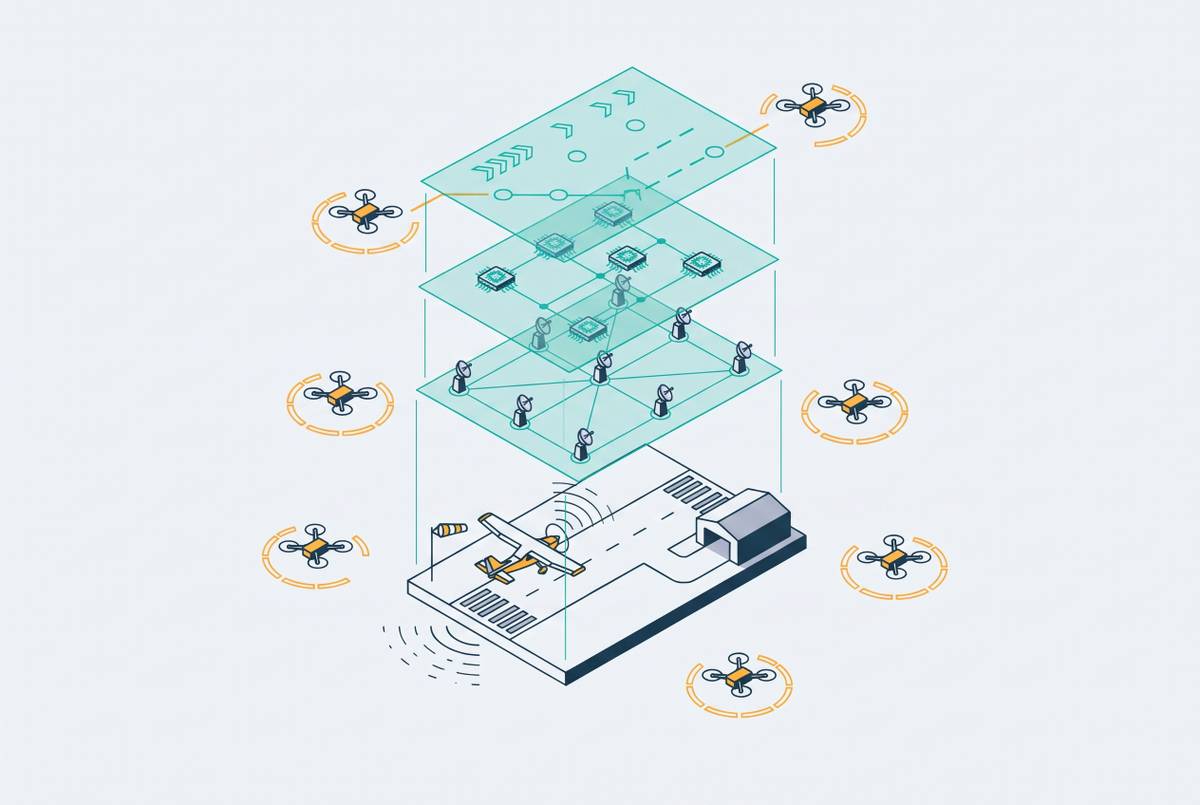
UAS Traffic Management Software Layers for Uncontrolled Airport Digital Infrastructure
Three software layers enable drones and manned aircraft to safely share uncontrolled airports.

Digital ATC infrastructure helps bring UAS and drones into non-towered airports by linking shared sensors to three UAS Traffic Management software layers, which are flight authorization, surveillance, and conflict management. Together, these layers provide digital permission, traffic awareness, and automated deconfliction where no controller is present. UTM is therefore foundational infrastructure for mixed manned and unmanned operations.
Why uncontrolled airports are the natural home — and the hardest test — for UTM integration
At a non-towered airport, pilots self-separate by making radio calls on a common traffic advisory frequency, scanning for other aircraft, and following established procedures. No controller assembles those individual observations into a managed traffic picture. Radio exchanges and visual awareness do not, by themselves, create a system that verifies participation or coordinates every aircraft. This absence of shared situational awareness is the starting point for evaluating UTM architecture.
The vast majority of U.S. airports have no air traffic control, so non-towered airports are a natural place for UAS integration. Yet unmanned operations at those airports lack the traffic-management infrastructure that a towered airport has. Flight plans alone cannot fill that gap because they describe what aircraft plan to do, which differs from information on where aircraft actually move. UTM must connect permission to awareness and conflict resolution. Its hardest test is therefore not managing participating drones in isolation, but supporting their safe operation near manned aircraft without a controller serving as the common decision point.
What UTM actually is — a three-layer software architecture, not a single system
The FAA describes UTM as a framework of regulatory requirements, technical capabilities, and interoperable services for managing and mitigating drone-operation risks. It is separate from, but complementary to, air traffic services. For airport infrastructure planning, its functions can be understood through three software layers, which are authorization, surveillance, and conflict management. Each has a distinct job to perform. Their interfaces allow individual functions to evolve and connect to different ground systems without treating UTM as one indivisible product.
De Luca et al. (2025) describe a related organizational architecture, with air traffic control at the highest level, UAS operators at the bottom, and a UAS service supplier between them. Those organizational tiers are distinct from the three functional layers, but explain who exchanges information through them. The supplier is the interface through which they share information, including during contingencies. ICAO’s UTM Framework (Edition 4) further separates technical areas including identification, communications, geofencing, separation management, and aerodrome integration. These distinctions give each service its own requirements while preserving the connections between services. A non-towered airport needs to run on highly automated systems that exchange digital data in place of voice communication with controllers.
The flight authorization layer — replacing verbal clearance with digital permission
Flight authorization serves a parallel role to a controller’s verbal clearance by deciding whether a proposed UAS operation may enter shared airspace. That parallel does not make digital authorization a tower clearance. ICAO’s framework identifies digital flight planning and authorization as core services, separate from aircraft registration and in-flight conflict management. Registration establishes identity, while authorization addresses permission for an operation. De Luca et al. describe a discrete Notification/Authorization component that coordinates operations and access to low-altitude airspace, tested at Grottaglie–Taranto airport in Italy.
The FAA’s Near-Term Approval Process (NTAP) evaluates third-party UTM services for their safety-mitigation value. Operators can receive safety credit for using an evaluated service when seeking waivers or exemptions. The FAA’s proposed rule of August 2025 would create a performance-based pathway for beyond visual line of sight (BVLOS) operations, including lower-risk permitted and higher-risk certificated operations that third-party services support. That change would make authorization more of a routine digital transaction and reduce the need for exceptional approvals. At the airport, however, permission still needs a connection to the available traffic picture, including Remote ID broadcasts and digital ATC sensor feeds.
The surveillance layer — creating a shared traffic picture where none exists
Authorization describes an operation that may take place, while surveillance establishes what is happening in the airspace. ICAO’s framework identifies surveillance, tracking, and network identification as core UTM services. In one national jurisdiction, Remote ID enforcement began in March 2024 and required most registered drones to broadcast identification and location information that surveillance software could use as standardized inputs. De Luca et al. require the platform to detect and manage unidentified or uncooperative UAS because a traffic picture must account for more than the operators who take part.
At a non-towered airport, surveillance must aggregate Remote ID, ADS-B from manned aircraft, airport radar or optical sensors, and potentially neighboring UTM service-provider feeds. The mix depends on the infrastructure the airport has. Vigilant Aerospace’s FlightHorizon TEMPO deployment at the Infinity One Oklahoma Spaceport demonstrates the fusion approach, integrating radar and transponder data into one airspace-management picture for safe autonomous-aircraft testing. Digital ATC cameras and sensors can contribute to that same picture. This is the physical junction between UTM and digital ATC infrastructure. Shared sensing lets the services that authorize operations and manage conflicts see mixed traffic in a shared picture, with more than each system could see on its own.
The conflict management layer — automated deconfliction as the substitute for controller judgment
Conflict management turns traffic information into coordination between operations. At scale, automation is not merely a substitute for an unavailable controller, but the means of handling operations that would overwhelm individual human oversight. De Luca et al. describe a contingency manager that suggests how to respond, including changing admissible flight volumes and quickly re-planning trajectories. The platform was tested operationally at Grottaglie–Taranto airport. Its modular design distinguishes contingency handling from the initial authorization decision.
The FAA’s UTM Operational Evaluation, launched in 2023, tested federated data sharing, governance, and strategic deconfliction for overlapping BVLOS operations. In July 2024, the FAA issued the first authorization permitting multiple operators to fly BVLOS commercial drones in the same North Texas airspace, enabled by UTM strategic deconfliction. Commercial operators then began flying at the same time under automated strategic deconfliction, starting with Flytrex and Wing in May 2025. By 2025, the FAA had also begun issuing Letters of Acceptance to service providers supporting strategic deconfliction. These developments distinguish operational evidence from an architectural proposal.
The manned-unmanned boundary nevertheless requires explicit treatment. ICAO’s framework dedicates an appendix to UTM-ATM boundaries and transition, including the distinction between automated resolution and escalation to a controller. A non-towered airport has no such controller endpoint. Its conflict-management arrangements must therefore resolve a conflict autonomously or alert the UAS operator directly, rather than assume a human handoff that the airport cannot provide.
How do UTM layers connect to digital ATC infrastructure at a small airport?
UTM software and digital ATC infrastructure perform complementary functions through bidirectional data exchange. UTM systems ingest ATC restrictions so that drone operations respect controlled or sensitive zones, while digital ATC systems ingest UTM feeds to display drones with manned traffic. Controllers can see drones without having to manage each one directly. Controllers or remote-center operators need that visibility where unmanned operations approach crewed-aircraft arrival and departure corridors.
The FAA’s remote tower RFP, issued in April 2026 with proposals due June 22, 2026, describes a digital environment built on cameras, sensors, and panoramic displays in place of the traditional out-the-window view. Those sensors can also supply UTM surveillance. This shared use is central to the small-airport integration model, because the same infrastructure supports airport awareness and unmanned-traffic services. De Luca et al. likewise describe the physical and digital parts as working together in one platform.
Norway’s Bodø Remote Tower Centre was managing a growing group of airports as of April 2025, with several more scheduled. It shows how shared digital infrastructure can bring ATC-equivalent awareness to several small airports and serve as a model for how to build UTM service interfaces. NASA and the FAA are also developing Extensible Traffic Management (xTM). That modular architecture extends UTM concepts while preserving ATC interoperability as new technologies emerge.
What the regulatory framework must provide before UTM layers can operate at scale
The software layers have been developed and tested, but their use as routine infrastructure depends on defined obligations, approval processes, and legal standing. The FAA’s proposed Parts 108 and 146 rulemaking of August 2025 would establish performance-based BVLOS regulations and an approval pathway for third-party UTM services. Without that framework, demonstrations and individual permissions do not amount to a general certification basis for commercial scale. The FAA Reauthorization Act of 2024 directed development of the rule, establishing the mandate without settling its implementation timetable.
Europe provides a useful benchmark for that transition. EASA issued its first U-space Service Provider certificate to ANRA Technologies in May 2025, describing it as a step toward harmonized and scalable U-space deployment. The SESAR Joint Undertaking published the U-space Implementation Handbook in January 2026, drawing on early deployment experience from U-ELCOME and contributions from BURDI and ÉALÚ-AER. ICAO’s framework also dedicates an appendix to UTM system certification, supplying an international foundation for national rules. The U.S. therefore needs rules that turn existing technical and organizational concepts into a structure for approving operations, building on the work that has already defined UTM.
Where simulation and testing fit — validating UTM layers before operational deployment
Simulation allows UTM services to be evaluated before their behavior becomes an operational dependency. Tests for a non-towered airport need to cover mixed manned and unmanned traffic as well as cooperative drones flying under ideal conditions. The interfaces require testing as well as the individual functions. An authorization service, surveillance feed, and conflict manager must be evaluated as an interacting architecture before the airport relies on their combined behavior.
Jover, Casado, and Bermúdez (2025) developed U-TRAFMAN to simulate UTM scenarios, including U-space, using the ROS ecosystem with Gazebo and Matlab. The platform supports service development and evaluation, aircraft-control software verification, and telemetry collection for analysis. For airport operators and digital ATC vendors, that supports modeling mixed traffic at a specific airport before installing hardware.
Field evaluation then provides a different form of evidence. The Grottaglie–Taranto work tested platform functions operationally, while the FAA’s evaluation examined federated sharing, governance, and strategic coordination in live conditions. Together, simulation and field testing establish a progression from software evaluation to operational evidence. They give approval and deployment decisions a technical basis beyond a platform’s stated capabilities.
What airport operators and stakeholders need to act on this now
Operators need to assess now whether one investment in sensors can support both digital ATC awareness and UTM integration. Cameras, radar, and panoramic displays can replace or supplement the physical tower view while supplying data to UTM services. The relevant comparison is not simply a drone-management platform against a tower, but an integrated architecture against separate systems serving overlapping needs. Affordability depends on the airport’s requirements.
The practical first step is to map existing infrastructure against authorization, surveillance, and conflict management. Remote ID broadcasts may already supply some of the data for surveillance, while other functions need more services or links between systems. Operators also need an integrator who understands both sides of the interface between air traffic control and unmanned aircraft traffic management. ICAO’s aerodrome-integration appendix provides a defined technical starting point, and simulation offers a way to examine the airport’s mixed-traffic environment before hardware deployment.
Companies designing affordable digital ATC towers specifically for uncontrolled airports have a clear fit with this requirement. Their sensor and software architecture can serve as both the airport-awareness system and the UTM integration point, provided those interfaces are addressed. That fit rests on function. The remote tower RFP and proposed rulemaking give operators reasons to start planning the architecture now, even while the final regulatory date is unsettled. Operators next need to decide which existing capabilities can be connected, which gaps require investment, and how the combined system will be validated.