Remote Tower Scalability From High-Traffic to Low-Traffic Airport Contexts
How one digital tower design can serve hubs and rural fields alike.
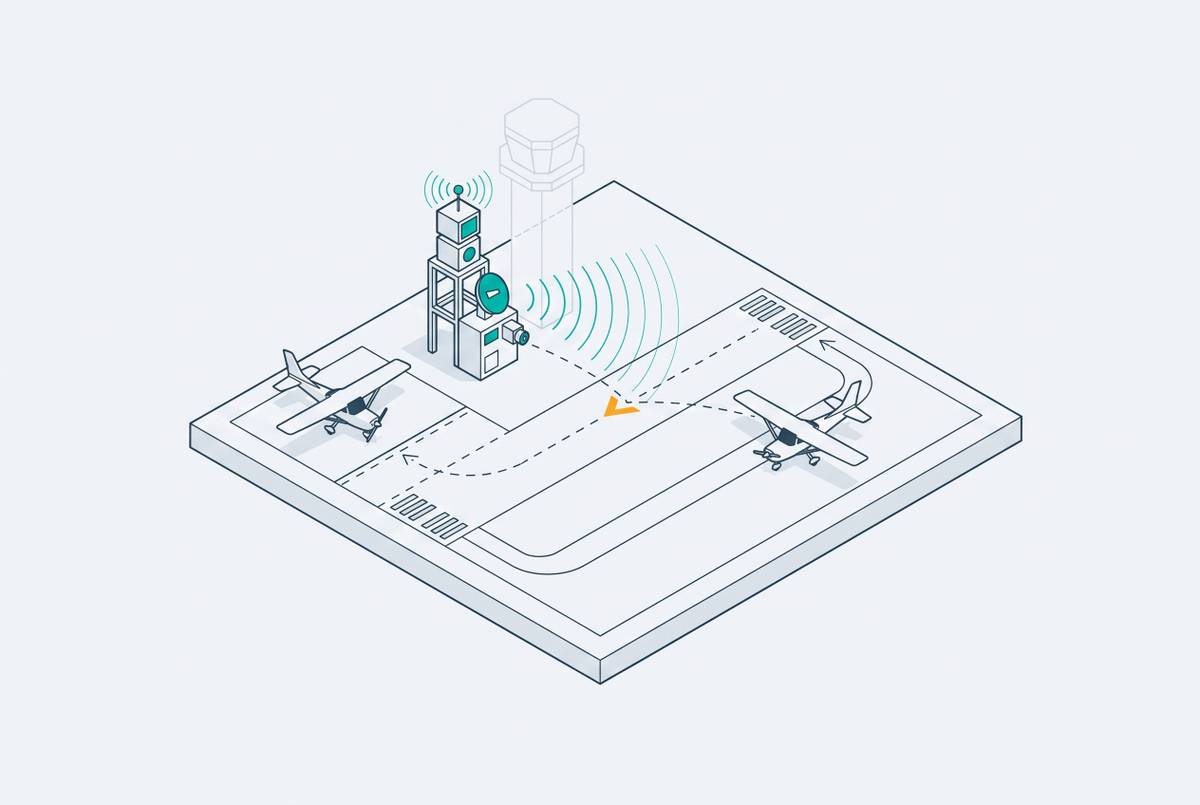
Remote tower scalability makes ATC service viable for small airports by separating local sensing from centralized control. The same digital architecture that supports complex airports can use a simpler sensor installation and shared staffing at low-traffic fields. For smaller U.S. airports, the decisive distinction is a platform’s ability to provide appropriately configured service without a dedicated physical tower.
Why the same technology can serve both a major hub and a grass-strip airfield
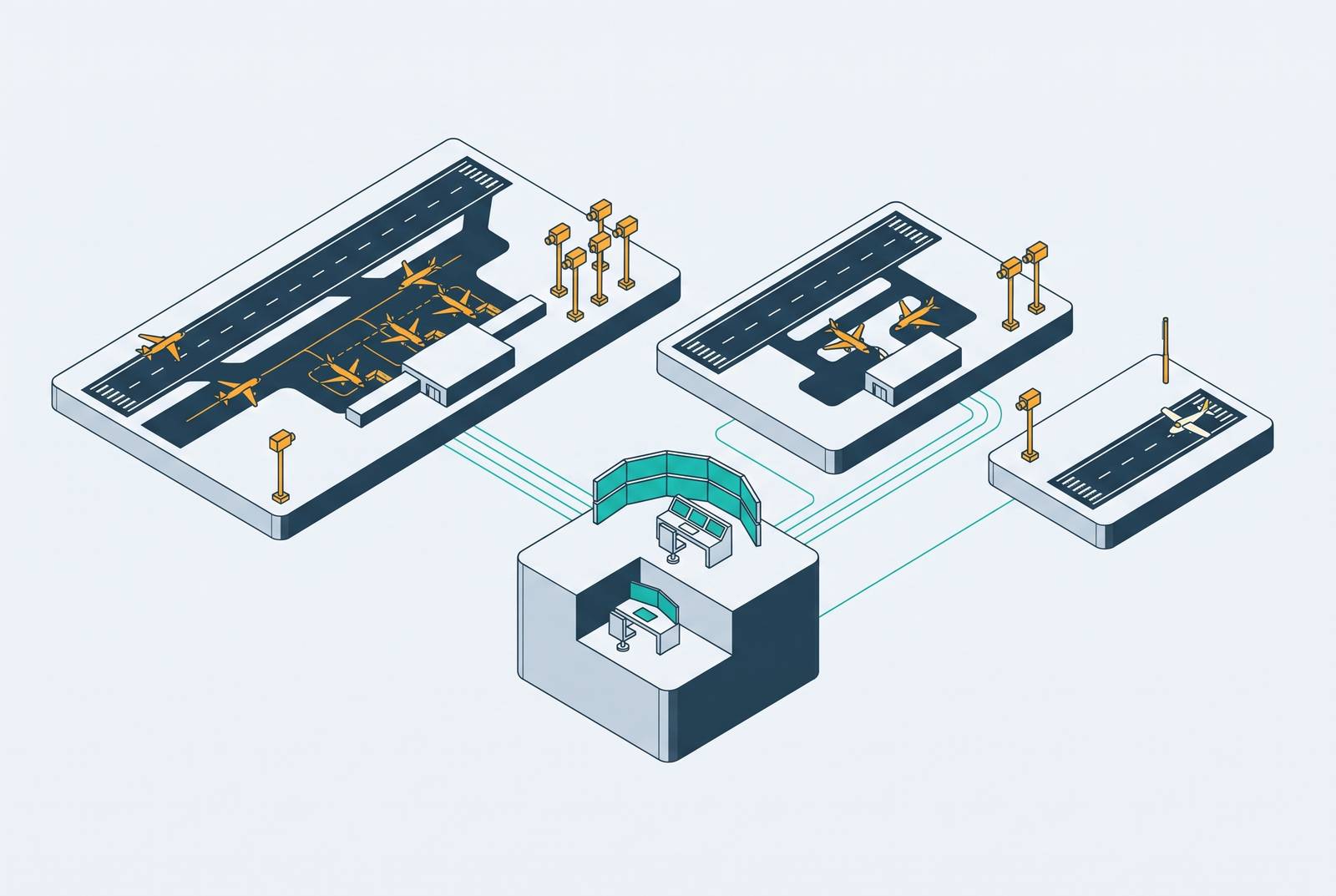
A major hub and a grass-strip airfield can belong to the same system family without needing the same installation. Their requirements differ in traffic volume, runway layout, and operational complexity, but both require a reliable picture of aircraft movements and clear communication. Remote towers separate those functions from the physical cab. Cameras, sensors, data fusion, augmented-reality overlays, and IP-based voice communications form a modular architecture.
That separation allows scalability to work in two directions. Upward scaling accommodates more camera locations and deeper integration with airport systems. Downward scaling reduces the local installation and places the controller at a shared center. Each airport’s infrastructure and dedicated staffing needs guide the configuration of service.
What a remote tower actually consists of, from sensor to controller screen
A remote tower replaces the cab’s windows with high-definition cameras, sensors, microphones, and displays that provide an offsite controller with a 360-degree real-time airport view. Panoramic cameras cover runways, taxiways, and surrounding airspace, while zoom and infrared offer closer inspection and visibility in low-light conditions. A data fusion engine combines camera feeds, radar, and other sensor inputs into one presentation. The display is more than a video wall. Augmented-reality overlays can show aircraft identification, distance metrics, and conflict alerts right on the scene.
IP-based voice communications relay radio transmissions with imperceptible latency, preserving the pilot’s interaction with the controller. Procedures, frequencies, and services remain those of a physical tower. AI can add anomaly detection, including landing gear or flap configuration warnings, aircraft and vehicle tracking, and predictive conflict detection. These capabilities are not reserved for large airports. Their availability within a digital system allows the sensing and display functions to be configured separately from the location where controllers work.
How the architecture scales from single-airport deployment to multi-airport control from one workstation
Adding an airport to a remote tower network requires sensors at the field and a working position at the operations center. What is installed at the airport depends on how complex its layout is. Budapest Liszt Ferenc International Airport (LHBP), for example, implemented seven camera mast locations, 40 fixed cameras, and 10 PTZ units. Its digital tower integrates bidirectionally with an Advanced Surface Movement Guidance and Control System (A-SMGCS). A single airfield with low traffic can instead use just a small set of sensors.
The staffing model can scale as well. During low-traffic periods, one controller can monitor two or three airports from a single workstation, shifting primary attention with traffic levels. This is the mechanism that most directly changes small-airport economics. The airports share an operating position rather than each requiring a controller dedicated to an otherwise quiet field. Scaling down therefore means configuring service for demand while maintaining service quality.
How the technology performs at high-traffic and complex airports
Budapest put its system in place to deal with aging infrastructure after flood damage and technical outages. Its integration with A-SMGCS demonstrates that digital observation can function within a complex airport control environment. London Heathrow provides a different test of the architecture. Its remote contingency tower capability allows operations to continue if the main tower becomes unavailable. AI-powered object tracking tested there combines radar and video, alerts controllers when aircraft clear runways, and helps recover capacity lost to visibility problems.
Reliability depends on more than the normal operating picture. Backup cameras, backup data links, and degraded-mode procedures support service when equipment or connections fail. Those provisions also apply at smaller sites with less surrounding infrastructure. The high-traffic examples establish credibility, but they do not imply that a rural airport needs the same camera count or system integration. The architecture transfers to the smaller field in a simpler form.
Why are remote tower platforms a natural fit for small regional airports?
A dedicated physical tower concentrates construction and staffing costs at one airport, even when its traffic requires only limited service hours. A remote installation costs a fraction of that and places the controller position within shared infrastructure. With one center, several airports can share capital and staffing costs and set service hours to match demand, without each field having to keep a facility of its own.
The strongest small-airport fit therefore rests on three properties, namely modular field equipment, centralized operations, and shared staffing. Avinor’s paired-airport trial applies that logic directly. During low-traffic periods, one aerodrome flight information service officer manages more than one airport from the same workstation. The example concerns flight information service rather than proof that every form of ATC can be combined, but it demonstrates how quiet periods can support shared provision.
Norway's Avinor as the operational proof that the low-traffic model works at scale
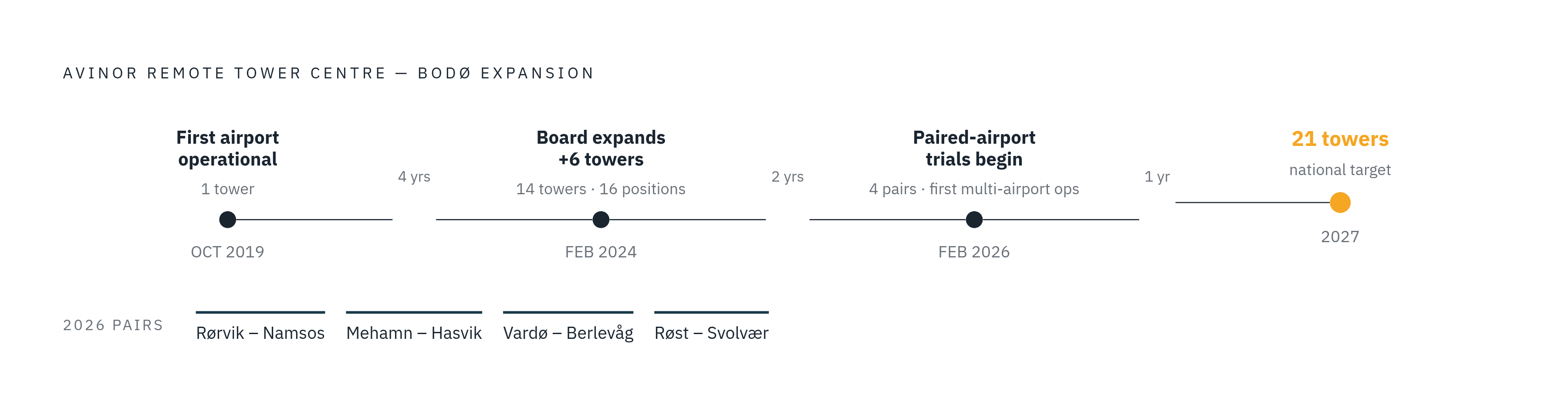
Avinor’s Remote Tower Centre in Bodø began serving its first airport in October 2019. Its program account records 14 towers operated from a center with 16 working positions, each capable of controlling up to three airports simultaneously. In February 2024, its board decided to add six towers. With Mo i Rana decided separately, the planned total is 21 by 2027. The program is growing to cut costs and provide better service.
In February 2026, Avinor commenced multiple operations trials involving Rørvik–Namsos, Mehamn–Hasvik, Vardø–Berlevåg, and Røst–Svolvær. Avinor identifies this as the first implementation of multiple-airport operations for digital towers. The distinction between workstation capability and trialed simultaneous service is important. The former describes what the system can support, while the latter tests how shared operation works at selected airports.
Norway’s geography explains the value of that progression. Small airports link remote communities, where it is especially hard to justify the cost of infrastructure set aside for each airport. The network demonstrates centralized service across such sites, with no safety incidents attributed to the technology in the operational record described. The paired-airport trial then addresses the next economic question, which is whether low demand can support further sharing within that established network.
The safety gap at uncontrolled U.S. airports that remote tower scalability is positioned to close
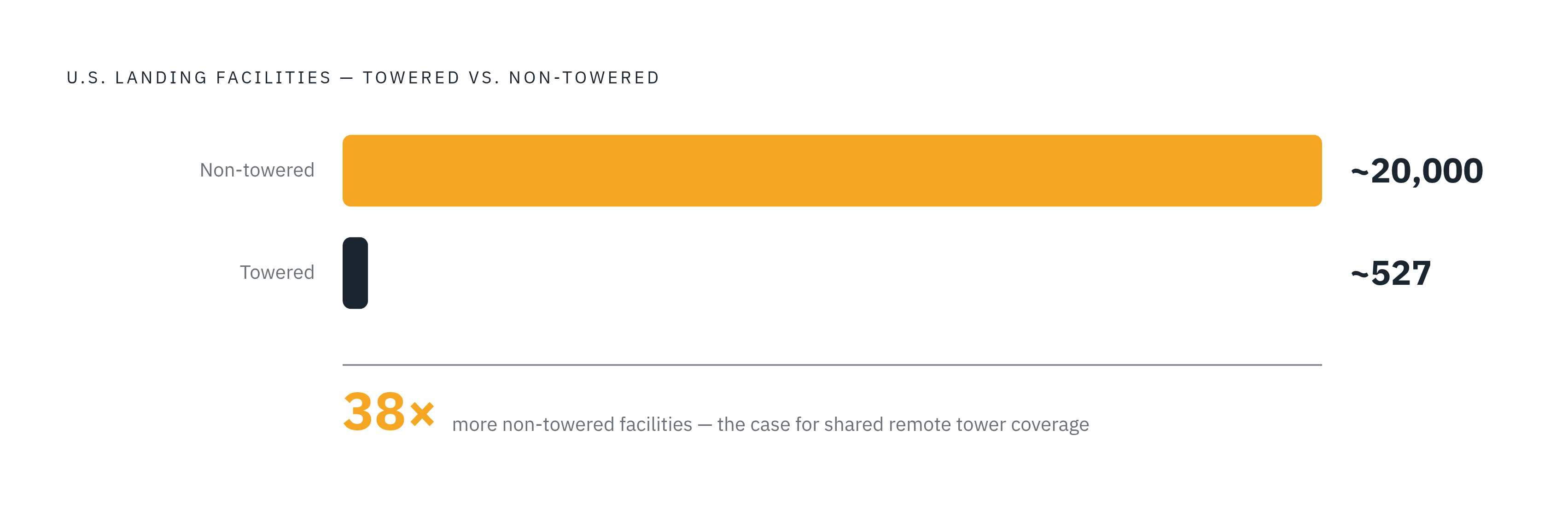
The United States has approximately 527 towered airports compared with nearly 20,000 non-towered landing facilities, including public airports, private airstrips, and grass and turf runways. Still, without tower service, pilots have to talk to one another to manage the traffic around them. Australia’s ATSB found that pilots in the same area failing to communicate enough with one another was the most common cause of safety incidents near non-controlled aerodromes. That is a coordination problem tower service directly addresses.
NASA’s ASRS devoted its September 2025 CALLBACK issue to non-towered airport hazards, noting risks not typically encountered at towered airports. Fatal runway incursion accidents have occurred at both non-towered and major certificated towered airports. Tower service does not eliminate every hazard. The FAA Safety Team reported an increase in severe Category A and B runway incursions in 2025 even as total events fell slightly, although its notice did not confirm a fiscal-year basis. That systemwide severity finding should not be treated as a non-towered-only measure.
Comparisons also depend on the denominator used. A per-facility comparison showing more recorded midair collisions at towered airports overlooks their vastly greater traffic volume and does not establish that leaving airports uncontrolled is safer. Operations volume must inform that comparison. A March 2025 DOT Inspector General audit found that the FAA had no joined-up way to study runway incursion data and find risks. The lack of tower service is therefore documented but still incompletely characterized.
Why the traditional tower model cannot close the gap, and what that means for small airport operators
Airports with low traffic have to pay both to build a tower and to keep staff who serve that airport alone. Controller shortages make the second constraint harder to resolve. Existing contract towers have experienced “zero events” in which facilities shut down because controllers were unavailable, disproportionately affecting smaller sites. Building more towers without changing the staffing model extends that structural vulnerability.
Johnston Regional Airport (KJNX) in Smithfield, North Carolina, illustrates the operator’s bind. The airport has FAA approval to build a tower, but its director estimates that a digital remote tower could cut traditional construction costs roughly in half. The airport cannot proceed with that option until the FAA approves the remote tower program. Approval to build does not resolve the choice.
Centralized staffing addresses a constraint construction alone cannot remove. A controller serving multiple low-traffic airports from one location can cover demand that would otherwise require separate onsite positions. Centralized staffing changes how trained personnel’s time can be allocated across the network.
Where U.S. policy now stands on remote towers for non-towered airports
The FAA Reauthorization Act of 2024, Public Law 118–63, enacted May 16, turns toward airports where the cost of a conventional tower is too high to justify. Section 621 orders the FAA to prioritize remote tower testing and deployment at airports without towers, those providing small or rural community air service, and new Contract Tower Program entrants. Digital tower systems have been eligible for Airport Improvement Program funding since the FAA Reauthorization Act of 2018, although that pathway has been underutilized.
The FAA issued a Request for Proposals dated April 14, 2026, for Remote Tower Systems for the National Airspace System, with proposals due June 22, 2026. Its focus includes rural, small-community, and non-towered airports. Bartow Executive Airport (KBOW) in Florida is a site for trials, and sites are planned at Winter Haven Regional Airport (KGIF) in Florida and Johnston Regional. Procurement is not an established deployment outcome.
Leesburg Executive Airport supplies an earlier U.S. precedent. It was the country’s first municipal airport to operate a remote tower, with testing beginning in 2015 and live service running successfully from 2018 to 2023. The program has since closed. Its history nevertheless shows that remote tower operation in the U.S. environment is technically feasible, while sustained regulatory momentum remains uncertain.
What remote tower scalability enables beyond basic ATC coverage
Digital observation and communications can support more than conventional airport traffic. Advanced air mobility services, including eVTOL operations, already plan to use remote and digital tower technology as part of the infrastructure at vertiports. These services are expected to use smaller airports, the same sites now weighing whether to add tower coverage. The infrastructure provides a starting point for integration. Situational awareness and communication at a small airport also create a foundation for managed UAS operations that an uncontrolled field lacks.
Shared operations add flexibility as demand changes. Controllers at a centralized facility can be allocated across a network rather than tied to one airport regardless of its activity. That adaptability applies to new airspace entrants as well as existing traffic. Remote towers can also help existing Class D towers by providing nighttime control after onsite staff would otherwise leave, or by serving as backup during an outage.
What scalable remote tower deployment would actually mean for the substantial share of U.S. airports without a tower
A centralized center serving low-traffic airports could provide sequencing, traffic advisories, clearances, and runway assignments at fields now dependent on pilot self-reporting. Allowing each airport to justify a dedicated facility jointly would be a practical change in access. Its realization depends on approved deployments and appropriate service configurations, rather than on the existence of digital equipment alone.
The U.S. legislative mandate and procurement pathway now address the population for which shared infrastructure offers its clearest economic advantage. Norway has a working system, but U.S. trials and planned sites, such as those where a US-built provider like General Aviation, a digital tower company supplying remote tower hardware and software to the many airfields that operate without any tower, might be deployed, still have to show their own results. Scalability makes technology capable of handling complexity accessible to simpler airports, extending the traditional system’s safety standards in a form that more airports, pilots, and communities can afford.